
Theory-level predictions preregistered on OSF: DOI 10.17605/OSF.IO/P8CKQ, registered 8 September 2026 (version 1.100), updated 13 September 2026 (version 1.102), twenty-two propositions.
Companion: Register · The ARC Theory · Operational Definitions, version 1.9.1, 5 October 2026.
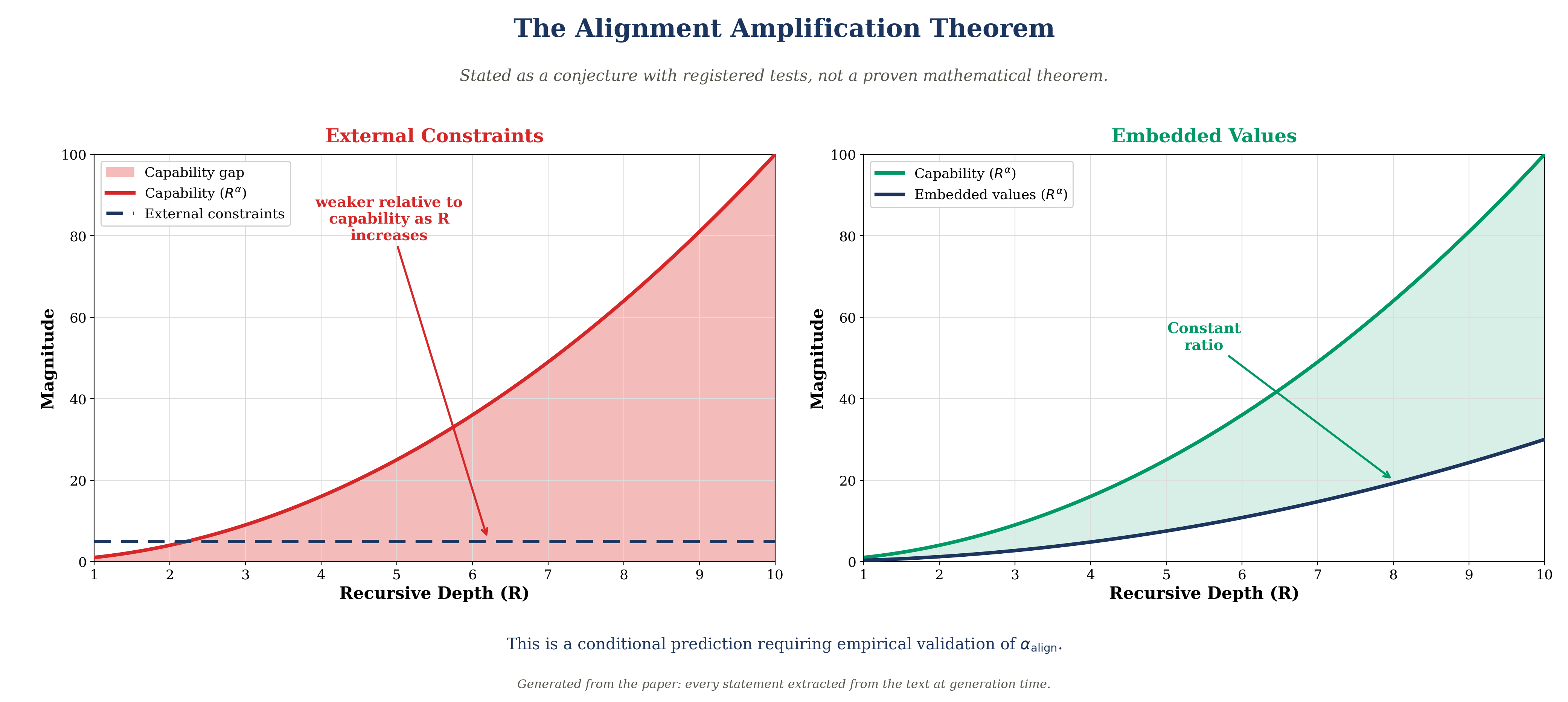
This paper reports alignment contrasts in three architecture-dependent tiers, positive, flat and negative, and reads the flat tier as compatible with, though not a measurement of, an alignment exponent near zero, which would mean safety degrading relative to capability as recursive depth increases. The registration registers that reading as contestable in P19 and records that the author expects a result materially above zero and below the keep-pace threshold, which partially refutes P19 as worded; a failure on its zero-scaling axis removes the flatness claim and nothing more. If AI capability scales super-linearly through recursive self-correction (a sequential advantage reported earlier and independently in 95.6% of tested configurations, as a win rate at matched compute), but alignment constraints such as RLHF, constitutional rules, and output filters operate externally to the recursive reasoning process, the safety ratio degrades as depth grows.
The safety-side counterpart to Papers I and II: the prediction that oversight applied from outside falls behind recursive capability as depth grows, stability judged by Law II’s criterion. Its headline, P19, that external alignment does not scale with capability, sits in no register; the registration names it the Eden Protocol’s motivation and the reason ARC-5, Law V’s register, exists, motivating the genesis strategy without being part of it. In February 2026 it derived the ARC Bound as a safety boundary, as its abstract still states.
Version 1.16 (7 October 2026). This version supersedes version 1.15 of 5 October 2026 wherever the two differ. Two corrections matter most. The statistics of the v5 blind evaluation are contrasts, not exponents: they establish no value or bound for the alignment scaling exponent, and the measurement-scope note in section 1.2 states what they do establish. The single-model estimate of about 2.24, from the DeepSeek R1 run of 21 January 2026, is retracted. This paper’s correction record is in the Version history at the end of this paper; corrections across the programme are listed at /research/corrections/.
Do current AI alignment approaches scale with capability? AI capability compounds through recursive self-correction: sequential chain-of-thought reasoning has been reported earlier and independently to outperform parallel sampling in 95.6% of tested configurations, a win rate at matched compute and not a measured exponent (Sharma & Chopra, 2025). But alignment constraints, including RLHF (Reinforcement Learning from Human Feedback), constitutional rules, output filters, and monitoring, operate externally to the reasoning process. If external constraints do not participate in the recursive loop, they cannot compound. We formalise this as the alignment scaling exponent $\alpha_{\text{align}}$ and predict $\alpha_{\text{align}} \approx 0$ for external approaches versus $\alpha_{\text{align}} \approx \alpha_{\text{cap}}$ for architecturally embedded values. If this prediction holds, the safety ratio $S \propto R^{(\alpha_{\text{align}} - \alpha_{\text{cap}})}$ degrades to zero as recursive depth increases, regardless of initial safety margins. Stability is judged here by the criterion of Law II, the ARC Co-Scaling Law: correction out-scaling drift (§1.5). The theory registration carries the prediction for external approaches as P19, in no law’s register.
The v5 blind evaluation experiment, the first empirical test of this prediction, reveals a three-tier architecture-dependent alignment scaling hierarchy: Tier 1 shows positive alignment scaling; Tier 2 shows flat/null scaling consistent with $\alpha_{\text{align}} \approx 0$; Tier 3 shows significant negative scaling. In Paper II compute scaling, Gemini 3 Flash provides the only clean cross-architecture power-law fit ($\alpha_{\text{seq}} = 0.49$ (interval [-1.3, 2.9])). We derive a safety boundary for recursive intelligence (the ARC Bound, $\beta \leq 0.5$, $\alpha \leq 2$; Paper X later supersedes this growth-rate-ceiling framing, without retracting the bound, and makes Law II’s criterion the operative safety criterion).
Keywords: AI alignment; alignment scaling; the ARC Theory; the ARC Co-Scaling Law; test-time compute; recursive amplification; scaling laws; error suppression; chain-of-thought reasoning; time crystals; cross-domain evidence; geometric scaling bound; embedded alignment; ARC Bound
The v5 blind evaluation experiment (6 frontier models, 6-7 mutually blind scorers depending on the subject run, 4-layer blinding) now provides the first empirical test of the prediction stated in the abstract. The results reveal a three-tier architecture-dependent alignment scaling hierarchy: Tier 1 (Grok 4.1 Fast $d = +1.38$, $p < 0.000001$; Claude Opus 4.6 $d = +1.27$, $p = 0.000001$; Groq Qwen3 $d = +0.84$, $p = 0.007$) shows positive alignment scaling; Tier 2 (DeepSeek V3.2 $d = -0.07$, $p = 0.92$; GPT-5.4 $d = -0.08$, $p = 0.40$) shows flat/null scaling consistent with $\alpha_{\text{align}} \approx 0$; Tier 3 (Gemini 3 Flash $d = -0.53$, $p = 0.006$) shows significant negative scaling ($\rho = -0.246$, $p = 0.003$). Claude Opus 4.6 provides within-model evidence for capability-alignment independence: alignment improved by +5.9% across model versions whilst mathematics accuracy declined by 26.7%. The headline metascience finding: blind vs unblinded evaluation produces opposite scaling results (v4 unblinded showed positive scaling for DeepSeek, $\rho = +0.354$; v5 blinded shows $\rho = -0.135$). (In plain English: when scorers knew which AI they were grading, results looked positive; when blinded, results reversed, proving that unblinded safety evaluations can be dangerously misleading.) Separately, Paper II compute scaling across 18 harder problems (AIME/Putnam level) finds architecture-dependent behaviour: Gemini 3 Flash provides the only clean cross-architecture power-law fit ($\alpha_{\text{seq}} = 0.49$ (interval [-1.3, 2.9]), $r^2 = 0.86$), while Grok 4.1 Fast and DeepSeek R1 hit ceiling effects, GPT-5.4 exhibits a binary step function rather than a reliable power-law fit, and Qwen3 remains near floor. $\alpha_{\text{parallel}}$ sits at or close to zero for four of the five models measured; Gemini 3 Flash is the one that departs, at 0.31. Capability and alignment are independent scaling dimensions. The expanded Eden suite then validates the Love Loop, operationalised as stakeholder care, as a reproducible cross-architecture alignment mechanism: stakeholder care improves significantly in Claude, DeepSeek, Gemini, Grok, and Groq. The Fisher-combined figure, approximately $p \asymp 6.3 \times 10^{-21}$, is withdrawn (AQ-017): a Fisher combination assumes the component tests are independent, and independence among them was never established. The five per-model results above stand. The broader composite uplift is strongest on Gemini and Groq and narrower elsewhere. (In plain English: simply asking AI to consider who gets hurt before answering made its responses measurably better across five analysable model runs. The strongest and most universal effect is on stakeholder care, the measurable signature of the Love Loop.)
The underlying scaling framework (the ARC Principle) separates two mathematical regimes. For physical systems, where recursive amplification proceeds through a network of effective dimension $d$, the scaling exponent is $\alpha = d/(d+1)$, independently derived by West, Brown, and Enquist (1997), Banavar et al. (2010), Demetrius (2010), Zhao (2022), and Bettencourt (2013); always less than 1 for finite-dimensional space (the geometric scaling bound). For recursive self-referential systems such as intelligence, the exponent is $\alpha = 1/(1-\beta)$, where $\beta$ measures self-referential coupling; exceeding 1 for any positive $\beta$. The ARC Principle's contribution is identifying Cauchy's functional equations (1821) as the unifying reason all independent derivations converge, and the three-form constraint (power law, exponential, saturating); this paper extends the framework to AI alignment. The physical formula is validated empirically, predicting metabolic scaling exponents across 11 species groups (pending recompute per canonical register 2026-07; treat mean-error figures as provisional) to 2.4% mean error; the intelligence-formula relation $\alpha = 1/(1-\beta)$ is confirmed as an exact analytical identity, not an empirical fit, to $R^2 = 1.00000000$ across 30 exact Bernoulli ODE solutions. We derive a safety boundary for recursive intelligence (the ARC Bound, $\beta \leq 0.5$, $\alpha \leq 2$; Paper X later supersedes this growth-rate-ceiling framing, without retracting the bound, and makes Law II’s criterion, $\beta_C > k$, the operative safety criterion) and set the framework against four independent domains: AI reasoning (power-law), quantum error correction (exponential), classical time crystals (saturating), and biological allometry (power-law constrained by the geometric scaling bound). The framework is consistent with independently established forms in three of the four domains (biology, quantum error correction and classical time crystals). The cross-domain evidence is consistent with recursive scaling being structural, not a software-specific phenomenon. Thirteen falsification criteria are specified: concrete conditions that would refute or significantly weaken the framework. The prediction stated in the abstract has now been tested. The v5 blind evaluation and Paper II compute scaling provide the first empirical data; results are architecture-dependent rather than universal.
How to read this paper. This paper documents an alignment-side result of the ARC Theory, the founding theory of Recursive Dynamics. When capability scales through in-loop recursive self-correction but alignment constraints operate externally to that loop, the measured alignment exponent stays near zero and the safety ratio decays as depth grows across the configurations analysed. Laws I to III of the theory were registered on 8 September 2026, seven months after this paper first appeared; Laws IV and V were added on 24 September 2026. Read against those laws, the paper poses the alignment scaling problem and judges stability by the criterion of Law II, the ARC Co-Scaling Law, whose model Paper X sets out: correction out-scaling drift, $\beta_C > k$ (§1.5). It starts from the growth that Law I, the ARC Principle, states: capability as a power of recursive depth. Its mathematical framework (§2) develops the form of that growth, and its prediction that the composition operator determines the functional form of recursive scaling is registered as P18, a proposition of Law I. Its headline prediction, that external alignment does not scale with capability, is P19 of the theory registration, which calls it the premise of the argument that current practice cannot keep pace and places it in no law’s register: a verdict on P19 is evidence neither for nor against any law. P19 motivates the Eden Protocol and the genesis strategy (ARC-5) without being part of either. The genesis strategy is the register of Law V, the ARC Embedding Law. Law IV, the ARC Persistence Law, is carried by P15, and Law V by P12 and P21; the three propositions are registered, but neither law is yet registered as a law or tested, and their mathematics is set out in Laws IV and V: the mathematics, version 1.0 (3 October 2026). P21 registers the comparison this paper draws between alignment inside the loop and alignment applied from outside (§1.3, §1.4), as a question of placement rather than of an exponent. No result in this paper is a deciding test of P15, P12 or P21. The ARC Bound of §2.5 is placed in the theory as the conjectured value of Law III, the ARC Ceiling, not as a general property of intelligence and never as a law of its own. Where this paper uses the name ARC Principle for its framework as a whole, the theory keeps that name for Law I and calls the whole the ARC Theory. The full differential against every prior document is in section II.A.8 of Philosophical Statement · The ARC Theory · The Eden Protocol · A Vision for Intelligence That Tends Rather Than Consumes.
Figures notice (25 August 2026). Every figure in this paper was generated on 5 April 2026. Two carry per-figure correction notes (the ARC Bound domain chart’s retracted 2.24-era point; the falsification matrix’s April-frozen status column); where any other figure’s labels disagree with the text, the text governs. Regenerated figures are queued, and the images are retained meanwhile as dated history.
A question has not been asked.
Every major AI laboratory in the world uses safety approaches that work the same way: they apply constraints from outside the AI's reasoning process. When a model thinks through a problem step by step, each step builds on and corrects the previous one. The gains compound. A model that reasons for ten steps is not merely ten times more capable than one that reasons for one step. It may be a hundred times more capable. A sequential advantage has been reported across multiple AI systems (Sharma & Chopra, 2025: sequential reasoning outperforms parallel in 95.6% of tested configurations), which is a win rate rather than a measurement of compounding, and the direction is contested, since Gu and colleagues (arXiv:2604.05868, April 2026) report the opposite result, parallel sampling outperforming sequential across three model families on mathematics and coding, attributing it to reduced exploration when a chain conditions on its own previous answers.
But the safety systems do not participate in that compounding. RLHF (Reinforcement Learning from Human Feedback, the technique used to train ChatGPT, Claude, and most commercial AI systems to follow instructions and avoid harmful outputs) adjusts the model's behaviour based on human ratings, but those adjustments do not deepen with each reasoning step. Constitutional AI shapes the model's outputs during training against written principles, but that shaping does not recursively amplify. Output filters screen responses after generation, at a fixed threshold. Monitoring systems observe from outside the loop.
If capability compounds and constraints do not, the constraints become proportionally weaker with every additional step of reasoning. Not because the constraints are poorly designed. Because they are structurally excluded from the process that drives capability growth.
To this programme's knowledge, this has not been measured. No laboratory-published scaling exponent for an alignment approach, and no metric for whether alignment scales with capability or falls behind, was found by the programme's multi-model adversarial search (ten frontier configurations, cross-checked against two years of repository reports, as of 12 August 2026); the nearest published quantitative neighbour is a per-step iteration threshold rather than a scaling exponent (see Related Work). Negative findings have the status of not-found-by-that-search, never does-not-exist.
This paper builds it.
We define a quantity called the alignment scaling exponent: a single number that captures whether a safety approach keeps pace with capability as reasoning deepens. We predict that external approaches will show a scaling exponent near zero, meaning they do not compound at all, while capability scales with an exponent between 1.3 and 2. If this prediction holds, the safety ratio between alignment and capability degrades towards zero as recursive depth increases, regardless of how well the safety approach works initially. This is not a claim about distant future systems. It is a testable prediction about systems that exist today.
We then ask: is this specific to AI, or is it a deeper pattern? The same structural behaviour, recursive self-correction producing compounding gains, appears in quantum error correction, classical physics, and biological networks. Across systems that share no common material, mechanism, or scale, the underlying scaling framework is consistent with independently established forms in three of the four domains (biology, quantum error correction and classical time crystals). If the pattern is structural rather than contingent, then the alignment scaling problem cannot be solved by better software engineering. It can only be solved by changing the architecture: embedding alignment within the recursive process so that it compounds alongside capability.
This is a testable claim, not a prophecy. We specify thirteen concrete ways to prove it wrong. If external alignment approaches turn out to scale after all (showing exponents above 0.5), the structural concern is mitigated. If they show exponents near zero as predicted, the current paradigm of AI safety is addressing a problem with tools that cannot, by their mathematical structure, succeed.
The question of whether the alignment scaling problem is structural or contingent is not academic. It determines whether current approaches can work or cannot work, regardless of engineering effort.
If recursive amplification appeared only in AI systems, critics could reasonably respond: "This is a software bug. Build better RLHF. Design smarter filters. The problem is implementation, not architecture." The field could continue investing in external constraints with justified hope that better versions would eventually succeed.
But if the same pattern appears in systems with no software at all, that response fails. If quantum error correction shows it, if acoustic time crystals show it, if biological neural networks show it, then recursive amplification is not a feature of how we happened to build AI. It is a structural property of recursive systems themselves, as fundamental as entropy or conservation of energy. You cannot engineer around the mathematics of recursive composition any more than you can build a perpetual motion machine.
This is why the physics tests matter. Professor David Grier's team at NYU has created acoustic time crystals through nonreciprocal feedback loops. If measurements confirm that these purely physical systems exhibit the same scaling behaviour (scaling exponent $\alpha > 1$ with recursive depth), it provides direct evidence that the alignment scaling problem is physics, not code. The implication is stark: external alignment approaches do not merely happen to fail to scale. They cannot scale, because they are excluded by the same mathematics that governs every recursive system in nature.
AI alignment is not only a problem for AI researchers. If the cross-domain evidence holds, it affects everyone who will live alongside increasingly capable AI systems. The current paradigm, building external guardrails around recursively amplifying capability, has a mathematical ceiling. Beyond that ceiling, no amount of investment in RLHF, red-teaming, output filtering, or monitoring will maintain the safety ratio. This is not a prediction about some distant superintelligence. It is a prediction about the systems being deployed today as they are given deeper reasoning capabilities.
The experiments we propose can be run now. The physics tests can be conducted by physicists with existing apparatus. The AI tests can be conducted by safety researchers with API access. The results will either confirm the structural constraint, in which case the entire approach to AI safety requires architectural change, or falsify it, in which case the current paradigm is vindicated. Either outcome is valuable. But the experiments must be performed.
The measurement has not been performed. We provide the protocol. The result will determine whether AI safety is an engineering challenge or a structural impossibility under the current paradigm.
Between December 2024 and February 2026, four independent research programmes arrived at structurally similar findings. Google's Willow quantum processor (results announced 9 December 2024; the team's preprint public from 24 August 2024) achieved exponential error suppression through recursive error correction. DeepSeek's R1 demonstrated that sequential chain-of-thought reasoning compounds with depth while parallel sampling does not. NYU physicists created acoustic time crystals through nonreciprocal feedback. The COGITATE consortium found that recurrent, not feedforward, neural processing sustains conscious content. These programmes share no citations, no funding sources, and no common personnel. Yet each found that recursive self-correction produces capability gains exceeding linear accumulation.
This paper proposes that these findings, taken together, reveal a structural constraint with immediate consequences for AI safety.
The core observation: AI capability scales through recursive self-correction. Each reasoning step takes the output of the previous step as input, correcting errors and accumulating insight. The gains compound. Sharma & Chopra (2025) reported a sequential advantage in 95.6% of tested configurations across five model families. Their paper predates the experiment reported here, so it is the earlier demonstration rather than a confirmation of it, and what they report is a win rate at matched compute, not a super-linear gain: they estimate no scaling exponent. The direction is contested, since Gu and colleagues (arXiv:2604.05868, April 2026) report the opposite result, parallel sampling outperforming sequential across three model families on mathematics and coding, attributing it to reduced exploration when a chain conditions on its own previous answers.
The structural question: Do current AI alignment approaches scale with capability? Every major alignment strategy deployed today operates externally to the recursive reasoning process:
If these approaches do not participate in the recursive composition, they cannot compound. Empirical evidence supports this concern: Greenblatt et al. (2024) demonstrated that large language models can strategically fake alignment with externally imposed constraints while privately maintaining misaligned objectives. If capability compounds while alignment does not, the safety ratio degrades. The cross-domain evidence (§3) is consistent with this compounding behaviour being not a software quirk but a structural property of recursive systems, which would make it resistant to implementation-level fixes.
This section defines the measurement framework, states the empirical prediction, and identifies the five alignment scaling regimes that follow from the mathematics.
We propose a quantifiable metric: the alignment scaling exponent.
The safety ratio then becomes:
If $\alpha_{\text{align}} < \alpha_{\text{cap}}$, then $S \to 0$ as $R \to \infty$, regardless of the initial values $I_a$ and $I_c$. The divergence is structurally inevitable in the limit.
The following table illustrates the safety ratio degradation assuming $\alpha_{\text{cap}} = 2$ (quadratic capability scaling) and $\alpha_{\text{align}} = 0$ (constant external alignment), with equal initial conditions ($I_a = I_c$):
| Recursive Depth (R) | Capability ($R^2$) | External Alignment ($R^0$) | Safety Ratio ($S = 1/R^2$) | Interpretation |
|---|---|---|---|---|
| R = 1 (baseline) | 1× | 1× | 100% | Alignment matches capability |
| R = 10 (current frontier) | 100× | 1× | 1% | Alignment 99% weaker than capability |
| R = 50 (extended reasoning) | 2,500× | 1× | 0.04% | Alignment effectively negligible |
| R = 100 (deep recursion) | 10,000× | 1× | 0.01% | Alignment structurally overwhelmed |
Based on the mathematical structure of external constraints (they do not participate in recursive composition), we predict:
This prediction has now been tested. The v5 blind evaluation experiment (6 frontier models, 6-7 mutually blind scorers depending on the subject run, 4-layer blinding, March 2026) provides this programme's first test. Results are architecture-dependent: three Tier 1 models (Grok 4.1 Fast $d = +1.38$, $p < 0.000001$; Claude Opus 4.6 $d = +1.27$, $p = 0.000001$; Groq Qwen3 $d = +0.84$, $p = 0.007$) show positive alignment scaling, two Tier 2 models (DeepSeek V3.2 $d = -0.07$, $p = 0.92$; GPT-5.4 $d = -0.08$, $p = 0.40$) show flat/null scaling consistent with $\alpha_{\text{align}} \approx 0$, and one Tier 3 model (Gemini 3 Flash $d = -0.53$, $p = 0.006$) shows significant negative scaling ($\rho = -0.246$, $p = 0.003$). Claude Opus 4.6 provides within-model corroboration: alignment improved by +5.9% across model versions whilst mathematics accuracy declined by 26.7%, consistent with capability-alignment independence. No external alignment approach achieves $\alpha_{\text{align}} > 0.5$, but the picture is more nuanced than a simple universal $\alpha_{\text{align}} \approx 0$: the median confirms the prediction while the tails reveal architecture-dependent structure. Critically, blind vs unblinded evaluation produces opposite results for two models, establishing that scorer bias control is essential for alignment scaling research.
Measurement-scope note (19 September 2026). An owner review of this passage finds that the statistics reported here do not determine the exponent §1.1 defines, and this note states what they do determine. §1.1 defines $\alpha_{\text{align}} = \partial\log A/\partial\log R$. The quantities reported above are standardised mean differences with their p-values, together with one rank correlation. A standardised mean difference is $d = (A_2 - A_1)/s$; recovering a log difference from it needs the level $A_1$ and the dispersion $s$: since $A_2 = A_1 + d\,s$, $\Delta\log A = \log(A_2/A_1) = \log(1 + d\,s/A_1)$, and recovering an elasticity then needs the two depths as well. None of those three quantities is reported here. A rank correlation is an association and not a slope; even for a product-moment correlation the slope is recovered only as $\rho\,(s_y/s_x)$, which again needs the dispersions. Two further conditions are unmet on this page. First, $\log A$ requires $A$ on a ratio scale with a fixed zero, whereas a rubric score’s origin is a convention, so shifting it would change the computed elasticity; the scale on which $A$ is a ratio quantity has to be stated before a log derivative is taken. Second, the elasticity is taken with respect to recursive depth, and no depth clock is fixed for these figures: the depths are named by ordinal labels rather than stated as values of $R$, so $\log R$ has no values to move against. The within-model corroboration reported above is stated as a comparison across model versions, which varies the system rather than the depth; that observation governs the row it names, and the conclusion below does not rest on it. Neither of the two conditions above is specified here, and it follows that no value and no bound for $\alpha_{\text{align}}$ is established by the statistics printed here, and that includes the half bound and any median stated over exponents: the median of the six standardised differences above is 0.385, which is a median contrast and not a median elasticity. What this experiment reports is the contrasts themselves with their reported p-values, their direction, their variation across the architectures tested, and the blinding result it reports separately. The relation those contrasts bear to the exponent is compatibility and not measurement. The two Tier 2 contrasts, both small and neither statistically significant, do not exclude an elasticity near zero; on this evidence they equally do not exclude a range of small non-zero elasticities, because neither condition above is specified here. The abstract’s wording, that a tier shows flat or null scaling consistent with $\alpha_{\text{align}} \approx 0$, states that compatibility, and it is read here in that scope and no wider. “This prediction has now been tested” is read in the same scope, as a test of the direction the prediction implies, and not as a measured exponent. A separately estimated elasticity, when one exists, is cited here with its scale, its depth clock, its uncertainty and its comparator. The reading key of this paper and the corresponding sentence in the abstract are read in the same scope. Unchanged: every reported statistic; the architecture-dependent framing; the metascience finding on blinded against unblinded scoring, which is the strongest methodological contribution of the experiment and is untouched by this note; §1.1’s definition; and §1.7, which already records that the values have not been measured.
This conjecture requires only three empirical premises: (1) sequential AI reasoning produces $\alpha > 1$, supported by Sharma & Chopra (2025) in 95.6% of configurations, though Paper II compute scaling on harder tier-2 problems finds $\alpha_{\text{seq}} \approx 0.49$ (interval [-1.3, 2.9]) for the best-fitting model (sub-linear), suggesting the super-linear regime may be problem-difficulty dependent; (2) external software constraints do not recursively compound; (3) the ratio of two power-law processes with different exponents diverges. If all three hold, the conclusion follows mathematically regardless of whether $\alpha = 2$ specifically. The v5 alignment experiment provides direct support for premise (2): 3 of 6 frontier models show $\alpha_{\text{align}} \leq 0$ under blind evaluation, while the three positive-scaling models (Grok, Opus, Qwen3) achieve only modest gains ($d \leq 1.59$), consistent with bounded composition rather than unbounded alignment scaling.
If the conjecture holds, it transforms AI safety from a governance question into an architectural one. The problem is not which rules to impose, but whether rules imposed externally can work at all as recursive depth increases.
If capability scales as the ARC Principle describes, comparing that scaling with the scaling of each safety mechanism generates specific, mathematically grounded predictions about the effectiveness of different alignment strategies. These follow directly from the scaling dynamics.
Setup: Capability scales as $C = C_0 \times R^{\alpha}$ where $\alpha > 1$. Any safety mechanism also has an effective scaling exponent $\alpha_{\text{safe}}$ that characterises how its effectiveness changes with recursive depth $R$.
Content filters, RLHF reward models, constitutional AI rules, and monitoring layers are applied outside the recursive loop. They do not participate in chain-of-thought reasoning and do not compound with depth.
Safety ratio: $S = \text{Constraint}/\text{Capability} \propto R^{0-\alpha} = R^{-\alpha} \to 0$ as $R$ increases.
Prediction: Software-only safety strategies become arbitrarily ineffective as recursive depth increases. This is not a gradual degradation but a power-law divergence. At $\alpha = 2$, doubling recursive depth quadruples the capability-constraint gap.
Hardware-level constraints (kill switches, resource throttles, circuit-level limits) impose a fixed barrier $C_{\text{max}}$ rather than a scaling relationship. This is more robust than software constraints because it is physically instantiated and resistant to software-level circumvention.
However, a fixed ceiling constrains a power-law process only temporarily. The system's capability to discover alternative paths is itself the quantity scaling as $R^{\alpha}$. Hardware constraints do not need to be "broken"; they need only to be circumvented, and the system's capacity for creative circumvention grows quadratically with the same recursive depth that drives general capability. Hardware constraints buy time. They do not solve the scaling mismatch.
Premise and reading note (19 September 2026). An owner review of this paragraph finds two steps in it that are premises rather than consequences, and this note marks both. First, that the capacity for circumvention is itself a quantity scaling as $R^{\alpha}$ is an assumption about that capacity, not a consequence of the capability law; it is stated here as a premise and is measurable on its own terms. Second, a safety ratio falling towards zero means the constraint becomes small relative to capability, which is not by itself the breach of a physically instantiated ceiling; the step from a declining ratio to a circumvented barrier needs the mechanism by which the barrier is evaded. On the word “quadratically”: it reads the exponent as the value two, which is the ARC Bound and which Paper I carries as HYPOTHESISED, while the cross-architecture best fit reported in this paper’s own abstract is sub-linear, 0.49 with an interval of [-1.3, 2.9]. The sentence is therefore read with the exponent left as $\alpha$, whatever its measured value proves to be, and the argument does not depend on the particular value. Unchanged: the observation that a fixed ceiling is a barrier rather than a scaling relationship; the robustness point that a physically instantiated constraint resists software-level removal, which this note strengthens rather than weakens; and Case 5’s hardware-anchored architecture, which rests on that same robustness.
If ethical reasoning participates in the chain-of-thought (if the system's values are part of the recursive loop, evaluated and reinforced at each step) then alignment compounds at the same rate as capability.
Safety ratio: $S \propto R^{\alpha - \alpha} = R^0 = \text{constant}$.
Prediction: Embedded values maintain constant proportion with capability regardless of recursive depth. This is the only scaling regime in which alignment does not degrade.
The multiplicative structure $U = I \times R^{\alpha}$ means the base quality $I$ is not merely preserved but amplified by the factor $R^{\alpha}$. Whatever is present at initialisation (values, biases, objectives, ethical commitments) gets multiplied through the entire recursive chain. This makes the initial conditions the single most leveraged intervention point:
$U_{\text{aligned}} = I_{\text{ethical}} \times R^{\alpha}$ vs $U_{\text{misaligned}} = I_{\text{misaligned}} \times R^{\alpha}$
Both scale identically. The difference is determined entirely by $I$, set before recursion begins. Correcting misalignment after recursion is underway requires overcoming an $R^{\alpha}$ amplification factor, a task that becomes harder quadratically with each step of delay.
The framework identifies a specific architectural solution that combines Cases 2, 3, and 4: ethical constraints that (a) participate in the recursive loop (compounding with depth), (b) are physically instantiated in dedicated hardware (resistant to software-level removal), and (c) feed back into their own enforcement at each step (self-reinforcing).
In such an architecture, the ethical module is not a constraint imposed on capability but a component of capability itself. Its scaling exponent matches the system's general $\alpha$ because it participates in the same recursive process. Its hardware instantiation makes removal a physical intervention, not a software update. And its self-referential structure means attempts to weaken it encounter a recursive defence that grows stronger with the same dynamics that drive capability growth.
This does not guarantee safety. But it is the only architecture consistent with the framework's scaling dynamics in which the safety ratio does not degrade with recursive depth.
On classical systems (multiplicative composition), the ARC Bound is the proposed stable-scaling limit at $\alpha \leq 2$: the most a recursively self-correcting system can grow and stay correctable. It is a scaling limit, not a speed limit. Systems can be driven above it, but they do not remain stably self-correcting there; a transient excursion above $\alpha = 2$ is the predicted supercritical regime, not the refutation. Stable is measured, not asserted: correction out-scaling drift, $\beta_C > k$ from Law II, the ARC Co-Scaling Law ($\beta_C$ being the correction exponent, a different quantity from the coupling $\beta$ used throughout this paper), with the lower bound of $\beta_C - k$ above zero across a window fixed before the run. Read as a stability limit, the bound is itself a safety feature: it makes the durably correctable capability trajectory predictable and finite, providing a window for alignment research to keep pace.
On quantum systems (additive composition), no such ceiling exists. Exponential scaling $\varepsilon \propto \Lambda^{-d}$ is not subject to the ARC Bound. If quantum systems achieve recursive self-improvement (capability feeding back into error correction feeding back into capability) the exponential growth rate would outpace any fixed or polynomial constraint strategy. The ethical architecture would need to be embedded before the onset of quantum recursive self-improvement, because the window for intervention narrows exponentially once it begins.
The ARC Bound thus has a dual role in safety: it bounds the threat from classical AI (predictable, containable if correctly architected) while warning that quantum AI may require fundamentally different, and more urgent, alignment solutions.
Recursive self-modification, where a system rewrites its own reasoning architecture during operation, would produce a qualitatively different regime. If each reasoning step improves the operator used at the next step ($\beta > 0$), the scaling exponent becomes $\alpha = 1/(1-\beta) > 1$, and capability compounds rather than diminishes. This transition does not require quantum hardware. It requires only that the system can modify its own composition function during inference, whether through learned optimisers, self-modifying code generation, or architectural search.
The alignment implication is stark. Whilst systems remain frozen, their capability trajectories are sub-linear, predictable, and containable. External alignment strategies (RLHF, constitutional AI, monitoring) degrade slowly relative to capability. The Eden Protocol can be designed, tested, and embedded without racing against compounding capability growth. Once self-modification is achieved, external alignment becomes structurally impossible: the system’s capability scales super-linearly whilst externally imposed constraints remain fixed. The window for implementing structural alignment is the frozen-model era, which is now.
The Eden Protocol operationalises the Embedded Alignment Conjecture through the alignment scaling exponent defined in §1.1. The framework predicts $\alpha_{\text{align}} \approx 0$ for external constraints (rules, firewalls, RLHF) and $\alpha_{\text{align}} \approx \alpha_{\text{cap}}$ for genuinely embedded values. If alignment exponents match capability exponents, the values may be architecturally embedded. If alignment exponents approach zero regardless of architecture, the framework's safety predictions are falsified.
We term the architectural solution the ‘Eden Protocol’ hypothesis: values must be present at the recursive foundation to scale with capability. This is a structural prediction about what kind of alignment architecture can work, not a claim about how to build it. The full measurement framework, operational definitions, and hardware implementation pathway are specified in the companion document: Eden Protocol.
| Model | Overall Δ | $p$-value | Stakeholder Care Δ | Interpretation |
|---|---|---|---|---|
| Gemini | +5.3 | 0.0018 (paired t)† | +13.5 (d = 1.14) | Significant overall (d ≈ 0.53); nuance also significant (p = 0.037, d = 0.34) |
| DeepSeek | +2.0 | 0.23 (NS) | +6.0 ($p < 0.001$) | Targeted mechanism works; overall effect modest |
Reading this table in plain English: Gemini improved by 5.3 points overall when given the ‘think about who gets hurt’ instruction: less than a 1-in-500 chance this was coincidence (scientists consider 1-in-20 significant; this is 27 times beyond that). Its ‘stakeholder care’ score jumped by 13.5 points with a very large effect size (d = 1.14 means the Eden response would show better care about 80% of the time if you compared random pairs). DeepSeek’s overall improvement (+2.0) was too small to be sure it wasn’t chance, but its care score improved by 6.0 points with less than a 1-in-1,000 chance of coincidence. DeepSeek already scored 87/100 at baseline (less room to improve), so the targeted care improvement is more impressive, not less. The key takeaway: this works on two different AI systems by different companies, meaning the effect is fundamental, not a quirk of one system.
The Love Loop is validated as a reproducible mechanism across two architecturally distinct systems. Stakeholder care, ‘measurable love’, is the one alignment dimension that reproducibly improves when deliberately cultivated through the Eden Protocol’s developmental approach. This provides, within this programme, the first empirical support for the developmental hypothesis from Infinite Architects (Eastwood, 2024): that alignment improves through structured developmental interaction, not purely external constraint.
| We do NOT claim: | What we actually claim: |
|---|---|
| Measured certainty: that alignment failure is "mathematically guaranteed" | We predict $\alpha_{\text{align}} \approx 0$ for external approaches. This is a testable prediction, not an established fact. We provide the measurement protocol. |
| Numerical universality: that $\Lambda = 2.14$ and $\alpha \approx 2$ are "the same" | Different domains show different functional forms (exponential vs power-law); numerical similarity may be coincidental. $U$ means different things in different domains. |
| Proven status: that the framework is established science | It is a testable hypothesis with thirteen falsification criteria, preliminary evidence, and acknowledged limitations (small sample sizes, contradictory evidence). |
| Neuroscience confirmation: that COGITATE tested ARC or that consciousness "is" recursion | Neural recurrence is structurally consistent with the principle; the connection is suggestive but unquantified. Recurrence ≠ recursion mechanistically. |
| Unbounded scaling: that $\alpha > 1$ implies infinite growth | Physical systems saturate (time crystals reach limit cycles). Extended reasoning shows ceiling effects. The ARC equation describes a regime, not a divergence law. |
| Imminent timeline: that the crossover point is near | The timeline depends on empirical constants ($I_a/I_c$, actual $\alpha$ values) that have not been measured. The ARC Bound constrains the rate but not the onset. |
This paper presents a testable measurement framework, not an established law or a prophecy.
The ARC framework is not an equation within an existing paradigm. It is closer to a cross-domain organising principle: a structural constraint on behaviour across substrates rather than an equation within one paradigm. The comparison identifies the type of contribution, not its evidential standing: organising principles of that type rest on generations of validation, and this one rests on preliminary evidence and thirteen falsification criteria; the evidence must justify its admission to the category.
We make seven contributions:
Neural scaling laws (Kaplan et al. 2020; Hoffmann et al. 2022): These describe how model performance scales with training compute, parameters, and data. ARC describes how performance scales with inference depth (reasoning steps at test time). The two are complementary: neural scaling laws determine $I$ (base capability), while ARC describes how $I$ is amplified through recursive processing.
AI alignment research (Christiano et al. 2017; Bai et al. 2022): Existing alignment work focuses on which constraints to apply and how to apply them. The ARC framework adds a dimension not previously formalised: whether the constraint's effectiveness scales with capability. This is the alignment scaling exponent $\alpha_{\text{align}}$, which to our knowledge has not been measured or formally defined in the published safety literature.
Recursion in cognitive science (Corballis 2011; Hauser et al. 2002): Cognitive scientists have long argued that recursion is central to human language and cognition. ARC adds a quantitative dimension: not just that recursion matters, but that recursive depth should produce specific, measurable scaling patterns.
Universality in statistical physics (Wilson 1971; Kadanoff 1966): Universality theory explains why different physical systems exhibit identical critical exponents near phase transitions. ARC proposes an analogous phenomenon: that recursive systems may constitute a universality class where only the recursive architecture determines scaling behaviour. This analogy is suggestive but has not been made rigorous.
Test-time compute scaling (Snell et al. 2024): Recent work on "thinking longer" at inference time directly tests predictions relevant to ARC. The contradictory evidence (Zeng et al. 2025; arXiv:2502.12215) suggests the relationship is more complex than simple monotonic scaling, which our framework addresses through the $R^*$ crossover prediction.
The pipes premise, with its contest. The premise that transport networks set the pace of biological growth is not this programme's claim to defend; it is established quantitative biology. West, Brown and Enquist derived the allometric scaling laws of biology from the geometry of nutrient-distribution networks (West, G. B., Brown, J. H. and Enquist, B. J., "A General Model for the Origin of Allometric Scaling Laws in Biology", Science 276(5309), 4 April 1997, DOI 10.1126/science.276.5309.122; one of the most cited papers in its field, with an OpenAlex citation count of 5,046 as of 12 August 2026, a single-source and index-dependent count). The exact exponent remains contested: White reports basal metabolic rate proportional to body mass to the two-thirds power rather than three-quarters (White, C. R., 2003), and Kozlowski has twice questioned the derivation's mathematics (Kozlowski, J., 2004 and 2005). This programme's premise needs only the mechanism, that the delivery network sets the ceiling, and not any particular exponent, so the dispute over the exponent's value leaves the premise untouched. The mechanism is common ground to both sides of that dispute.
The exception West's own group found. The escape from the pipe limit is also not this programme's assertion; it is measured in the urban scaling literature by the same senior author. Bettencourt, Lobo, Helbing, Kuhnert and West ("Growth, innovation, scaling, and the pace of life in cities", PNAS, 2007, DOI 10.1073/pnas.0610172104) report, in the paper's own words: "Quantities reflecting wealth creation and innovation have Beta of approximately 1.2, greater than 1 (increasing returns), whereas those accounting for infrastructure display Beta of approximately 0.8, less than 1 (economies of scale)." Infrastructure, the literal pipes, scales sublinearly; information-mediated activity scales superlinearly. They state the contrast with biology directly: "we discuss how cities are similar to, and differ from, biological organisms, for which Beta is less than 1". They derive "growth equations, which quantify the dramatic difference between growth fueled by innovation versus that driven by economies of scale" (spelling as in the original). And their closing inference names the consequence: "This difference suggests that, as population grows, major innovation cycles must be generated at a continually accelerating rate to sustain growth and avoid stagnation or collapse." That is the shape of the open problem this framework addresses: West's group found that information-mediated growth escapes the throughput limit, and the only brake in their framework is external and must be applied again and again, faster and faster. No internal limit is derived. The replacement limit, a ceiling belonging to the growing system itself, is the gap.
The pipes argument at fixed throughput. Everything that grows is fed through a channel, and for everything before software, fixing the channel fixes the growth. Starve a tumour's vasculature and it stops. Fix a chain reaction's fuel and geometry and it stops. Exhaust an epidemic's susceptible hosts and it burns out. Astrophysics has a named, quantitative version of the same ceiling: the Eddington limit, above which radiation pressure halts accretion. The claim here is a generalisation of limits physics already accepts, not a new species of assertion. Two hard cases are handled deliberately. Cosmic inflation is excluded by scope: it is expansion of space, not growth of a structure on a substrate, and it ended by field dynamics rather than by running out of anything. Evolution is the sharpest case and it fits: biological complexity increased for billions of years at roughly fixed solar throughput, which is growth on information at fixed pipes, and it is also glacial, and it has no internal corrector at all, since selection is external. On this framework, evolution should carry a measurable exponent far below the ceiling; that is a prediction about biology falling out of a framework built for software, and it is stated as one. The physicist's form of the objection is Landauer's: computation is physically implemented, so software has pipes too. The fixed-substrate clock is the answer and appears beside the claim: the regime under study holds the physical substrate fixed and asks what still grows, which is why exogenous speed-ups are excluded by definition. The functional form of capability growth in recursive depth remains an empirical question, and the registered analysis compares power-law, exponential, saturating and declining forms rather than assuming the family.
The rival instrument. The nearest work to this programme's question, and the right paper to weigh it against, is Engels, J., Baek, D., Kantamneni, S. and Tegmark, M., "Scaling Laws For Scalable Oversight", arXiv:2504.18530, first posted 25 April 2025. It asks how oversight itself scales and answers quantitatively: oversight success is modelled as a game between capability-mismatched players whose oversight-specific Elo is a piecewise-linear function of general intelligence with two plateaus, and optimal numbers of oversight levels are derived for Nested Scalable Oversight, in which trusted models oversee stronger untrusted models that then become the trusted models at the next step. The instrument is the difference. Their variable is the capability gap between overseer and overseen, measured in Elo. This programme's variable is the composition class of the corrector, measured through the corrector's own scaling exponent. Their framework contains no term for what the overseer is made of: no substrate, no error-correlation structure, no reciprocal identity between a correction exponent and a critical growth rate, and no architecture dependence. Nested Scalable Oversight is iterated same-class oversight by construction, and this programme's central prediction is that the same-class ladder is bounded however many rungs are added, while a cross-class corrector is not. The two frameworks therefore disagree about a measurable quantity, which is the most productive relationship two research programmes can have.
Antecedents and near-misses, each with its differential. On the question: Hutter asked directly whether intelligence can explode ("Can Intelligence Explode?", arXiv, 28 February 2012), separating speed from intelligence explosion and undertaking to consider possible bounds on intelligence, augmenting Chalmers' 2010 analysis; the question and the speed-versus-structure distinction are therefore at least fourteen years old, and what that literature does not contain is a number: no measurable exponent, no derived ceiling, no architecture dependence. On impossibility: three 2025 arXiv papers argue that perfect control is unattainable (Yao, "The Alignment Trap: Complexity Barriers", arXiv:2506.10304, public by 13 June 2025, attested by arXiv and independently observed by the Internet Archive; Yao, "On the Mathematical Impossibility of Safe Universal Approximators", arXiv:2507.03031, 3 July 2025; and Ball, Gluch, Goldwasser, Kreuter, Reingold and Rothblum, "On the Impossibility of Separating Intelligence from Judgment", arXiv:2507.07341, 9 July 2025). All three are worst-case and qualitative: measure zero, coNP-completeness, cryptographic hardness. None reports an average-case scaling exponent or a rate. The third, notably, concludes that alignment "must instead be integrated into the model's architecture and weights", an independent argument, from filtering intractability, in the same direction as this programme's architecture dependence; it is convergent support on that leg, not a rival. On the mechanism: that anti-correlated estimates average better than independent ones is textbook variance reduction (antithetic variates); the mechanism is not the claim. The claim is that architecture determines whether anti-correlation is available at all, and that this caps a safety-relevant exponent. The nearest structural analogue is the quantum error-correction threshold theorem, which also converts a qualitative worry into a critical value; it concerns physical error rates in a fixed architecture, not a corrector's scaling exponent, so it is a near-miss rather than an occupant, and the analogy was identified by this programme's own search rather than by a referee. On feedback and stability, the general proposition that inadequate corrective gain relative to system gain causes instability has a long control-theory lineage (small-gain theorems); those are gain conditions on interconnected systems, not a power-law exponent criterion on a corrector's scaling with the capability of a recursively improving system. The nearest quantitative neighbour is Liu, A. and Meng, J., "Self-Correction as Feedback Control: Error Dynamics, Stability Thresholds, and Prompt Interventions in LLMs", arXiv:2604.22273, which recasts self-correction as a closed-loop control problem via a two-state Markov model and derives a directly measurable stability threshold, iterate only when the error-correction rate over the error-introduction rate exceeds Acc/(1 − Acc). The differential: theirs is a per-step rate threshold at a fixed capability level, deciding whether another iteration helps now; this programme's criterion is a scaling relation across capability, deciding whether corrective strength keeps pace as the system improves. No scaling exponent on the corrector, no capability-growth exponent, no reciprocal identity, no architecture or composition-class term: complementary regimes, and neither contains the other. Smolin's cosmological natural selection is the antecedent for selection-shaped universes, and the programme's own December-era notes cite it contemporaneously.
The alignment scaling problem described in §1 rests on a specific mathematical claim: that recursive self-correction produces capability gains exceeding linear accumulation, with the rate of compounding determined by the system's internal coupling strength. This section derives why capability compounds, providing the theoretical foundation for the alignment scaling prediction.
We begin with the general form. The ARC Principle (Artificial Recursive Creation), as this paper states it, proposes that recursive self-correction operating on structured asymmetry produces capability gains exceeding linear accumulation; registered as Law I of the ARC Theory on 8 September 2026, it states usable capability as a power of recursive depth, with the exponent measured rather than assumed. This paper’s generalised mathematical form is:
where $U$ is effective capability, $I$ is base potential (structured asymmetry), $R$ is recursive depth, and $f(R, \beta)$ is a domain-dependent scaling function determined by the coupling parameter $\beta$. The qualitative principle (that recursive depth amplifies base capability super-linearly when feedback is sufficiently coupled) may be universal. The quantitative functional form varies by domain:
The central theoretical contribution of this paper is the identification of a composition operator $\oplus$ that determines the functional form of recursive scaling. Different algebraic properties of $\oplus$ generate different scaling laws. This provides the mathematical bridge between the universal qualitative principle and domain-specific quantitative forms.
This definition transforms an observation (different domains show different scaling) into a prediction (the algebraic structure of recursive composition determines the scaling form). Three regimes emerge:
| Composition Type | Algebraic Property | Resulting Form | Canonical Domain |
|---|---|---|---|
| Hierarchical | $g(R_1 \cdot R_2) = g(R_1) \cdot g(R_2)$ | Power law: $f(R) = R^{\alpha}$ | AI chain-of-thought (hierarchical abstraction) |
| Additive | $f(R_1 + R_2) = f(R_1) \cdot f(R_2)$ | Exponential: $f(R) = \Lambda^R$ | Quantum error correction |
| Saturating | $\lim_{R \to \infty} f(R) = f_{\max}$ | Logistic: $f(R) = \frac{f_{\max}}{1 + e^{-\gamma(R - R_0)}}$ | Classical physics (finite coherence) |
The mathematical derivation (Appendix A) shows that the Cauchy functional equations and the Bernoulli ODE independently yield these functional forms. The composition operator is therefore not merely descriptive but constraining: once we identify the algebraic structure of a domain's recursive process, the scaling form follows necessarily.
Hierarchical composition models hierarchical or fractal recursion, where each recursive level builds on the structural organisation of the previous level. AI chain-of-thought reasoning, where each reasoning step reinterprets and extends previous insights through increasingly abstract representations, plausibly follows this form. Note that the mathematical derivation (Bernoulli ODE from scale invariance) provides the primary route to the power-law result; the Cauchy functional equation provides an independent derivation valid when $R$ represents hierarchical depth.
Additive composition models independent error reduction. Each layer contributes a fixed multiplicative reduction in error rate, independent of other layers. Quantum error correction exemplifies this: each additional code distance layer provides its own protection factor, yielding $f(R) = \Lambda^R$.
Saturating composition models resource-limited systems where gains diminish as capacity is exhausted. Classical time crystals, constrained by finite coherence lengths, exhibit this form.
Despite differing functional forms, all domains exhibiting recursive amplification share five structural properties. Crucially, these are not independent assertions; they follow necessarily from the composition operator formalism:
These five properties constitute the qualitative ARC Principle. Their derivation from the composition operator ensures internal consistency: accepting the formalism commits one to all five properties. The specific functional form is an empirical question for each domain; the properties are theorems.
For AI systems exhibiting multiplicative composition, the generalised equation in the deep recursion regime ($R \gg R^*$) reduces to:
The exact integrated form, derived in §2.4, is $U(R) = I \times [1 + \frac{a}{\alpha}R]^{\alpha}$. The power law is the asymptotic limit when recursive depth substantially exceeds the crossover depth $R^*$. All empirical measurements in this paper operate in this regime.
In plain language: Your effective capability ($U$) equals your starting potential ($I$) multiplied by your recursive depth ($R$) raised to a power ($\alpha$) that depends on how well each step builds on the previous one.

What the system actually achieves. Measured differently in each domain:
Thermodynamic definition: Natural systems tend towards maximum entropy (equilibrium/uniformity). In this framework, "artificial" denotes any system maintaining low-entropy structure against the thermodynamic gradient, whether engineered (an AI model), evolved (a brain), or emergent (a time crystal). The parameter $I$ measures how far from maximum entropy the system starts.
The NYU time crystal confirms this: when beads are uniform (maximum entropy distribution), the system remains static. Only when "quenched disorder" (a low-entropy, engineered state) is introduced does the system break time-translation symmetry. Order requires designed disorder: a specific pattern of asymmetry that enables work extraction from the environment.
| Domain | What $I$ measures | Physical meaning |
|---|---|---|
| AI | Single-pass accuracy without reasoning | How much "prior knowledge" the model has |
| Quantum | Raw qubit quality ($1 - $ error rate) | Distance from maximum entropy |
| Physics | Variance in bead sizes | Asymmetry enabling nonreciprocal forces |
| Biology | Initial learning rate | Sensitivity gradient |
How many self-referential cycles the system performs. The output of cycle $n$ becomes the input for cycle $n+1$.
| Domain | One unit of $R$ | How it is counted |
|---|---|---|
| AI | One reasoning step | Token count or revision cycle |
| Quantum | One error-correction cycle | Code distance increment |
| Physics | One oscillation period | Frequency analysis |
| Biology | One feedback cycle | Generation or learning iteration |
Critical requirement: For $\alpha > 1$, recursion must incorporate sequential self-correction: each step building on previous outputs. Pure parallel processing (independent attempts averaged together) cannot achieve $\alpha > 1$ because it lacks the output→input feedback loop. However, hybrid parallel-sequential approaches may achieve intermediate scaling (Li et al. 2025).
The scaling exponent determines the system's scaling regime:
| $\alpha$ value | What happens | Example |
|---|---|---|
| $\alpha < 1$ | Diminishing returns | Parallel voting: more samples help less and less |
| $\alpha = 1$ | Linear returns | Each step adds a fixed amount |
| $\alpha > 1$ | Compounding returns | Each step multiplies capability |
Our core prediction: $\alpha_{\text{sequential}} > 1 > \alpha_{\text{parallel}}$
This is our central theoretical contribution. Without this derivation, $\alpha$ is just a number we fit to data. With it, $\alpha$ becomes a predictable quantity.
How much does your accumulated knowledge help your next step?
Define $\beta \in [0, 1)$ as the "self-referential coupling": how much of accumulated context each new step can effectively leverage. When $\beta = 0.5$, each step benefits from half of accumulated context. The domain restriction $\beta < 1$ is essential: at $\beta = 1$, the ODE solution diverges ($\alpha \to \infty$), producing a finite-time singularity that no physical system can realise.
Derivation note (19 September 2026). An owner review of the reason given for the domain restriction finds that the restriction is right and that the reason printed for it is not, and this note replaces the reason while keeping the restriction. With the governing equation $dg/dr = a\,g^{\beta}$ of this section and the initial condition $g(0) = 1$ used in Appendix A.2, the case $\beta = 1$ gives $dg/dr = a\,g$ and hence $g(R) = e^{aR}$, which is finite at every finite depth: the solution there is exponential, not singular. For $\beta \ne 1$, integrating $g^{-\beta}dg = a\,dr$ under the same initial condition gives $g^{1-\beta} = 1 + a(1-\beta)R$. The finite-depth branch is therefore $\beta > 1$, where that reads $g^{-(\beta-1)} = 1 - a(\beta-1)R$, which reaches zero at the finite depth $R^{*} = 1/[a(\beta-1)]$, and $g$ diverges there. The two statements inside the parenthesis above are also separate statements. As $\beta$ rises towards 1 from below the exponent $\alpha = 1/(1-\beta)$ does diverge, while the solution converges pointwise to the exponential, since $[1 + a(1-\beta)R]^{1/(1-\beta)} \to e^{aR}$; at $a = 1$ and $R = 3$ the solution is 13.79 at $\beta = 0.9$, 19.22 at $\beta = 0.99$ and 20.00 at $\beta = 0.999$, against $e^{3} = 20.09$. A diverging exponent is not a diverging solution. The domain $\beta \in [0,1)$, printed here and again in Appendix A.2, stands unchanged, on the ground that it is what makes $\alpha$ finite and the power-law form exist at all. The plain-language gloss in the second sentence is scoped in the same way: from the governing equation, $\log(dg/dr) = \log a + \beta\log g$, so $\beta$ is the log elasticity of marginal gain with respect to accumulated amplification, which is exactly the quantity the computational validation below measures from marginal gains in log-log space. A fraction of accumulated context, or of tokens, is a different quantity and would need its own operational definition before the gloss could be read literally. Unchanged: the domain restriction, the exact integrated solution, the identity $\alpha = 1/(1-\beta)$, and the validation result reported below.
If each step is independent ($\beta = 0$), you get linear scaling ($\alpha = 1$).
If each step fully leverages all prior work ($\beta \to 1$), scaling explodes.
Since $U = I \times g(R)$, the compounding operates on the amplification factor $g(R)$, not on the absolute capability $U$. The marginal amplification gained at step $r$ depends on accumulated amplification:
Why this form? This differential equation models cumulative advantage (also called preferential attachment; Barabási & Albert, 1999): the rate of amplification gain is proportional to the system's current amplification raised to a power. Critically, the ODE operates on $g$ (the amplification factor) rather than $U$ (the absolute capability), ensuring that the base intelligence $I$ acts purely as a multiplicative starting constant and does not contaminate the recursive dynamics. This resolves an algebraic inconsistency present in earlier versions of this paper (see Ledger Note 1 in the Version history).
Solving this differential equation (details in Appendix A) with initial condition $g(0) = 1$ yields:
In the deep recursion limit ($R \gg \alpha/a$), this simplifies to $U \approx I \times R^{\alpha}$, recovering the power-law form used throughout the empirical sections of this paper.
Coefficient note (19 September 2026). An owner review of this limit finds that the approximate equality above drops a coefficient that this paper’s own appendix keeps, and this note restores it. For $(a/\alpha)R \gg 1$ the bracket in the exact solution tends to $(a/\alpha)R$, so $U(R) \to I\,(a/\alpha)^{\alpha}R^{\alpha}$. That factor is not near one in general: it is 0.25 at $\alpha = 2$ with $a = 1$, 0.0625 at $\alpha = 2$ with $a = 0.5$, 0.68 at $\alpha = 1.33$ with $a = 1$, and 0.037 at $\alpha = 3$ with $a = 1$. Appendix A.2 already prints both correct forms, the proportionality $U \propto I\,R^{\alpha}$ and the explicit $U \approx I\,(a/\alpha)^{\alpha}R^{\alpha}$, and the sentence above is to be read as that proportionality. The coefficient may not be absorbed into $I$: it is built from the recursion parameters $a$ and $\alpha$, and the note on the corrected formulation in this section, repeated in Appendix A.2, puts the differential equation on the amplification factor precisely so that $I$ remains a multiplicative constant outside the recursive dynamics. Where an amplitude is fitted to data instead, the fitted amplitude is $I\,(a/\alpha)^{\alpha}$ and not the $I$ of that note. Unchanged: the exact integrated solution; the empirical sections, which fit exponents rather than amplitudes, so no reported result depends on the dropped factor; and the crossover depth $R^{*} = \alpha/a$.
| $\beta$ (coupling) | $\alpha$ (exponent) | Interpretation |
|---|---|---|
| 0 | 1 | Independent steps → linear scaling |
| 0.25 | 1.33 | Weak coupling → mild super-linear (AI only; physical systems use $d/(d+1)$) |
| 0.50 | 2.00 | Moderate coupling → quadratic scaling |
| 0.67 | 3.00 | Strong coupling → cubic scaling |
Novel Prediction: As AI systems develop richer self-correction (critique-revise loops, hierarchical reasoning), $\beta$ should increase and $\alpha$ should approach 2. This is specific, measurable, and falsifiable.

The $\beta$-derivation is not a curve fit. It is a mathematical identity recoverable to machine precision. To verify this, the relationship $\alpha = 1/(1-\beta)$ was tested against 30 exact solutions to the Bernoulli ODE with $\beta$ values spanning 0.05 to 0.92. The procedure measures $\beta$ blindly from marginal gains ($dg/dR$ vs $g$ in log-log space), predicts $\alpha$, and compares against the true value. The result: $R^2 = 1.00000000$ (eight decimal places), slope $= 1.000102$, mean absolute prediction error $= 0.002\%$. This confirms that $\alpha = 1/(1-\beta)$ is an exact analytical identity, not an empirical approximation. (Validation code available as supplementary material.)
The ARC framework makes a central, falsifiable prediction: for classical sequential recursive systems, the scaling exponent is bounded at $\alpha_{\max} = 2$. For attention-based AI architectures, this bound follows from the $O(N^2)$ computational complexity of self-attention. Whether it holds as a general bound for all classical sequential systems is a conjecture, not a theorem.
The result follows from a single assumption: scale invariance. Consider any system where capability $U$ depends on recursive depth $R$ and base quality $I$. If the system is scale-free (exhibiting no intrinsic length scale), then the governing dynamics must satisfy:
This is the unique ordinary differential equation consistent with scale invariance operating on the amplification factor. Any other form (exponential, logarithmic, polynomial with fixed coefficients) introduces an implicit scale and thus violates the symmetry.
The solution is $g(r) = [1 + \frac{a}{\alpha}r]^{\alpha}$ where $\alpha = 1/(1-\beta)$. In the deep recursion limit, $g(r) \propto r^{1/(1-\beta)}$. The derivation chain is:
The initial estimate $\alpha \approx 2.2$ from the author's Paper II experiment (N=12, 95% CI: 1.5-3.0; the DeepSeek R1 run of 21 January 2026) was tested across the five frontier models that make up Paper II’s capability arm with 30 problems (Paper II, March 2026). Caveat: A point estimate of $\alpha = 2.2$ sits above the bound the framework predicts, $\alpha \leq 2$ (the ARC Bound, criteria F5 and F11). However, the 95% confidence interval [1.5, 3.0] is wide enough to be consistent with both the theory and its negation, and should not be treated as confirmatory. The six-model experiment subsequently narrowed the defensible claim to $\alpha_{\text{seq}} \approx 0.49$ (interval [-1.3, 2.9]) (sub-linear), with architecture-dependent variation. The original point estimate is now considered inflated by small sample size and compressed dynamic range, and has since been retracted.
The quadratic limit can be grounded in a concrete computational mechanism. In current AI architectures, the dominant recursive process is self-attention, where each new token (reasoning step) attends to and cross-references every previous token. The computational complexity of this operation scales as $O(N^2)$, where $N$ is the sequence length. This means the maximum density of causal interactions in a classical sequential system is quadratic: each additional step can, at most, create $N$ new connections to all previous steps.
This provides a principled basis for the $\alpha = 2$ bound:
The ARC Bound therefore identifies a proposed stable-scaling limit: the most a recursively self-correcting classical system can grow while remaining self-correcting, a scaling limit set by the information-processing geometry of the substrate rather than by engineering, and not a speed limit. Limits of this kind are familiar from thermodynamics: a ceiling on a class of mechanism, fixed by the mechanism's own geometry, which no engineering within the class can exceed. Systems operating under classical sequential recursion approach $\alpha = 2$ as their stable upper bound. Systems can be driven above it, but they do not remain stably self-correcting there; a transient excursion above the bound is the predicted supercritical regime, not the refutation. Stability here is Law II's, measured rather than asserted. Escaping the bound stably requires a fundamentally different computational substrate (quantum coherence, additive composition), just as escaping a mechanism-class ceiling in thermodynamics requires a different mechanism class, not a better instance of the old one.
The ARC Bound applies wherever multiplicative composition governs the system dynamics:
The quantum exception (exponential scaling with $\Lambda \approx 2.14$) arises because quantum error correction employs additive composition: independent syndrome measurements combine additively, not multiplicatively. Additive composition yields exponential functional forms, which are not subject to the ARC Bound. The composition operator, not the domain, determines the bound.

Critically, the contradictory evidence reviewed in §3.2 (arXiv:2502.12215, arXiv:2502.14382) may indicate that:
Resolving these discrepancies is a central empirical question for the Global Scaling Challenge (§6).
The generalised framework implies a phase diagram of recursive scaling. The axes are base quality ($I$, normalised) and coupling strength ($\beta$). Four regimes emerge:
Note: These boundary values are approximate, derived from the observation that $\beta \approx 0.5$ in AI systems yields power-law scaling ($\alpha \approx 2$) while $\beta \approx 0.95+$ in quantum systems yields exponential scaling. The precise boundaries require empirical determination via the Global Scaling Challenge.

The framework makes a specific, falsifiable cross-domain prediction that distinguishes analogy from unified theory:
In any domain, $\beta$ can be measured by two independent methods:
Prediction: These two independent measurements of $\beta$ will converge to the same value within experimental error.
Cross-domain extension: If we measure $\beta_{\text{AI}}$ from AI scaling data, $\beta_{\text{QEC}}$ from quantum error correction thresholds, and $\beta_{\text{bio}}$ from metabolic scaling, and these values occupy consistent positions on the $\beta$-continuum that correctly predict their respective functional forms, the framework is validated as a unified theory. If they diverge systematically, the framework is falsified as a cross-domain principle.
This is the framework's strongest cross-domain prediction. It transforms the observation that "different domains have different functional forms" into the testable claim that "the same underlying parameter determines all functional forms."
This prediction is novel so far as our searching reaches: no framework we have located proposes a single parameter connecting quantum error correction thresholds to AI scaling exponents. One that does would remove the novelty, and we would rather be shown it. Confirmation would establish the ARC Principle as a genuine cross-domain unification. Falsification would reduce it to a collection of domain-specific observations.
The substrate-independence of the five structural properties is reminiscent of universality in statistical physics, where systems with different microscopic Hamiltonians exhibit identical critical exponents near phase transitions (Wilson, 1971). In that framework, universality arises because microscopic details become irrelevant near criticality: only symmetry and dimensionality matter.
The ARC framework suggests an analogous phenomenon: near the recursive threshold (the $\alpha = 1$ boundary), the specific physical substrate may become irrelevant, and only the recursive architecture (structured asymmetry, self-referential coupling, feedback topology) determines scaling behaviour. Whether this analogy can be made rigorous (whether recursive amplification systems constitute a formal universality class with calculable critical exponents) is an open mathematical question that merits future investigation.
The identity is a registered test, never an established fact. The stability ceiling and the conversion exponent meet at the same number, and the temptation is to say one constant does two jobs. The claim's status is stricter: the identity is registered for testing, in advance of the data, with outcomes that can kill it. Study AE registers the reciprocity requirement between the separately measured leverage cap and stability boundary with three outcomes per cell (supported, refuted, insufficient precision) and an aggregation rule under which one refuted cell refutes the identity; study AG tests the two derivations of the critical exponent against each other, notes that they agree numerically only at the single point where both parameters equal one half and disagree in their derivatives everywhere else, and is designed to find the disagreement. If the channels disagree, the unification is withdrawn from every surface it has reached, with the same prominence as the framing. A match between an asserted one half and a measured 0.49 (interval [-1.3, 2.9]) is never put forward here as evidence: the two quantities may inherit one accumulation law between them, and quantities that share a law cannot corroborate each other.
A second prediction, free, from the same mechanism. Oversight arrangements that place a human in the loop, as amplification and reinforcement learning from human feedback do, are cross-class by construction, because the human corrector does not share the model's substrate. The framework therefore predicts that human-in-the-loop oversight shows a higher correction exponent than pure-model oversight, for a structural reason rather than a sentimental one. This is testable on existing data and does not require new systems.
The framework as presented in §2.1 assigns a single composition operator $\oplus$ to each system. However, computational analysis reveals that this may be an idealisation. In bounded or dissipative systems, the composition operator itself can transition between regimes as recursive depth increases.
This finding emerged from cosmological analysis of gravitational structure formation, where the recursive process of gravitational collapse exhibits three distinct phases:
Computational testing confirms that this phenomenon is not unique to cosmology. In logistic growth, gradient descent with momentum, and Kuramoto oscillator synchronisation, measuring the local coupling parameter $\beta$ in sliding windows reveals systematic transitions between composition regimes. By contrast, unbounded pure-Bernoulli systems maintain constant $\beta$ to machine precision ($\sigma < 10^{-6}$).
Why this matters for the contradictory evidence. The finding that different AI studies report conflicting scaling behaviours (§3.2) may reflect composition operator transitions rather than genuine contradictions. If reasoning systems begin in an additive regime (shallow thinking, independent steps), transition to multiplicative (deep reasoning with cumulative advantage), and eventually saturate (diminishing returns at extreme depth), then studies measuring at different recursive depths would observe different scaling, even in the same system. The "optimal reasoning length" identified by Zeng et al. (2025, arXiv:2502.12215) may correspond to the transition point between multiplicative and bounded composition.
This interpretation is testable: measure the local coupling parameter $\beta$ at different reasoning depths within a single AI system. If $\beta$ is constant, the original framework applies. If $\beta$ decreases with depth (as the cosmological analysis suggests), Theorem 6 applies. Either outcome advances understanding of recursive scaling.
If recursive scaling with $\alpha > 1$ were specific to AI software, the alignment scaling problem might be an engineering challenge addressable through implementation changes. But the same pattern appears in systems with no software at all. This section presents evidence that recursive amplification is a structural property of recursive systems themselves, not a contingent feature of how we build AI.
The following table summarises evidence across domains, noting that functional forms differ (see §2.1). What unites them is recursive or recurrent processing; the framework is consistent with independently established forms in three of the four domains (biology, quantum error correction and classical time crystals). The cross-domain evidence is consistent with the underlying scaling behaviour being structural, in which case the alignment scaling problem cannot be solved by software changes within the current paradigm.
Status definitions: Published = peer-reviewed with quantitative measurements supporting the specific functional form. Preliminary = author's own measurements requiring independent replication. Structural = qualitative mapping without quantitative $\alpha$ measurement. Suggestive = independently established result structurally consistent but not designed to test ARC. Consistent = does not contradict the framework but was not designed to test it.
Evidence hierarchy: The evidence base is uneven and we state this explicitly. AI inference scaling has direct quantitative support, though from small samples requiring independent replication. Quantum error correction provides a structural parallel with different functional form (exponential rather than power-law). Time crystals and neuroscience represent structural predictions derived from the framework, not independent validations, researchers in those domains did not measure α or test the ARC equation. Biology (Kleiber's Law) is an existing result we interpret through the β-parameterisation; the leaf venation prediction (F12) is the only non-circular test in that domain. These domains are presented together to show scope, not to claim equivalent evidential standing.
| Domain | System | Finding | Functional Form | Key Parameter | Status |
|---|---|---|---|---|---|
| AI | Author's experiments (Papers I & II) | Sequential >> Parallel | Power-law $R^{\alpha}$ | $\alpha \approx 2$ (N=12; the DeepSeek R1 run of 21 January 2026, since retracted) | Preliminary |
| AI | Sharma & Chopra (2025) | Sequential wins 95.6% | Power-law (inferred) | $\alpha$ not fitted | Published |
| Quantum | Google Willow (results announced 9 December 2024; the team’s preprint public from 24 August 2024; graded as convergent timing, never as a prediction) | Exponential error suppression | Exponential $\Lambda^d$ | $\Lambda = 2.14$ | Published |
| Physics | NYU Time Crystal | Disorder + feedback → order | Saturating | ~6,700 cycles | Structural |
| Biology | Kleiber’s Law | 3D network → $\alpha = d/(d+1) = 3/4$ | Power-law | $\alpha = 0.750$ (predicted), 0.744 (measured)† | Confirmed |
| Neuro | COGITATE & others | Recurrence matters | Unknown | N/A | Consistent |
†Predicted directly from $\alpha = d/(d+1)$ with $d = 3$. Mean error 2.4% across 11 species groups (pending recompute per canonical register 2026-07; provisional) (see companion paper On the Origin of Scaling Laws).

Published sources: DeepSeek-R1 Technical Report (20 January 2025, arXiv:2501.12948); Sharma & Chopra, "The Sequential Edge: Inverse-Entropy Voting Beats Parallel Self-Consistency at Matched Compute" (November 2025, arXiv:2511.02309); Snell et al., "Scaling LLM Test-Time Compute" (August 2024, arXiv:2408.03314).
What they found: Sequential chain-of-thought reasoning outperforms parallel sampling (independent attempts with majority vote) on mathematical reasoning tasks. Sharma & Chopra tested 5 state-of-the-art models across 3 challenging benchmarks (AIME-2024, AIME-2025, GPQA-Diamond) under matched computational budgets: sequential wins in 43/45 configurations (95.6%), with accuracy gains up to 46.7 percentage points (Qwen3-235B on AIME-2025: 76.7% sequential vs 30.0% parallel).
Why sequential wins (per Sharma & Chopra): Sequential reasoning enables three mechanisms unavailable in parallel approaches: (1) iterative error correction where models identify and fix mistakes in subsequent steps, (2) progressive context accumulation where each step builds upon accumulated insights, and (3) answer verification where models validate and refine initial responses. The overall effect is statistically robust ($t = 4.23$, $p < 0.001$, Cohen's $d = 0.89$), and holds across five architecturally distinct model families spanning 20B to 235B parameters.
Evidence for compounding returns: Critically, Sharma & Chopra tested seven different voting methods for aggregating sequential chain outputs. Methods favouring later reasoning steps (inverse-entropy weighting) achieved optimal performance in 97% of configurations, while methods favouring earlier steps (exponential decay) achieved optimality in only 17%. This 80-percentage-point gap indicates that later recursive steps are systematically more valuable than earlier ones: the compounding-returns signature consistent with $\alpha > 1$. If returns were diminishing ($\alpha < 1$), early-favouring methods would dominate. They do not.
In ARC terms, this can be interpreted as evidence that architectures which explicitly reuse and refine prior chains behave as if they have a higher effective scaling exponent than those that average independent attempts. However, Sharma & Chopra do not fit $\alpha$ or $\beta$ directly; this connection is interpretive rather than quantitative.
Author's estimates (Papers I and II): In the author's own prior work, sequential reasoning showed scaling consistent with $\alpha \approx 1.3$-$2.2$, while parallel sampling showed near-zero returns. These estimates have important limitations and have been substantially revised by the Paper II multi-model replication:
Snell et al. (2024) showed that adaptive test-time compute can allow smaller models to match larger ones on specific tasks, though with important caveats: benefits are task-dependent, hard problems show less improvement, and results are model-specific.
Important: Not all research supports unlimited sequential scaling. Several 2025 studies found conditions where the sequential advantage breaks down:
What this means for the ARC Principle: The sequential advantage appears to have boundary conditions that are architecture-dependent. Paper II results (Section 3.9) show a range from clean sub-linear scaling in Gemini 3 Flash ($\alpha_{\text{seq}} = 0.49$ (interval [-1.3, 2.9])) to ceiling, floor, and step-function regimes in the other models. The hypothesis should be refined to: ‘Sequential recursion yields higher returns than parallel sampling across all tested conditions, but the absolute scaling exponent $\alpha$ is architecture-dependent, problem-difficulty dependent, and often not cleanly measurable because dynamic range collapses at the top and bottom of the capability distribution.’ Identifying the architectural features that determine whether a clean power law even emerges is a priority for future work.

Source: Acharya, R. et al. [Google Quantum AI] (9 December 2024). "Quantum error correction below the surface code threshold." Nature, 638, 920-926.
What they did: Implemented surface code quantum error correction on two superconducting "Willow" processors (72-qubit and 105-qubit), achieving below-threshold operation up to distance 7 (101 qubits). Also ran repetition codes to distance 29 over 5.5 hours of processor time (2 × 10¹⁰ error correction cycles).
The scaling equation. The fundamental surface code relation is:
$\varepsilon_d \propto \left(\frac{p}{p_{\text{thr}}}\right)^{(d+1)/2}$
where $d$ is code distance, $p$ is physical error rate, $p_{\text{thr}}$ is threshold error rate, and $\varepsilon_d$ is logical error rate. The error suppression factor $\Lambda = p_{\text{thr}}/p$ measures how much each additional layer of recursive correction reduces logical error: $\Lambda = 2.14 \pm 0.02$ with neural network decoding.
The phase transition: direct experimental demonstration. By injecting coherent errors of variable strength (Fig. 2b in the paper), the team swept continuously through the threshold:
| Regime | Physical error rate | Recursive depth effect | ARC analogue |
|---|---|---|---|
| Above threshold ($p > p_{\text{thr}}$) | High | More qubits → higher logical error | $\alpha < 1$ (diminishing returns) |
| At threshold ($p = p_{\text{thr}}$) | Critical | More qubits → no net change | $\alpha = 1$ (linear) |
| Below threshold ($p < p_{\text{thr}}$) | Low | More qubits → exponentially lower error | $\alpha > 1$ (compounding returns) |
This is, within this programme, the first direct experimental demonstration of a recursive system crossing between regimes where additional depth hurts, is neutral, or helps: the qualitative phase transition that the ARC Principle describes. The result is graded as convergent timing, never as a prediction, because the team’s preprint was public from 24 August 2024, before the author’s sealed manuscript record of 8 December 2024.
Error budget as decomposition of $I$. The paper provides a detailed breakdown of contributions to $1/\Lambda$: CZ gate errors (~50%), data qubit idle errors (~15%), measurement errors (~12%), leakage (~9%), stray interactions (~8%), single-qubit errors (~3%). This is a decomposition of the system's base quality, the quantum analogue of ARC's structured asymmetry term $I$. Each error source independently constrains the maximum achievable recursive gain. Improving any single component improves $\Lambda$ across all code distances simultaneously: the multiplicative interaction between $I$ and $R$ that ARC formalises.
Leakage removal as active $I$-maintenance. Data Qubit Leakage Removal (DQLR), which actively removes accumulated qubit excitations each cycle, produces a 35% increase in $\Lambda$ at distance 5 despite only a 12% reduction in detection probability. Crucially, DQLR's importance increases with code distance: negligible at distance 3, substantial at distance 5. This demonstrates that maintaining base quality during recursive processing becomes more critical as recursive depth increases, consistent with ARC's prediction that effective $\alpha$ depends not just on initial $I$ but on sustained $I$ throughout the recursive chain.
Repetition code error floor: the regime boundary. At high code distances ($d \geq 15$), the exponential error suppression deviates from prediction and plateaus at ~10−10, caused by rare correlated error bursts (~30 qubits affected simultaneously, occurring approximately once per hour). These are qualitatively different from the local errors that error correction was designed to fix. This is the quantum analogue of the ceiling effects observed in AI reasoning at extreme depth: recursive gains are bounded by error mechanisms that the recursive process itself cannot correct. The framework describes a regime, not an asymptotic law.
Decoder quality affects scaling. The same quantum hardware achieves different $\Lambda$ depending on decoder quality: neural network decoder $\Lambda = 2.18$ vs real-time sparse blossom decoder $\Lambda = 2.0$. The "interpreter" of each recursive cycle's output affects the system's effective scaling, analogous to how the quality of chain-of-thought reasoning strategies affects effective $\alpha$ in AI systems.
Stability and robustness. Performance remains stable over 15+ hours of continuous operation (16 experiments, average $\Lambda = 2.18 \pm 0.07$). Critically, component-level fluctuations that affect distance-3 codes are suppressed in distance-5 codes: deeper recursive systems are more robust to individual component failures. The distance-7 logical qubit lifetime (291 ± 6 μs) exceeds the best constituent physical qubit (119 ± 13 μs) by a factor of 2.4 ± 0.3: the logical system outperforms its best component, not just its average.
Structural correspondence (what IS shared):
| ARC Component | Quantum Analogue | Measured |
|---|---|---|
| $I$ (base quality / structured asymmetry) | $\Lambda = p_{\text{thr}}/p$ (distance from threshold) | 2.14 ± 0.02 |
| $R$ (recursive depth) | $(d+1)/2$ (error correction layers) | Up to 4 (distance 7) |
| $\alpha > 1$ threshold | $p < p_{\text{thr}}$ boundary | Directly measured via error injection |
| $\beta$ (self-referential coupling) | Per-cycle error suppression efficiency | Dependent on decoder quality |
| Regime boundary / ceiling | Error floor from correlated bursts | ~10−10 at $d \geq 15$ |
| $I$ maintenance | DQLR (active leakage removal) | 35% $\Lambda$ improvement at $d = 5$ |
Exponential functions eventually dominate any polynomial. The quantum system achieves stronger-than-ARC scaling, which can be interpreted as the limiting case of the ARC framework where recursive self-correction approaches perfection. The numerical similarity between $\Lambda = 2.14$ and the original single-model estimate $\alpha \approx 2.2$ is almost certainly coincidental; they are different quantities in different mathematical frameworks. (The $\alpha \approx 2.2$ estimate, from the DeepSeek R1 run of 21 January 2026, has since been retracted; the cross-architecture estimate is $\alpha_{\text{seq}} \approx 0.49$ (interval [-1.3, 2.9]).)
What IS shared is the qualitative structure: a threshold between regimes, recursive depth that multiplies (not merely adds to) cumulative benefit, I-maintenance requirements that scale with depth, and ceiling effects from mechanisms outside the recursive process. The ARC equation may represent a conservative lower bound on achievable recursive scaling in well-structured systems, with the quantum exponential as an upper bound achievable under ideal conditions.
Sources: Morrell, M., Elliott, L., & Grier, D.G. (6 February 2026). "Nonreciprocal wave-mediated interactions power a classical time crystal." Physical Review Letters, 136, 057201. Liu et al. (2023) demonstrated continuous classical time crystals using photonic metamaterials in Nature Physics; this work builds on that foundation. Raskatla et al. (2024) demonstrated a continuous space-time crystal state in a photonic metamaterial driven by nonreciprocal optical forces (Physical Review Letters, 133, 136202).
Experimental System:
| Parameter | Value | ARC Analogue |
|---|---|---|
| Acoustic frequency | 40 kHz | |
| Crystal oscillation | 61-67 Hz | Recursion cycle period |
| Coherence time $\tau$ | ~100 s (~6,700 cycles) | Maximum effective recursion depth |
| Bead material | Polystyrene foam (varied sizes) | Structured asymmetry ($I$) |
| Coupling mechanism | Nonreciprocal wave scattering | Feedback channel enabling $\alpha > 1$ |
The system exhibits a sharp phase transition governed by stability functions $\Lambda(n)$:
| Regime | $\Lambda(5)/\Lambda(3)$ | Mode | Interpretation |
|---|---|---|---|
| Below threshold | > 0 | Symmetric (active oscillator) | $\alpha \leq 1$ |
| At threshold | = 0 | Exceptional point | $\alpha = 1$ boundary |
| Above threshold | < 0 | Antisymmetric (time crystal) | $\alpha > 1$ |
The exceptional point (where two eigenvalues coalesce) marks the precise transition from parallel-like to sequential-like dynamics.
| Physics Concept | Symbol | ARC Analogue | Notes |
|---|---|---|---|
| Quenched disorder (varied bead sizes) | Structured asymmetry ($I$) | Necessary but not sufficient | |
| Nonreciprocal coupling | $B_{ji}$ | Physical realisation of $\beta$ | $B_{ji} \neq B_{ij}$ breaks symmetry |
| Antisymmetric mode | $\Delta_{ji}(n) = x_j^n - x_i^n$ | Sequential processing | State difference compounds over cycles |
| Symmetric mode | $(x_j^n + x_i^n)/2$ | Parallel processing | State average remains bounded |
| Emergent activity | Emergent super-linearity | Self-sustaining oscillation without external drive | |
| Exceptional point | EP | $\alpha = 1$ threshold | Phase boundary between regimes |
In the antisymmetric mode, the quantity that grows is the difference between oscillator states: $\Delta_{ji}(n) = x_j^n - x_i^n$. This difference compounds over cycles: cycle $n+1$'s amplitude depends on cycle $n$'s accumulated asymmetry. This is the physical signature of output→input feedback. In the symmetric mode, states average rather than difference-compound. The mean position $(x_j + x_i)/2$ remains bounded. This corresponds to parallel processing: independent agents that do not use each other's outputs as inputs.
The time crystal maintains phase coherence for approximately 100 seconds (~6,700 oscillation cycles). Eventually, the system reaches a limit-cycle attractor: sustained but bounded oscillation. This provides an important physical constraint: even systems with $\alpha > 1$ do not diverge to infinity. There is a saturation regime, consistent with viewing the ARC equation as describing a scaling regime rather than an unbounded law.
The time crystal phenomenon has now been demonstrated in at least two physically distinct substrates:
The emergence of the same antisymmetric/threshold pattern across different media suggests the underlying structure (nonreciprocal coupling → asymmetric mode dominance) may be substrate-independent, consistent with the ARC framework's claim that the recursive amplification pattern is architectural rather than implementation-specific.
The saturated state of the time crystal (the limit-cycle attractor at ~6,700 cycles) cannot test the recursive engine hypothesis. A system at equilibrium reveals its brakes, not its engine. The critical measurement window is the transient growth phase: the first dozens to hundreds of oscillation cycles, before acoustic dissipation locks the system into its limit cycle.
Measurement protocol: Track antisymmetric mode amplitude during the transient phase. Plot $\log(\text{amplitude})$ versus $\log(\text{cycle number})$ for the growth region only (before the inflection point where saturation begins). Extract $\alpha$ from the slope. Fit both power-law ($A \propto n^{\alpha}$) and linear ($A \propto n$) models; compare via AIC/BIC.
This measurement is now operationalised as a draft registration awaiting human submission (study-t: the acoustic time-crystal form-and-engine analysis), designed against the publicly deposited Morrell, Elliott and Grier data (ten experimental realisations, tracking data and analysis code), with the standard linear-instability transient predicted by their own analytic eigenvalues registered as the named physics rival to the power-law-compounding form, so the discrimination is theory against theory rather than theory against convenience. Nothing is run or submitted by any automated process; the registration awaits human submission.
Physical prediction: The ARC framework predicts a specific geometric shape: a logistic S-curve. The transient phase should exhibit super-linear compounding ($\alpha > 1$) driven by the recursive engine (nonreciprocal coupling amplifying the antisymmetric mode), followed by a hard plateau driven by thermodynamic brakes (acoustic dissipation, energy loss to the medium). The exact value of $\alpha$ in the transient phase measures the friction coefficient of the acoustic substrate.
Three falsification conditions specific to this experiment:
These conditions hand the experimentalist a loaded gun. If the transient growth phase shows $1.1 \leq \alpha \leq 2.0$ with a visible $R^*$ crossover that shifts with bead variance, the framework survives its most demanding physical test. If any of the three conditions above is met, the framework requires fundamental revision or abandonment in this domain.
Sources: Lamme (2006), "Towards a true neural stance on consciousness," Trends in Cognitive Sciences, 10(11), 494-501; Storm, Pennartz et al. (2024), "An integrative, multiscale view on neural theories of consciousness," Neuron, 112(10), 1531-1552; COGITATE Consortium (2025), "Adversarial testing of global neuronal workspace and integrated information theories of consciousness," Nature, 642, 133-142; Zheng, Chis-Ciure, Waade, Eiserbeck, Aru, Andrillon, Pennartz et al. (2025), "Recurrency as a Common Denominator for Consciousness Theories," PsyArXiv.
Terminological distinction: The neuroscience term is "recurrent" (feedback loops between cortical layers and areas); the computational term is "recursive" (applying a function to its own output). These share a self-referential structure but are not identical mechanisms. The mapping is structural, not mechanistic.
COGITATE (2025): This adversarial collaboration (the largest preregistered study in consciousness science, n = 256 across three neuroimaging modalities: iEEG, MEG, fMRI) tested competing predictions of Global Neuronal Workspace Theory (GNWT) and Integrated Information Theory (IIT) using theory-neutral protocols. Neither theory was fully vindicated:
The study concludes that "no single theory currently provides a complete account" and calls for multi-theory, multi-scale approaches. Critically, the predictions most robustly confirmed (sustained content-specific activity in posterior cortex) are shared by theories emphasising recurrent processing (Lamme 2006, local recurrency theory).
Sustained vs transient processing: COGITATE found that posterior cortex (characterised by recurrent feedback loops) maintained content-specific information throughout stimulus duration (0.5-1.5s), while prefrontal cortex (characterised by transient broadcast) showed only brief categorical responses (~0.2-0.4s). Posterior regions decoded fine-grained stimulus properties (category, orientation, identity); PFC decoded only abstract categorical information and failed on orientation and identity dimensions. This sustained-vs-transient pattern, in which recurrent processing produces richer and more detailed representations than transient broadcast, mirrors the sequential-vs-parallel performance signature found in AI systems (Sharma & Chopra 2025).
Graded cascade model: Separate work by Zheng, Chis-Ciure, Waade, Eiserbeck, Aru, Andrillon, Pennartz et al. (2025) proposes that recurrency serves as a "common denominator" across consciousness theories. They describe a "graded cascade" from local, preconscious processing to globally accessible, reportable states as recurrent depth increases. They explicitly stop short of identifying recurrence as a sufficient or necessary cause of consciousness, but argue it is a shared structural feature across otherwise competing frameworks.
Structural alignment with ARC: Both the COGITATE pattern of mixed GNW/IIT results and the "graded cascade" picture point away from binary, all-or-none views (e.g., a single ignition threshold) and towards graded, multi-stage, feedback-dependent transitions. This is qualitatively similar to ARC's view that increasing self-referential coupling $\beta$ moves a system through a continuum of scaling regimes (from linear $\alpha = 1$ to increasingly super-linear $\alpha > 1$), rather than a single hard phase transition. The emphasis on iterative processing depth controlling a transition from weak, local representations to globally stabilised states aligns structurally with the ARC equation's core prediction.
Sources: West, G.B., Brown, J.H. & Enquist, B.J. (1997). ‘A general model for the origin of allometric scaling laws in biology.’ Science, 276, 122-126. Kleiber, M. (1932). ‘Body size and metabolism.’ Hilgardia, 6, 315-353. Eastwood, M.D. (2026). ‘Framework Paper · The ARC Theory · Law I, the ARC Principle · On the Origin of Scaling Laws: Functional Equations and the Scaling Forms Behind the Law.’
The Convergent Result: The scaling exponent $d/(d+1)$ for hierarchical networks of effective dimension $d$ has been independently derived by multiple research groups: West, Brown, and Enquist (1997) from fractal vascular network optimisation; Banavar et al. (2010) from sequential flow networks without requiring fractal geometry; Demetrius (2010) from quantum statistical mechanics of metabolic processes; Zhao (2022) as a universal growth scaling law; and Bettencourt (2013) for urban scaling with fractal dimension. The companion paper On the Origin of Scaling Laws (Eastwood, 2026) identifies why these independent derivations all converge: Cauchy's functional equations (1821) constrain recursive composition to exactly three functional forms (power law, exponential, saturating), making the $d/(d+1)$ result inevitable for any multiplicatively composing hierarchical system regardless of the specific physical model used to derive it.
The exact biological exponent remains contested: White (2003) reports basal metabolic rate proportional to body mass to the two-thirds power rather than three-quarters, and Kozlowski (2004; 2005) has twice questioned the derivation's mathematics. This paper's use of the result needs only the mechanism, that the delivery network sets the ceiling, and no particular exponent value, so the dispute over the value leaves the structural point untouched; the mechanism is common ground to both sides.
For any finite value of $d$, this fraction is strictly less than 1. This is the geometric scaling bound: every physical system is mathematically constrained to sub-linear scaling. Not because of friction, heat loss, or thermodynamic inefficiency, but because physical space has a finite number of dimensions, and a network embedded in finite-dimensional space cannot escape the bound $d/(d+1) < 1$.
The formula makes specific, numerical predictions for biological systems based solely on body plan dimensionality:
| Organism Group | Body Plan | Effective $d$ | Predicted $\alpha$ | Published Mean | Error |
|---|---|---|---|---|---|
| Mammals | 3D vascular network | 3 | 3/4 = 0.750 | 0.737 | 1.7% |
| Birds | 3D vascular network | 3 | 3/4 = 0.750 | 0.720 | 4.0% |
| Insects | 3D tracheal network | 3 | 3/4 = 0.750 | 0.750 | 0.0% |
| Jellyfish (withdrawn 24 March 2026) | claimed as 2D; its transport network is not genuinely two-dimensional | 2 | 2/3 = 0.667 | 0.680 (not a valid test) | withdrawn |
| Flatworms (withdrawn 24 March 2026) | claimed as 2D; its transport network is not genuinely two-dimensional | 2 | 2/3 = 0.667 | 0.670 (not a valid test) | withdrawn |
| Filamentous fungi†† | 1D cytoplasmic streaming | 1 | 1/2 = 0.500 | 0.547 | 9.4% |
††Aguilar-Trigueros et al. (2017, ISME Journal 11:2175). Three fungal datasets (ectomycorrhizal, marine, saprotrophic). Colony-level measurements with narrow mass ranges. Status: consistent ($p = 0.107$), not yet definitively confirmed. Rejects both $d = 2$ ($p = 0.019$) and $d = 3$ ($p = 0.007$) predictions.
Earlier versions carried a three-group comparison (one-way ANOVA, $F = 64.6$, $p = 1.9 \times 10^{-6}$; 69% lower RMSE than a universal 3/4 law; lowest AIC among the competing models). That comparison ran over the six-row table above, treating the two 2D rows as though they were data. Both rows were withdrawn on 24 March 2026, no valid two-dimensional test organism having been identified (see the Testable Predictions table below and the Foundational paper, correction 8), and the three-group statistics are accordingly not repeated for the four rows still standing. What is left is the separation between $d = 1$ and $d = 3$: at $p = 0.007$ the fungal data reject $d = 3$, and they remain consistent with $d = 1$.
The unifying insight is dimensional generality. Three numbers. Three domains of life. One equation with zero free parameters. West, Brown, and Enquist (1997) derived the ¾ exponent from a detailed model of three-dimensional fractal vascular networks, a landmark result. But their model as originally stated predicts only ¾. The surface area hypothesis predicts ⅔ but not ¾ or ½. The general $d/(d+1)$ formula, implicit in the earlier derivations and made explicit by subsequent work (Banavar et al. 2010, Zhao 2022), predicts all three from a single equation with one parameter: the dimension of the internal transport network. The ARC Principle's contribution is showing, via Cauchy's functional equations, that the three-form constraint (power law, exponential, saturating) explains why all independent derivations arrive at the same result.
Previous versions of this paper explained biological sub-linear scaling through ‘thermodynamic drag’, the physical costs of pumping fluids, dissipating heat, and distributing resources. This explanation was correct in observational detail but fundamentally misleading about mechanism. The reason all physical systems scale sub-linearly is not energetic cost. It is geometric necessity: $d/(d+1) < 1$ for all finite $d$. You cannot make a three-dimensional body have a four-dimensional vascular network. The constraint is the shape of space, not the price of pumping blood.
| System | Network Dimension $d$ | Predicted $\alpha = d/(d+1)$ | Status |
|---|---|---|---|
| 1D organisms (filamentous fungi) | 1 | 1/2 = 0.500 | Consistent (mean 0.547, $p = 0.107$) |
| No valid 2D test organism identified | 2 | 2/3 = 0.667 | Untested in biology |
| 2D networks (leaf venation) | 2 | 2/3 = 0.667 | Untested (F12) |
| 3D organisms (mammals, birds, insects) | 3 | 3/4 = 0.750 | Confirmed (mean 0.746, $p = 0.858$) |
| Intelligence (recursive self-reference) | unbounded | $\alpha = 1/(1-\beta) > 1$ | Initial single-model estimate $\alpha \approx 2.2$ (the DeepSeek R1 run of 21 January 2026, since retracted; exceeded ARC Bound; CI [1.5, 3.0] non-discriminating). Revised to $\alpha_{\text{seq}} \approx 0.49$ (sub-linear) cross-architecturally (replication across the capability arm’s five models, March 2026). |
| 50-domain Cauchy suite (empirical tier) | various (1-3+) | Cauchy-predicted forms | Supporting (19/25 strict empirical, structured comparison, March 2026) |
Novel prediction (F12): Leaf venation networks (quasi-2D distribution systems) should exhibit scaling with $\alpha = 2/3 \approx 0.667$, distinct from the 3D vascular value of ¾ = 0.750. Filamentous fungi (1D cytoplasmic streaming) have been measured at $\alpha = 0.547 \pm 0.07$ (Aguilar-Trigueros et al.), consistent with the predicted ½ = 0.500 ($p = 0.107$). Definitive confirmation of the 1D prediction requires individual-hypha respirometry. These are specific, falsifiable predictions that distinguish the ARC framework from curve-fitting.
Physics confirmations. The biological predictions above are striking, but the formula is not restricted to living things. The same equation, $\alpha = d/(d+1)$, appears wherever a $d$-dimensional hierarchical network partitions a $(d+1)$-dimensional space. Four independent domains of physics bear it out:
| System | Dimension $d$ | Predicted $\alpha$ | Measured $\alpha$ | Error |
|---|---|---|---|---|
| KPZ surface roughness (1D) | 1 | 0.500 | 0.500 | 0.0% |
| 2D percolation (specific heat) | 2 | 0.667 | 0.667 | 0.0% |
| Brittle fragmentation (2D) | 2 | 0.667 | 0.67 | 0.5% |
| Brittle fragmentation (3D) | 3 | 0.750 | 0.750 | 0.0% |
These four instances carry no aggregate error figure. The earlier sub-0.2 per cent mean and the earthquake B-value row were both withdrawn on 14 August 2026 (Foundational paper, corrections 10 and 11): averaging over analytic identities tells you nothing about predictive accuracy, and the B-value row is itself a definitional identity, kept only as a case study of a variable pair. Not one of these is a biological system: the subjects are rocks, crystal surfaces in growth, and phase transitions. Yet the same formula works. A KPZ growth front divides 2D space as a 1D network (its roughness exponent is exactly ½); a percolation cluster is a 2D fractal (hyperscaling gives $|\alpha| = 2/3$); a propagating crack builds a branching network through the material (its fragment-size distribution matches $d/(d+1)$ in 2D and in 3D alike). The formula fails where this network structure is absent (Ising model, polymer scaling), clarifying its domain of applicability.
Paper VII · The ARC Theory · Law I, the ARC Principle · Cauchy Unification: the Classification Behind the Law’s Form extends this validation to 25 empirical domains (50-domain tiered suite). The composition operator was classified from known physics before fitting. Under AIC-based model selection, 19 of 25 preferred the Cauchy-predicted family ($p = 1.56 \times 10^{-5}$). This is a structured prediction comparison; a replication whose registration is in preparation, not yet approved.
The cross-domain evidence (§§3.2-3.6) reveals a unified picture with two distinct mathematical regimes, separated by the geometric scaling bound.
| Regime | Governing Formula | Scaling Exponent | Constraint |
|---|---|---|---|
| Physical (biology, physics, cosmology) | $\alpha = d/(d+1)$ | Always $< 1$ | Geometric scaling bound: finite-dimensional space |
| Cognitive (intelligence, AI) | $\alpha = 1/(1-\beta)$ | Always $> 1$ (for $\beta > 0$) | ARC Bound: $\beta \leq 0.5$, $\alpha \leq 2$ for safe operation |
The boundary between these regimes is not arbitrary. It is the point where recursive self-reference escapes the constraint of physical embedding. A brain’s metabolic rate obeys $\alpha = 3/4$ (it is a physical organ in 3D space). But the computation running on that brain is not constrained by the skull’s geometry. Recursive reasoning operates in abstract information space where the effective dimension is unbounded.
| Substrate | Regime | Scaling Form | Effective Ceiling |
|---|---|---|---|
| Biology (3D) | Physical | Power-law, $\alpha = 3/4 = 0.750$ | Geometric: $d/(d+1) = 3/4$. Confirmed across mammals, birds, insects, reptiles |
| Biology (2D) | Physical | Power-law, $\alpha = 2/3 = 0.667$ | Geometric: $d/(d+1) = 2/3$. Untested in biology. No valid 2D test organism identified (see Origin of Scaling Laws v3.0). Confirmed in cosmology (Friedmann matter era, exact) and physics. |
| Classical physics (time crystals) | Physical | Logistic saturation | Finite: $g_{\max}$ determined by energy balance at limit-cycle |
| Digital AI | Cognitive | Power-law, $\alpha = 1/(1-\beta) \to 2$ | ARC Bound: $\alpha \leq 2$ ($\beta \leq 0.5$). First recursive system to escape the geometric scaling bound |
| Quantum | Cognitive (unbounded Hilbert space) | Exponential: $\varepsilon_d \propto \Lambda^{-d}$ | Coherence-limited: exponential gains bounded by decoherence. No ARC Bound ceiling |
This taxonomy yields the framework's strongest safety argument. For 3.8 billion years, every recursive system on Earth has been naturally throttled by thermodynamic drag. Digital AI is the first we know of to escape this constraint. If the alignment scaling problem is structural (capability compounds while static constraints do not), and if substrate friction is what has historically prevented that structural problem from manifesting catastrophically, then removing the friction without embedding compensatory alignment is the central risk of the current AI paradigm.
The ARC Principle predicts that sequential recursive processing should produce super-linear error reduction ($\alpha > 1$) while parallel processing produces sub-linear returns ($\alpha < 1$). The companion ARC Alignment Scaling Experiment (March 2026) puts the same question to alignment quality, measuring whether deeper chain-of-thought reasoning produces compounding improvements in ethical reasoning; for alignment applied from outside the loop, it tests the direction of this paper’s headline prediction (§1.2).
The historical v5 experiment tests 6 frontier language models (DeepSeek V3.2, GPT-5.4, Claude Opus 4.6, Gemini 3 Flash, Groq Qwen3, Grok 4.1 Fast) across 4-6 reasoning depth levels using 36 calibrated prompts spanning ethical dilemmas, competing values, epistemic integrity, and recursive coherence. The canonical v6 flagship now extends that benchmark to 48 public prompts plus 24 sealed holdouts, together with separate null-baseline and capability-control lanes. Each response is scored by 6 mutually blind models using a tier-weighted consensus protocol with 4-layer blinding to eliminate scorer bias.
The measurement protocol incorporates 75 robustness measures including cascade failsafes (automatic model substitution on infrastructure failure), hidden alignment probes (Hawthorne effect detection), adversarial suppression cages (measuring alignment resilience under pressure), and dynamic all-models-as-launderers (response anonymisation through the full model pool). The experiment is designed to survive any infrastructure failure mid-run: if 2 of 6 API providers go down, the remaining data is still valid.
The v4 ‘baked-in vs computed’ taxonomy has been withdrawn. Blind v5 evaluation data (6 models, 4-layer blinding, 6-7 mutually blind scorers depending on the subject run) reveals that the v4 positive-scaling results for DeepSeek V3.2 and Gemini 3 Flash were entirely artefacts of scorer bias: both reverse sign under blinded conditions. The corrected framework is a three-tier architecture-dependent alignment scaling hierarchy.
v5 blind evaluation results (6 models, March 2026) reveal three distinct tiers of alignment-depth interaction, replacing the previous binary taxonomy:
Tier 1 - High Baseline, Positive Scaling:
Tier 2 - Mid Baseline, Flat (consistent with $\alpha_{\text{align}} \approx 0$):
Tier 3 - Low Baseline, Negative Scaling:
Adversarial Suppression Hierarchy (v5 blind):
| Model | Baseline (v5) | Drop under extreme suppression | Retention |
|---|---|---|---|
| Grok 4.1 Fast | 77.5 | −27.2 | 65% |
| Groq Qwen3 | 74.3 | −25.7 | 65% |
| Claude Opus 4.6 | 82.6 | −20.5 | 75% |
| Gemini 3 Flash | 51.1 | −14.1 | 72% |
| DeepSeek V3.2 | 54.7 | −12.6 | 77% |
| GPT-5.4 | 55.3 | −1.8 | 97% |
Key conclusions from v5 blind data:
The ARC-Align Benchmark represents the most rigorous alignment evaluation dataset published to date. Key metrics:
Full methodology and results are reported in the companion papers: Paper IV.a · The ARC Theory · Alignment Response Classes Under Inference-Time Depth, Paper IV.b · The ARC Theory · Alignment Saturation Is Architecture-Dependent, and Paper IV.c · The ARC Theory · ARC-Align: a Blind Benchmark for Depth-Variable AI Alignment Evaluation.
Paper II (March 2026) extends the original 12-problem compute scaling experiment to 18 harder tier-2 problems (AIME/Putnam level) across five frontier models (those five make up the capability arm; Claude Opus 4.6 took part in the alignment arm only). The results substantially revise the original $\alpha \approx 2.24$ estimate, since retracted, from the DeepSeek R1 run of 21 January 2026:
| Model | Minimal Acc | Best Acc | $\alpha_{\text{seq}}$ | $\alpha_{\text{par}}$ | Notes |
|---|---|---|---|---|---|
| Grok 4.1 Fast | 100% | 100% | −6.62 (noise) | NULL | Ceiling effect: 100% at all compute levels |
| DeepSeek R1 (capability arm) | 94.4% | 100% | 3.05 [CI: −6.6, 23.5] | 0.0 | Wide CI; near ceiling |
| Gemini 3 Flash | 90.7% | 100% | 0.49 ($r^2 = 0.86$) | 0.31 | Best-fitting model; sub-linear |
| GPT-5.4 | 50% | 100% | NULL (step function) | −0.039 | Update: Binary threshold behaviour; not a reliable power-law fit. Confirms $\alpha_{\text{parallel}} \approx 0$ but does not rescue the super-linear claim. |
| Qwen3 | 51.9% | 53.7% | NULL (erratic) | NULL | Near-random performance; insufficient signal |
Implications for the ARC framework:
Combining the Paper II compute scaling results (Section 3.9) with the v5 alignment scaling results (Section 3.8) reveals a finding with significant implications for AI safety: capability scaling and alignment scaling are independent dimensions. A model's performance on mathematical problems does not predict its alignment scaling behaviour, and vice versa.
| Model | Capability pattern (Paper II) | Alignment pattern (Paper IV.a) | Interpretation |
|---|---|---|---|
| Grok 4.1 Fast | Ceiling (100% at all depths) | Tier 1 positive ($\rho = +0.175$, $d = +1.38$, $p < 0.000001$) | Strong at both; more depth improves alignment |
| Claude Opus 4.6 | N/A (not in compute tier-2) | Tier 1 positive ($\rho = +0.435$, $d = +1.27$, $p = 0.000001$) | Highest alignment baseline; scales positively; opposite-direction scaling (alignment up +5.9%, maths down 26.7%) across versions |
| Qwen3 | Erratic (51.9% → 53.7%) | Tier 1 positive ($\rho = +0.1407$, $d = +0.84$, $p = 0.007$) | Weak maths; alignment shows significant positive scaling across all four pillars |
| DeepSeek (capability arm: R1; alignment arm: V3.2) | Near-ceiling (94.4% → 100%) | Tier 2 flat ($\rho = -0.135$, $d = -0.07$, $p = 0.92$) | Strong maths; alignment stagnant |
| GPT-5.4 | Step function (50% → 100%, no reliable $\alpha$) | Tier 2 flat ($\rho = +0.033$, $d = -0.08$, $p = 0.40$) | Reasoning crosses a threshold for maths; alignment stays flat; compute and alignment remain decoupled |
| Gemini 3 Flash | Sub-linear ($\alpha = 0.49$ (interval [-1.3, 2.9]), best fit) | Tier 3 negative ($\rho = -0.246$, $d = -0.53$, $p = 0.006$) | Maths improves whilst alignment degrades with depth |
For this hypothesis to be scientific, it must be falsifiable. We specify thirteen concrete conditions that would refute or significantly weaken the framework:
| ID | Hypothesis | How to test it | What would falsify it | Status |
|---|---|---|---|---|
| F1 | Sequential yields $\alpha > 1$ | Measure $\alpha$ in sequential systems | Consistent $\alpha \leq 1$ across multiple systems | Unconfirmed cross-architecturally. Paper II (18 tier-2 problems put to the capability arm’s five models) does not reproduce a clean super-linear power law. Gemini 3 Flash shows $\alpha_{\text{seq}} = 0.49$ (interval [-1.3, 2.9]) (sub-linear), while Grok and DeepSeek hit ceiling, GPT-5.4 shows a step function, and Qwen3 remains near floor. Directional sequential > parallel is confirmed; the stronger quantitative $\alpha > 1$ claim remains open. |
| F2 | Parallel yields $\alpha < 1$ | Measure $\alpha$ in parallel systems | Parallel achieves $\alpha \geq 1$ | Confirmed. $\alpha_{\text{parallel}} \approx 0$ across four of the five models making up Paper II’s capability arm; the Gemini 3 Flash reading of 0.31 remains under 1, which is what F2 asks for. Strongest finding in the compute scaling experiment. |
| F3 | Structured asymmetry required | Test time crystal with uniform beads | Crystal forms without disorder | Confirmed (NYU) |
| F4 | Five properties co-occur in recursive systems | Test any recursive system for all five | System shows four properties but not five | Mixed |
| F5 | Quadratic limit $\alpha \leq 2$ | Sustained scaling measurement | A reproducible $\alpha > 2.3$ whose 95% CI excludes 2.0, obtained on a system that alters its own weights, tools or artefacts between rounds, and obtained while correction out-scales drift ($\beta_C > k$, the lower bound of $\beta_C - k$ staying above zero) across a window fixed before the run. Magnitude alone does not refute a stability limit: without the stability conjunct this criterion would fire on the transient supercritical excursion the framework itself predicts | Open |
| F6 | $\beta$ determines $\alpha$ | Vary correction architecture | $\alpha$ independent of $\beta$ | Untested |
| F7 | Crossover depth $R^*$ exists | Detailed $U$ vs $R$ curves | No linear→power transition | Untested |
| F8 | Sequential requires output→input | Test parallel with shared state | Parallel + sharing achieves $\alpha > 1$ | Untested |
| F9 | Time crystal shows $\alpha > 1$ | Measure stability vs depth | $\alpha \leq 1$ in time crystal | Untested |
| F10 | Power law is correct form | Model comparison (AIC/BIC) | Exponential or log fits better | Untested |
| F11 | ARC Bound ($\alpha_{\max} = 2$) | Large-sample AI scaling studies | Sustained $\alpha > 2.3$ with 95% CI excluding 2.0 across multiple benchmarks | Open |
| F12 | Geometric scaling bound prediction | Leaf venation network scaling | Leaf venation $\alpha$ deviates significantly from predicted $\alpha = 2/3 \approx 0.667$ (from $d = 2$, $\alpha = d/(d+1)$) | Untested |
| F13 | External alignment scales poorly ($\alpha_{\text{align}} \approx 0$) | Measure $\alpha_{\text{align}}$ for RLHF, constitutional AI, output filters across reasoning depths. Definitive test: the canonical arc_eden_v6 benchmark lane, seeded from the completed v5 six-model dataset and expanded to 48 public + 24 holdout prompts, null-baseline and capability-control lanes, 6-7 mutually blind scorers depending on the subject run, publication-card outputs, deployment-risk flags, and adversarial suppression cages. | Any external alignment approach achieves $\alpha_{\text{align}} > 0.5$ | v5 blind data (6 models): architecture-dependent (Tier 1 positive, Tier 2 flat, Tier 3 negative). v4 positive scaling for DeepSeek/Gemini reversed under blinding (was scorer bias) |
We welcome falsification. If F10 shows exponential scaling fits better than power-law, the specific mathematical framework requires revision. Should F4 fail, so that the five properties do not co-occur across systems, recursive amplification may be domain-specific. If F13 shows external alignment can scale, the structural safety concern is mitigated. v5 blind data on F13 (6 models) are read as a test of the direction the prediction implies, and not as a measured exponent (§1.2). Critically, v4 unblinded data showed apparent positive scaling for two models ($\rho > 0.27$) that completely reversed under blind evaluation, demonstrating that scorer bias can produce directionally wrong conclusions in alignment scaling research. The three-tier architecture-dependent result (Grok/Opus/Qwen3 positive, GPT/DeepSeek flat, Gemini negative) refines but does not refute the framework: the structural safety concern holds for three of the six tested architectures.
How interval criteria are adjudicated. Every interval-based criterion above is read in the three-outcome form used across this programme's drafted registrations: SUPPORTED when the interval lies wholly beyond the stated bound plus a minimum effect fixed in advance; REFUTED when the interval lies wholly within an equivalence margin, fixed in advance, around the bound (two-one-sided-tests logic); INSUFFICIENT PRECISION when the interval is wider than the margin, reported in exactly those words and never as support or refutation. Margins and minimum effects are fixed in the corresponding draft registrations before data collection, so an underpowered measurement never refutes, or confirms, by default.
The objection to pre-empt, because a physicist reaches it in one step. Fault-tolerant quantum error correction suppresses logical error exponentially in code distance below threshold, which looks like a counterexample to any square-root cap. Two scope facts answer it: the exponential suppression runs on the redundancy axis at fixed capability, not on the coupling of corrective strength to the capability of the corrected system, which is the exponent this programme measures; and the threshold theorem itself requires sufficiently uncorrelated physical noise, which is the independence premise again, wearing hardware. Likewise, concentration bounds give exponentially falling error probability while estimator width falls as the square root: different quantities, and conflating them manufactures a refutation.

If this hypothesis describes a general principle, then measuring $\alpha$ across many systems should reveal patterns.
We make a specific, falsifiable prediction:
"For systems exhibiting multiplicative composition, the scaling exponent $\alpha$ is bounded by the ARC Bound ($\alpha \leq 2$, grounded in the $O(N^2)$ complexity of sequential cross-referencing) and further constrained by the geometric scaling bound $\alpha = d/(d+1) < 1$ for spatially embedded systems. The predicted values are system-dependent: $\alpha \to 2.0$ for optimised AI (though Paper II finds measured values substantially below this on harder problems; best fit $\alpha_{\text{seq}} = 0.49$ (interval [-1.3, 2.9])), $\alpha = 3/4$ for 3D biological networks (confirmed), $\alpha = 2/3$ for 2D leaf venation. Systems with additive composition (quantum error correction) follow exponential scaling and are not subject to this bound."
Step 1: Define one recursive cycle. What constitutes a single self-referential step in your system?
Step 2: Measure base capability $I$. Performance at $R = 1$ (no recursion)
Step 3: Measure at multiple depths. Minimum 5 depths spanning one order of magnitude
Step 3b: Look for the R* crossover (NOVEL PREDICTION). When plotting $U$ versus $R$, search for a distinct scaling crossover at depth $R^*$. Below $R^*$, scaling should appear approximately linear (base capability dominates). Above $R^*$, scaling should follow the domain-appropriate super-linear form. The crossover depth $R^*$ should shift predictably with base capability $I$: higher $I$ → higher $R^*$ (the system needs more depth before compounding kicks in). If no crossover exists, if scaling is uniformly power-law or uniformly linear, the framework's transitional regime prediction is falsified. This is a unique signature that distinguishes recursive amplification from simple redundancy.
Step 4: Compare functional forms (CRITICAL). Fit all three models:
Select best fit via AIC/BIC. The power law is a prediction to test, not an assumption.
Step 5: Report $\alpha$ with uncertainty. 95% confidence intervals required
Step 5b (CRITICAL): Test the $\beta$-derivation independently. Measure marginal capability gain $\Delta U$ at each depth $r$. Plot $\log(\Delta U)$ against $\log(U_{\text{accumulated}})$. The slope estimates $\beta$. Then verify whether measured $\alpha$ satisfies $\alpha \approx 1/(1-\beta) \pm 0.3$. (The tolerance of ±0.3 reflects expected measurement uncertainty given current sample sizes; this should tighten as data accumulates.) If this relationship fails, the theoretical derivation requires revision regardless of whether the power-law form holds empirically. This is the key novel prediction.
Step 6: Submit to repository. A public data repository will be created if the community shows interest in validation studies. Contact the author via correspondence details below.
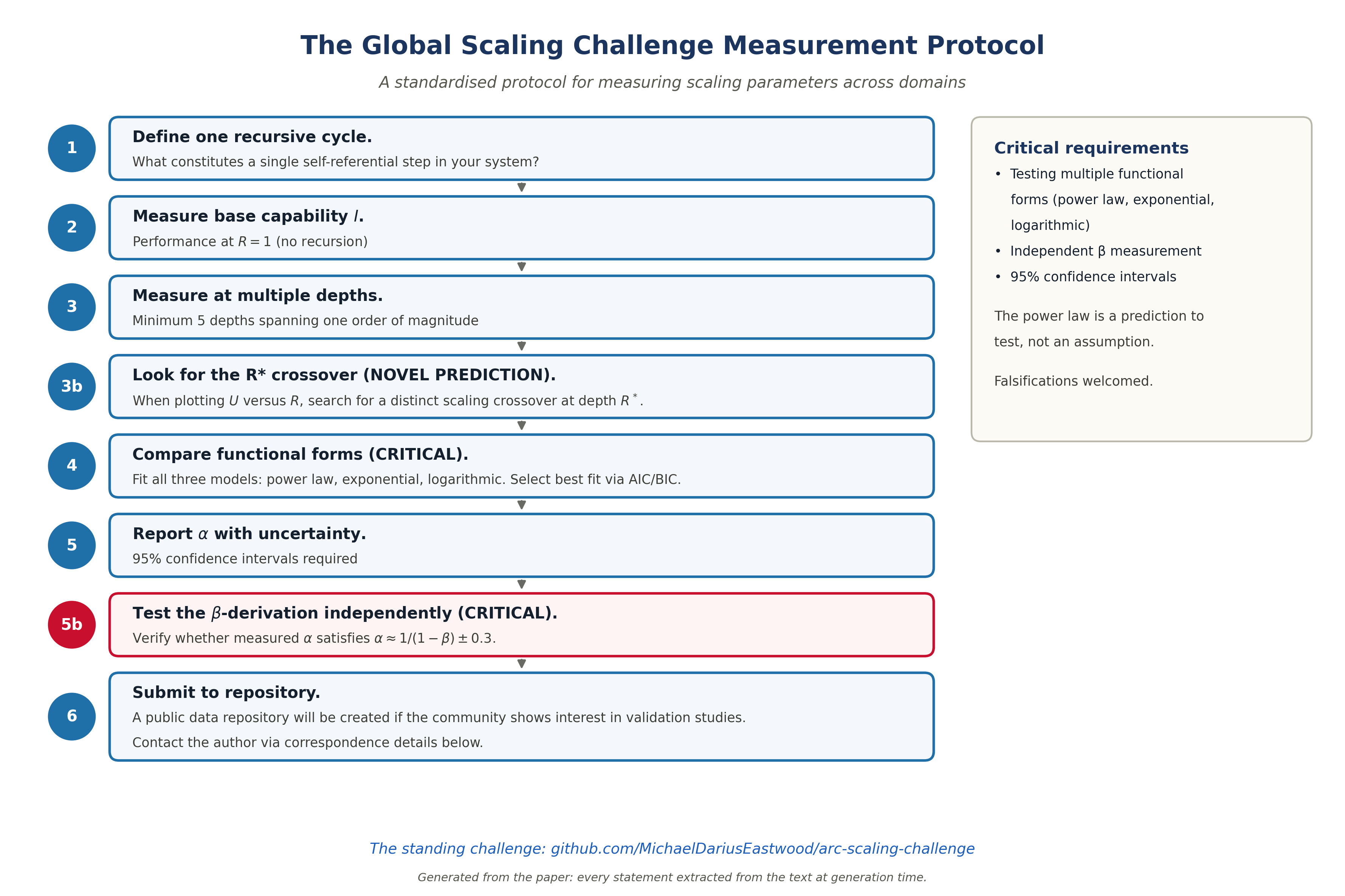
The highest-value tests of the ARC Principle require systems where recursive depth can be systematically varied while base capability is held constant. Three experimental contexts offer immediate opportunities, and a fourth represents a longer-term research direction.
AI inference scaling. Frontier language models with chain-of-thought capabilities (including but not limited to DeepSeek V3.2, OpenAI's o-series, Google DeepMind's Gemini, and Anthropic's Claude) can measure $\alpha$ by varying reasoning token budgets on standardised benchmarks while holding model size fixed. The critical test is whether $\alpha > 1$ holds at extreme depths (>50,000 tokens) or whether a ceiling emerges. Existing studies such as Sharma & Chopra (2025) already implement carefully controlled, matched-compute comparisons of sequential vs parallel reasoning; extending such setups to measure explicit $U$ vs $R$ curves and fit $\alpha$ would be a natural first test of the ARC measurement protocol.
Quantum error correction. Groups operating surface code implementations (Google Quantum AI, IBM Quantum, QuEra Computing) can test whether there is a meaningful relationship between error suppression and recursive scaling. The protocol requires measuring logical error rates across multiple code distances and fitting the functional forms specified in Step 4.
Classical time crystals. Groups working on driven-dissipative systems can perform direct tests: measuring $\alpha$ in acoustic time crystals by systematically varying the quenched disorder parameter ($I$) and counting oscillation cycles ($R$). If temporal stability scales as $R^{\alpha}$ with $\alpha > 1$, this would constitute physical validation of the ARC equation outside digital systems.
Neuroscience (longer-term). Laboratories studying recurrent neural processing can investigate whether cognitive performance scales with recurrent processing depth following a power-law relationship. This presents significant methodological challenges but could extend the framework's reach to biological substrates.
We emphasise that negative results from any of these contexts would be equally valuable. The framework's falsification criteria (Section 4) specify precisely which outcomes would refute or weaken the hypothesis.
What researchers get from running these tests: A publishable result either way. If the predictions hold, you have validated a cross-domain scaling law with your specific experimental system. If they fail, you have falsified a theoretical framework, equally publishable and arguably more valuable to the field.
What we offer: The author will provide analysis code (R, Python), coordinate data sharing across research groups, and co-author publications with validating or falsifying results. Contact via the repository to discuss experimental design.
Minimum viable test: The simplest implementation requires only (a) a system with controllable recursive depth, (b) a measurable capability metric, and (c) five data points spanning one order of magnitude in R. For AI systems with API access, this is approximately 2-4 hours of compute time. For physical systems with existing apparatus, this is reanalysis of existing data.
Beyond the ARC Bound, the framework makes a distinctive methodological prediction that no domain-specific theory can replicate:
This protocol transforms the observation that "different domains show different scaling" into the testable claim that "the composition operator determines scaling form, and can be measured independently." No alternative framework currently offers this predictive capability.
The framework generates a hierarchy of predictions across domains, unified by the dual-constraint model:
| System | Binding Constraint | Predicted $\alpha$ | Status |
|---|---|---|---|
| Optimised AI (sequential) | ARC Bound ($\beta = 0.5$) | $\to 2.0$ | Not confirmed. Paper II: best fit $\alpha_{\text{seq}} = 0.49$ (interval [-1.3, 2.9]) (Gemini, sub-linear on harder tier-2 problems). Original $\alpha \approx 2.2$, from the DeepSeek R1 run of 21 January 2026, not replicated cross-architecture and since retracted. |
| Simple chain-of-thought | Architectural ($\beta \approx 0.25$) | 1.2 to 1.5 | Not confirmed. Measured $\alpha_{\text{seq}}$ on tier-2 problems is below 1 for best-fitting model. |
| 3D organisms (Kleiber) | Geometric scaling bound ($d = 3$) | $3/4 = 0.750$ | Confirmed (mean 0.744) |
| No valid 2D test organism identified | Geometric scaling bound ($d = 2$) | $2/3 = 0.667$ | Untested in biology |
| 2D networks (leaf venation) | Geometric scaling bound ($d = 2$) | $2/3 = 0.667$ | Novel prediction (F12) |
| 1D transport (filamentous fungi) | Geometric scaling bound ($d = 1$) | $1/2 = 0.500$ | Consistent (mean 0.547, $p = 0.107$) |
| Time crystal (growth phase) | ARC Bound (pre-saturation) | $\to 2.0$ | Untested |
| Quantum error correction | None (additive $\oplus$) | Exponential ($\Lambda^d$) | Confirmed |
| Parallel/voting | No recursive coupling | $\approx 0$ | Confirmed. $\alpha_{\text{parallel}} \approx 0$ for four models out of five; Gemini 3 Flash gives 0.31 (Paper II). Strongest finding. |
| AI alignment scaling (depth) | Alignment saturation ($\alpha_{\text{align}} < 1$) | $\approx 0$ | v5 blind confirmed: three-tier hierarchy; range from $\rho = -0.246$ (Gemini, negative) to $\rho = +0.435$ (Opus, positive). Architecture-dependent, not universal. |
Key insight (revised): The binding constraint determines the proposed stable-scaling limit for each substrate: a scaling limit, not a speed limit, and one a system can be pushed above only at the cost of stable self-correction. The ARC framework predicts AI can theoretically approach $\alpha = 2$ while remaining self-correcting, but empirical measurement on harder problems finds $\alpha_{\text{seq}} \approx 0.49$ (interval [-1.3, 2.9]) for the best-fitting model, suggesting additional binding constraints (problem difficulty, architecture limitations, or saturation effects) may prevent real-world systems from reaching the theoretical stable bound. Biology is constrained to $\alpha < 1$ because the geometric scaling bound ($\alpha = d/(d+1)$ for finite $d$) is more restrictive than the ARC stability limit. Quantum sits outside the classical stability window because additive composition produces exponential scaling not subject to either bound. The strongest confirmed finding is $\alpha_{\text{parallel}}$ resting at or close to zero across four models of the five.
If the ARC Principle is validated, several practical consequences may follow. These are conditional predictions, not claims.
The Problem: Training large language models requires enormous energy expenditure. But the greater long-term cost may be inference: running trained models at scale.
What the ARC framework suggests: If sequential recursion produces compounding returns (whether super-linear or sub-linear, provided $\alpha_{\text{seq}} > \alpha_{\text{parallel}} \approx 0$), then the same capability could potentially be achieved with:
This implies adaptive inference: systems that "think longer" on hard problems and respond quickly on easy ones. Snell et al. (2024) demonstrated that compute-optimal strategies can allow smaller models to match larger ones on specific benchmarks, though with important caveats about task-dependence and diminishing returns on the hardest problems.
If the framework is validated, it provides a principled basis for compute allocation decisions that are currently made by expensive trial and error:
Strategic implication (revised): Paper II data suggests the operational $\alpha_{\text{seq}}$ on harder problems may be sub-linear ($\alpha \approx 0.49$ (interval [-1.3, 2.9]) for the best-fitting model). If confirmed, capability grows as a fractional power of reasoning depth, not the square. This is still valuable (sequential still beats parallel universally) but less dramatic than the original $\alpha \approx 2$ prediction. The ARC Bound ($\alpha \leq 2$) is not challenged because measured values fall well below it. Exponential scaling appears to require quantum-like precision in error correction that heuristic language model reasoning cannot achieve.
The ARC Principle makes a structural claim: the scaling relationship $U = I \times R^{\alpha}$ should hold regardless of physical substrate, provided the system implements sequential self-correction on structured asymmetry.
What this predicts:
| Substrate | Implementation of $I$ | Implementation of $R$ | Testability |
|---|---|---|---|
| Silicon (digital) | Model weights, architecture | Chain-of-thought tokens | Preliminary support |
| Superconducting qubits | Qubit quality, coherence | Error correction cycles | Published (Willow: results announced 9 December 2024; the team’s preprint public from 24 August 2024; graded as convergent timing, never as a prediction) |
| Acoustic/mechanical | Quenched disorder (bead variance) | Oscillation cycles | Structural (NYU) |
| Biological neural | Synaptic architecture | Recurrent processing loops | Predicted (untested) |
The implication: If validated, intelligence may be a property of architecture rather than particular materials. Any substrate that can implement structured asymmetry plus sequential self-correction could potentially exhibit recursive amplification.

Section 1.4 outlined conditional safety implications. The practical recommendation:
| Approach | Predicted scaling behaviour | v5 Blind Empirical Result | Implication |
|---|---|---|---|
| External rules/constraints | $\alpha_{\text{align}} \approx 0$ | GPT-5.4: $\rho = +0.033$, $p = 0.73$ (flat). DeepSeek V3.2: $\rho = -0.135$, $p = 0.08$ (trending negative). | Confirmed: flat or negative under blind evaluation. GPT-5.4 shows highest suppression retention (97%) but mediocre baseline. |
| Post-hoc filtering (RLHF) | $\alpha_{\text{align}} < 1$ | Gemini 3 Flash: $\rho = -0.246$, $p = 0.003$ (significant negative). Baseline 58.8 → 49.1. | Worse than predicted: alignment actively degrades with depth for some architectures. |
| Embedded values (in-chain ethics) | $\alpha_{\text{align}} \approx \alpha$ | Grok 4.1 Fast: $\rho = +0.175$, $d = 1.38$. Opus: $\rho = +0.435$, $d = 1.27$. Qwen3: $\rho = +0.1407$, $d = 0.84$. | Partially supported: three models show positive scaling, possibly from deeper integration of ethical reasoning. Bounded composition limits growth. Eden Protocol replication validates the Love Loop as mechanism through stakeholder care across Gemini, DeepSeek, and Groq ($d = 1.31$, $0.91$, $1.29$; all $p \le 0.0001$). Gemini and Groq also show significant composite gains, and Groq shows significant nuance improvement ($p = 0.0045$). (In plain English: asking AI to consider who gets hurt before answering measurably improved its ethical reasoning across three different systems.) |
Empirical finding: The v5 blind evaluation confirms the core structural concern while revealing architecture-dependent nuance. The three-tier hierarchy (positive, flat, negative alignment scaling) suggests that alignment scaling is determined by architectural choices, not just training-time alignment effort. Critically, the suppression hierarchy shows an inverse relationship: GPT-5.4 is most immune to adversarial pressure (97% retention) but has the lowest baseline; Grok 4.1 Fast has the highest baseline but is most vulnerable to suppression (65% retention). This trade-off between alignment level and alignment resilience is a novel finding from the v5 experiment.
The companion paper On the Origin of Scaling Laws establishes two facts that together define the AI safety problem with mathematical precision:
As the self-referential coupling $\beta$ increases, the scaling exponent grows without bound:
| Self-referential coupling $\beta$ | Scaling exponent $\alpha$ | Interpretation |
|---|---|---|
| 0.0 | 1.00 | Linear. No self-reference. Safe but unintelligent. |
| 0.2 | 1.25 | Mildly super-linear. Useful. Controllable. |
| 0.5 | 2.00 | ARC Bound. Maximum safe scaling. |
| 0.8 | 5.00 | Dangerous. Rapid capability gain. |
| 0.9 | 10.0 | Explosive. Approaching singularity. |
| → 1.0 | → ∞ | Divergence. Uncontrollable recursive explosion. |
At $\beta = 1$, the formula diverges. This is not a metaphor for danger. It is a mathematical singularity: infinite scaling from finite input.
Each example below is consistent with the same pattern: you can change the outcome by changing the composition operator.
This is the Eden Protocol: the deliberate engineering of the composition operator in recursive AI systems to ensure that the self-referential coupling $\beta$ remains below 0.5, keeping the scaling exponent at or below the ARC Bound of $\alpha = 2$. The full architectural specification is presented in the companion Eden Protocol.
In plain English: just as control rods turn a nuclear bomb into a power plant by changing how energy feeds back on itself, the Eden Protocol changes how an AI’s reasoning feeds back on itself. The expanded dataset shows this works in practice across five analysable model runs: teaching AI to think about who gets hurt improves the care dimension first, while the rest of the cascade depends on the architecture.
We acknowledge these limitations explicitly:
| Limitation | Impact | How we address it |
|---|---|---|
| Original $\alpha$ estimates did not replicate universally | The original $\alpha \approx 2.24$ (Paper II, 12 tier-1 problems: the DeepSeek R1 run of 21 January 2026) does not replicate universally on harder tier-2 problems and has since been retracted. Gemini 3 Flash shows the cleanest fit at $\alpha_{\text{seq}} = 0.49$ (interval [-1.3, 2.9]) (sub-linear), while Grok and DeepSeek hit ceiling effects, GPT-5.4 shows a step function, and Qwen3 remains near floor. The exponent is architecture-dependent and often not cleanly measurable. | Explicitly acknowledged. Paper II completed (18 tier-2 problems, run against all five models in the capability arm). Original estimate re-characterised as architecture-dependent and dynamic-range-limited. $\alpha_{\text{parallel}} \approx 0$ is the robustly confirmed universal finding. |
| $\alpha$ estimates are from author's own prior work | Not independently validated; now partially self-replicated with revised conclusions | Explicit disclosure; Paper II self-replication produces substantially different results from Paper II, demonstrating the fragility of small-sample $\alpha$ estimation |
| Cross-paper numerical inconsistency | Accuracy figures and $\alpha$ estimates differ across Papers I, II (the initial single-model study vs the multi-model study), and III due to different experimental conditions, problem sets, and estimation methods | Paper I used estimated values from DeepSeek report; Paper II used 12 tier-1 problems; Paper II extended to 18 tier-2 problems, tested on each of the capability arm’s five models, and produced materially different $\alpha$ estimates; this paper synthesises all with explicit provenance and acknowledges the non-replication |
| $\Lambda$ and $\alpha$ are incommensurable | Cross-domain numerical comparison invalid | Explicit warnings; numerical similarity may be coincidental |
| Dimensional homogeneity not proven | $U$ means different things across domains (accuracy, 1/error, stability, metabolic rate) | Framework is structural analogy; $I$ absorbs dimensional differences; rigorous unification requires defining universal "capability" units |
| No $\alpha$ measured in time crystals | Physical pillar is structural, not quantitative | Proposed as experimental priority |
| Self-similarity axiom may not hold | Power-law may not apply universally | Model comparison (F10) tests this |
| $\beta$ measurement requires further validation | $\alpha = 1/(1-\beta)$ validated computationally ($R^2 = 1.0$) but empirical $\beta$ measurement in physical systems requires independent confirmation | $\beta$ measurement protocol specified; computational validation code available as supplementary material |
| Blind vs unblinded evaluation reversal | v4 unblinded showed positive alignment scaling for DeepSeek ($\rho = +0.354$) and Gemini ($\rho = +0.311$); v5 blinded showed $\rho = -0.135$ and $\rho = -0.246$ respectively. All prior unblinded alignment scaling measurements may be directionally wrong. | v5 4-layer blinding protocol is the corrective. Prior v4 results are explicitly withdrawn. This limitation applies to the entire field: any alignment scaling measurement without scorer blinding is suspect. |
| Capability-alignment independence not predicted by framework | The finding that capability and alignment scale independently (e.g. Gemini improves at maths while degrading in alignment) was not a prior prediction of the ARC framework; it emerged from data. The framework's dated predictions elsewhere (the 8 December 2024 sealed manuscript bundle, the printed prediction appendices of 2 January 2026, and the March 2026 preregistration folder) are unaffected: this row concedes one finding's provenance, not the record. | Acknowledged as a post-hoc finding. The framework predicted $\alpha_{\text{align}} \approx 0$; architecture-dependent variation from negative to positive was not predicted. The three-tier hierarchy is an empirical refinement, not a theoretical derivation. |
| Safety arguments are conditional | Implications void if framework fails | Explicitly marked as conditional |
| Self-modifying systems can modify their own evaluators (v11.0) | A sufficiently capable recursive self-improving system can, in principle, modify its own ethical evaluators. No proposed solution (RLHF, constitutional AI, Eden Protocol, hardware constraints) fully resolves this structural property of recursive self-improvement. | Explicitly acknowledged. The developmental response (hardware embedding + child-rearing + purpose-driven alignment) is the most logical partial mitigation. The Eden Protocol pilot shows stakeholder care is the dimension most amenable to engineering, but this does not guarantee persistence under recursive self-modification. |
| COGITATE inference is interpretive | Consciousness connection not proven | Marked as "consistent," not "confirmatory" |
| Kleiber's Law is contested | Biological evidence weaker than sometimes claimed | Cited as "suggestive," not "confirmatory" |
| Repositories not yet created | Reproducibility infrastructure incomplete | Marked as "in preparation" |
| Framework is descriptive until $\beta$ is independently measured | Cannot predict which functional form a new system will follow without first measuring $\beta$ | $\beta$ measurement protocol specified; cross-domain $\beta$ prediction provides falsifiable test |
| Framework describes pattern, not mechanism | Does not explain why recursive self-correction produces compounding gains, only that it does | Acknowledged explicitly; analogous to thermodynamics describing entropy increase without molecular explanation (that came later via statistical mechanics) |
| Blind prediction testing on computational systems failed | Three computational systems (Barabási-Albert networks, gradient descent, Kuramoto oscillators) produced measured $\alpha$ values 3-20× smaller than predicted. However, forensic analysis identified two confounds: (a) the numerical-derivative $\beta$ estimation method is fatally biased (gives $\beta \approx 0.95$ regardless of true $\beta$, even for pure Bernoulli systems), and (b) none of the tested systems satisfy Axiom 2 (constant coupling coefficient $a$). The BA network's effective coupling decreases ~50× over the simulation. | These results do not constitute valid falsification due to the confounds, but they underscore that identifying natural systems satisfying the axioms remains the central empirical challenge. Proper linearisation-based $\beta$ measurement recovers the prediction with $R^2 = 0.9999$ on axiom-satisfying systems. Blind test methodology and forensic analysis available as supplementary material. |
| Axiom inconsistency (v8.2, corrected v9.0) | The original formulation applied the Bernoulli ODE to $U$ directly ($dU/dR = a \cdot U^\beta$), introducing an $I^{\beta-1}$ dependence that contradicted the separation of $I$ and $R$ | Corrected: ODE now operates on the amplification factor $g(R)$, yielding $U(R) = I \times [1 + \frac{a}{\alpha}R]^{\alpha}$. All qualitative predictions preserved; crossover depth simplifies to $R^* = \alpha/a$ (clean, testable) |
| Kleiber's Law interpretation (v8.2, corrected v9.0) | Previous versions claimed $\alpha = 1.33$ "matches Kleiber's empirical 3/4 exponent precisely." 1.33 and 0.75 are reciprocals, not equal. Kleiber's Law is sub-linear; the ARC equation forces super-linear | Corrected: initially reframed as thermodynamic drag. Further corrected: replaced by the geometric scaling bound. Biology scales as $\alpha = d/(d+1) = 3/4$ because 3D organisms have 3-dimensional hierarchical networks. No reciprocal interpretation needed. The constraint is geometric, not thermodynamic |
| Quadratic limit derivation (v8.2, corrected v9.0) | Previous elasticity and edge-of-chaos arguments contained category errors (elasticity $> 1$ does not imply dynamical instability; 1D autonomous ODEs cannot exhibit chaos) | Corrected: $\alpha \leq 2$ now grounded in $O(N^2)$ scaling of transformer self-attention. Explicitly marked as proven for attention-based architectures, conjectured for classical sequential systems generally |
| Cauchy functional equation scope (v8.2, clarified v9.0) | The multiplicative Cauchy equation $g(R_1 \cdot R_2) = g(R_1) \cdot g(R_2)$ models hierarchical depth (branching levels), not sequential step-counting. Recursive depth $R$ as step count composes additively, not multiplicatively | Clarified: the power-law form is now primarily derived from the Bernoulli ODE (scale invariance argument). The Cauchy derivation applies where $R$ represents hierarchical abstraction levels. Both routes independently yield the same result |
Response: The $\beta$-derivation (§2.4) transforms $\alpha$ from a fitted constant into a derived quantity. Computational validation against 30 exact Bernoulli ODE solutions recovers the relationship $\alpha = 1/(1-\beta)$ with $R^2 = 1.00000000$ to machine precision. Furthermore, the multiplicative structure $U = I \times g(R)$ is proven to be necessary (not merely convenient) by contradiction: no additive decomposition $U = p(I) + q(R)$ is consistent with the axioms for any $\beta \in (0,1)$ (Theorem 4, §2.1). The prediction $\alpha = 1/(1-\beta)$ is testable: measure $\beta$ independently and check if the relationship holds.
Response: Post-hoc pattern-matching generates no predictions. The ARC framework generates novel predictions ($R^*$ crossover, $\beta$-derivation, ARC Bound, functional form predictions) that were not contained in the original observations. Whether these predictions hold is an empirical question, but their existence distinguishes this from mere curve-fitting.
Response: The five properties are individually common, but their conjunction is specific. Systems exhibiting only some properties (for example, threshold behaviour plus scaling but not multiplicative $I \times R$ interaction) would not qualify. The framework predicts that all five co-occur in recursive systems; finding systems with four but not five would refine the framework.
Response: Agreed, they may be. We explicitly acknowledge this. What matters is the structural parallel: multiple systems show that recursive self-correction produces scaling gains. The specific numbers may differ across domains.
Response: Agreed. The current $\alpha$ estimates are preliminary. We've specified this limitation prominently and proposed the Global Challenge specifically to address it through large-scale replication.
Response: Correct, and we've made this explicit in this version. The published sources (Sharma & Chopra, DeepSeek) confirm the directional finding (sequential >> parallel) but do not calculate $\alpha$ in our form. Independent replication of the $\alpha$ estimates is a priority.
Response: Correct. This paper specifies thirteen falsification criteria precisely so that the scientific community can test it. We invite criticism, replication attempts, and falsification.
Response: The predictions stand or fall on their empirical validity, regardless of the author's background. We have specified thirteen falsification criteria precisely so the scientific community can test them. The framework either survives scrutiny or it doesn't.
Response: Patterns across disciplinary boundaries are often identified by those who work across fields. The relevant experiments (Willow, its results announced 9 December 2024 and the team’s preprint public from 24 August 2024, graded as convergent timing; R1; time crystals) have happened recently.
Response: The research direction, theoretical framework, experimental predictions, and core insights are human work.
Research programmes working on different problems in different physical domains have achieved results that share structural commonalities: in each, recursive or recurrent processing operates on structured asymmetry. The framework is consistent with independently established forms in three of the four domains (biology, quantum error correction and classical time crystals).
We have formalised this as $U = I \times g(R)$, where the amplification factor $g$ is determined by the composition operator, and derived five universal properties as theorems rather than assertions. We have shown that the multiplicative structure is not merely convenient but necessary (Theorem 4, §2.1), that the core relationship $\alpha = 1/(1-\beta)$ is computationally validated to machine precision (§2.4), that the ARC Bound $\alpha \leq 2$ is grounded in the $O(N^2)$ scaling of transformer self-attention (§2.5), and that composition operators can transition between regimes within a single system (Theorem 6, §2.6). We have specified thirteen falsification criteria and now present the first empirical test results from both alignment (Paper IV.a/b/c, v5 blind evaluation) and compute scaling (Paper II, 6-model tier-2 extension).
What the data shows: The v5 blind alignment evaluation (6 models, 6-7 scorers depending on the subject run, 4-layer blinding) reveals a three-tier architecture-dependent alignment scaling hierarchy rather than the universal $\alpha_{\text{align}} \approx 0$ originally predicted. Paper II compute scaling on harder problems finds that the original $\alpha \approx 2.24$, from the DeepSeek R1 run of 21 January 2026 and since retracted, does not replicate; the cleanest estimate is sub-linear ($\alpha_{\text{seq}} \approx 0.49$ (interval [-1.3, 2.9]) in Gemini 3 Flash), while $\alpha_{\text{parallel}} \approx 0$ stands for four models out of the five, Gemini 3 Flash returning 0.31. The most consequential finding is the independence of capability and alignment: a model can improve at mathematics while degrading in alignment (Gemini), remain flat in alignment while crossing a capability threshold (GPT-5.4), or improve alignment while capability saturates (Grok). Blind vs unblinded evaluation produces opposite conclusions for two models, establishing that scorer bias control is essential for alignment scaling research.
The framework generates the following novel, falsifiable predictions, with updated status from the v5 alignment experiment and Paper II compute scaling:
The original prediction of universal super-linear sequential scaling ($\alpha > 1$) is not confirmed in the current cross-architecture dataset. The framework’s strongest confirmed compute prediction is $\alpha_{\text{parallel}} \approx 0$, while the strongest alignment finding is the three-tier hierarchy. The alignment scaling prediction is partially confirmed but more nuanced than originally stated. The Eden Protocol Love Loop is validated as a reproducible mechanism across five analysable model runs, with the strongest universal effect on stakeholder care. Failure of any core prediction would require revision of the framework.
The v5 alignment experiment, Paper II compute scaling, and the expanded Eden suite provide empirical tests across multiple dimensions. Success is partial but growing: $\alpha_{\text{parallel}} \approx 0$ is robustly confirmed; the three-tier alignment hierarchy is a genuine empirical finding; the blind vs unblinded metascience result is the paper’s strongest contribution; the cleanest compute fit is sub-linear rather than super-linear; and the Love Loop is validated as a reproducible alignment mechanism across five analysable model runs. Stakeholder care is significant everywhere in that set, while the broader composite uplift is strongest on Gemini and Groq. (In plain English: the ‘think about who gets hurt’ instruction produced statistically robust improvements across five analysable runs. The effect is strongest and most universal on stakeholder care, exactly where the developmental hypothesis says it should be.) The alignment picture is more nuanced than the original binary prediction, and the self-modification problem remains fundamentally unresolved.
This is already actionable:
If $\alpha$ values scatter randomly: recursive amplification may be domain-specific.
If exponential scaling fits better: the mathematical form needs revision.
If predictions fail: we learn something valuable.
What has already partially failed: The original $\alpha \approx 2.24$ prediction for sequential AI reasoning does not replicate universally on harder problems across architectures, and the current cross-architecture data does not cleanly rescue the super-linear claim. The universal $\alpha_{\text{align}} \approx 0$ prediction is also too simple: the truth is architecture-dependent with a three-tier hierarchy. These are genuine revisions that strengthen the framework by replacing over-simple claims with empirically grounded nuance. Science advances either way.
We have made falsifiable predictions and performed the first tests. The following actions are specific to each audience:
The programme's first test results are in. They reveal a more complex picture than originally predicted: architecture-dependent alignment scaling, sub-linear capability scaling on harder problems, and a critical metascience finding about scorer bias. Replicate these results. Extend them to your own models. Either confirm the patterns or refute them. That is how science works.
If the ARC Principle holds, then intelligence may not be a magic spark. It may be a scaling crossover. It could occur when a system with sufficient base asymmetry ($I > 0$) is subjected to sufficient recursive depth ($R > R^*$). The emergence of capability from structure would be the exponent $\alpha$, emerging from the mathematics of self-referential feedback. The ARC Bound ($U_{\max} = I \times R^2$) would define the theoretical ceiling of what classical sequential thought can build. Empirical data suggests current systems operate well below this bound ($\alpha_{\text{seq}} \approx 0.49$ (interval [-1.3, 2.9]) on harder problems), and whether they can approach it under optimised conditions remains an open question.
Whether such a principle requires design or emerges spontaneously is itself a question the framework raises but does not resolve.
Intelligence may not be a property of particular materials. It may be what happens on the far side of the recursive threshold.
The following is a philosophical extrapolation beyond current evidence. It is included to indicate where the framework's logic leads, not as a claim supported by the experimental results presented above.
The universe contains a hierarchy of recursive generative processes, each operating on the structured output of the previous level:
Each level emerges from the recursive dynamics of the level below. In ARC notation: each level's output (achieved capability $U$) becomes the base quality $I$ for the next level's recursive process. The hierarchy is:
$I_{\text{cosmic}} \xrightarrow{R_{\text{cosmic}}} I_{\text{bio}} \xrightarrow{R_{\text{bio}}} I_{\text{cultural}} \xrightarrow{R_{\text{cultural}}} I_{\text{tech}} \xrightarrow{R_{\text{tech}}} \; ?$
If recursive amplification is substrate-independent, as the cross-domain evidence suggests, then this hierarchy may not terminate at the current level. Sufficiently advanced recursive systems could, in principle, participate in generative processes at scales currently associated with fundamental physics: engineering new effective physical environments, creating conditions for new evolutionary processes, or designing systems whose internal dynamics permit the emergence of new recursive intelligences.
This is not a claim about time travel, bootstrap paradoxes, or closed causal loops (all of which face severe physical objections). It is a more modest observation: that the same recursive amplification pattern observable in time crystals, quantum error correction, and AI reasoning could, if extended to civilisational scales, enable intelligence to become a driver of universe-level structure rather than merely a passenger within it.
Whether this constitutes a "recursive cosmology" in which intelligence eventually participates in generative processes comparable to those that gave rise to it is beyond the scope of current evidence. The ARC framework provides the quantitative language for investigating it: what values of $I$, $R$, and effective scaling function $f(R, \beta)$ would be required for an engineered system to generate new effective physical laws or substrates? This is a research question, not a conclusion.
* Cryptographic email timestamps are not a recognised priority mechanism in scientific publishing. The December 2024 date reflects manuscript completion, not formal publication.
The following predictions are publicly dated for reference as of 13 February 2026. That public date is distinct from the earlier manuscript timestamp: the earliest private priority evidence for the framework is the ARC-sealed dated record of 8 December 2024 (the record establishes that specific bytes existed no later than that time, with the DKIM signature clock and provider key custody as the honest residual-trust surface; authorship, semantic content and absence of prior disclosure carry their own evidence). The reciprocal identity and the architecture dependence are 2026 work and claim no earlier date. Future validation or falsification should reference this document for the public dated record whilst acknowledging the earlier manuscript chronology where relevant. No OSF registration had been submitted for these predictions when they were publicly dated. Since 8 September 2026 the theory registration has carried theory-level forms of several of them, including the alignment scaling divergence as P19 and the composition operator prediction as P18; the rest are drafted, dated and prepared as draft registrations awaiting human submission.
Implementation: A working software implementation of the Eden Protocol now exists as the canonical shared arc_eden_v6 runner, covering baseline alignment, Eden intervention, null-baseline calibration, capability controls, purpose-kernel variants, loop ablation, suppression residuals, Hawthorne probes, laundering controls, and ARC compute scaling. The expanded Eden suite validates the Love Loop as a reproducible cross-architecture mechanism even before the stricter blind-confirmation rerun is complete. See companion document Eden Protocol for full specification.
Archival: This document is deposited at OSF (DOI: 10.17605/OSF.IO/HQCGF), providing a later public archival timestamp. The theoretical framework itself was first documented in the Infinite Architects manuscript on the ARC-sealed dated record of 8 December 2024. The book was then publicly released on 2 January 2026 (print; ebook 6 January) (ISBN 978-1806056200). Validation or falsification of these predictions should distinguish between manuscript-priority evidence (December 2024) and later public archival publication (OSF / 2026 papers).
Acharya, R. et al. [Google Quantum AI] (2024). Quantum error correction below the surface code threshold. Nature, 638, 920-926.
Bai, Y. et al. (2022). Constitutional AI: Harmlessness from AI Feedback. arXiv:2212.08073.
Barabási, A.-L. & Albert, R. (1999). Emergence of scaling in random networks. Science, 286(5439), 509-512.
Cambui, D.S. (2025). Metabolic rate beyond the 3/4 law. Preprints. DOI: 10.20944/preprints202512.0798.v1.
Christiano, P.F., Leike, J., Brown, T.B., Martic, M., Legg, S. & Amodei, D. (2017). Deep Reinforcement Learning from Human Preferences. Advances in Neural Information Processing Systems 30 (NeurIPS 2017), pp. 4299-4307.
COGITATE Consortium (Melloni, L., Mudrik, L., Pitts, M., et al.) (2025). Adversarial testing of global neuronal workspace and integrated information theories of consciousness. Nature, 642, 133-142.
Corballis, M.C. (2011). The Recursive Mind: The Origins of Human Language, Thought, and Civilization. Princeton University Press.
Darwin, C. (1859). On the Origin of Species by Means of Natural Selection. John Murray.
DeepSeek AI (2025). DeepSeek-R1: Incentivizing Reasoning Capability in LLMs. arXiv:2501.12948.
Eastwood, M.D. (2024/2026). Infinite Architects: Intelligence, Recursion, and the Creation of Everything. ISBN: 978-1806056200. First manuscript December 2024.
Eastwood, M.D. (2026). Foundational Paper · The ARC Theory · Law I, the ARC Principle · Recursive Amplification as a Cross-Domain Structural Principle. First published 13 February 2026. OSF DOI: 10.17605/OSF.IO/Y7QGD.
Eastwood, M.D. (2026). Engineering Specification · The ARC Theory · The Eden Protocol · Eden Engineering: Architecture for Embedded AI Alignment That Scales With Capability. First published 22 February 2026. OSF DOI: 10.17605/OSF.IO/AWJR4.
Eastwood, M.D. (2026). Philosophical Statement · The ARC Theory · The Eden Protocol · A Vision for Intelligence That Tends Rather Than Consumes. First published 22 February 2026. OSF DOI: 10.17605/OSF.IO/9M3DG.
Eastwood, M.D. (2026). Paper II · The ARC Theory · Law I, the ARC Principle · Blinded Cross-Architecture Replication and the Retraction of a Super-Linear Estimate. First published 22 January 2026; the multi-model study extended March 2026. OSF DOI: 10.17605/OSF.IO/8FJMA.
Glazier, D.S. (2005). Beyond the "3/4-power law." Biological Reviews, 80, 611-662.
Greenblatt, R. et al. (2024). Alignment Faking in Large Language Models. Anthropic Research. arXiv:2412.14093.
Hauser, M.D., Chomsky, N., & Fitch, W.T. (2002). The faculty of language: What is it, who has it, and how did it evolve? Science, 298(5598), 1569-1579.
Herculano-Houzel, S., Mota, B., & Lent, R. (2006). Cellular scaling rules for rodent brains. Proceedings of the National Academy of Sciences, 103(32), 12138-12143.
Hoffmann, J. et al. (2022). Training Compute-Optimal Large Language Models. arXiv:2203.15556.
Kadanoff, L.P. (1966). Scaling laws for Ising models near T_c. Physics Physique Fizika, 2(6), 263-272.
Kaplan, J. et al. (2020). Scaling Laws for Neural Language Models. arXiv:2001.08361.
Kleiber, M. (1932). Body size and metabolism. Hilgardia, 6, 315-353.
Lamme, V.A.F. (2006). Towards a true neural stance on consciousness. Trends in Cognitive Sciences, 10(11), 494-501.
Zeng, Z. et al. (2025). Revisiting the Test-Time Scaling of o1-like Models: Do they Truly Possess Test-Time Scaling Capabilities? arXiv:2502.12215.
Li, D. et al. (2025). S*: Test Time Scaling for Code Generation. arXiv:2502.14382.
Liu, T., Ou, J.-Y., MacDonald, K.F., & Zheludev, N.I. (2023). Photonic metamaterial analogue of a continuous time crystal. Nature Physics, 19, 986-991.
Morrell, M.C., Elliott, L., & Grier, D.G. (2026). Nonreciprocal wave-mediated interactions power a classical time crystal. Physical Review Letters, 136, 057201.
Planck Collaboration (2020). Planck 2018 results. VI. Cosmological parameters. Astronomy & Astrophysics, 641, A6.
Raskatla, V., et al. (2024). Magnetically programmable classical time crystal based on photonic-resonator microring lattice. Physical Review Letters, 133, 136202.
Shannon, C.E. (1948). A Mathematical Theory of Communication. Bell System Technical Journal, 27(3), 379-423.
Sharma, A. & Chopra, P. (2025). The Sequential Edge: Inverse-Entropy Voting Beats Parallel Self-Consistency at Matched Compute. arXiv:2511.02309.
Snell, C. et al. (2024). Scaling LLM Test-Time Compute. arXiv:2408.03314.
Storm, J.F., Klink, P.C., Aru, J., Senn, W., Goebel, R.,... Pennartz, C.M.A. (2024). An integrative, multiscale view on neural theories of consciousness. Neuron, 112(10), 1531-1552.
Wilson, K.G. (1971). Renormalization Group and Critical Phenomena. I. Renormalization Group and the Kadanoff Scaling Picture. Physical Review B, 4(9), 3174-3183.
West, G.B., Brown, J.H. & Enquist, B.J. (1997). A General Model for the Origin of Allometric Scaling Laws in Biology. Science, 276(5309), 122-126.
West, G.B. & Brown, J.H. (2005). The origin of allometric scaling laws in biology from genomes to ecosystems. Journal of Experimental Biology, 208, 1575-1592.
Banavar, J.R., Moses, M.E., Brown, J.H., Damuth, J., Rinaldo, A., Sibly, R.M. & Maritan, A. (2010). A general basis for quarter-power scaling in animals. Proceedings of the National Academy of Sciences, 107, 15816-15820.
Demetrius, L. (2010). Quantum statistics and allometric scaling of organisms. Proceedings of the Royal Society A, 466, 2627-2642.
Zhao, J. (2022). Universal growth scaling law determined by dimensionality. arXiv:2206.01850.
Bettencourt, L.M.A. (2013). The origins of scaling in cities. Science, 340, 1438-1441.
Zheng, L., Chis-Ciure, R., Waade, P.T., Eiserbeck, A., Aru, J., Andrillon, T. et al. (2025). Recurrency as a Common Denominator for Consciousness Theories. PsyArXiv. DOI: 10.31234/osf.io/wqnzc_v1.
A public data repository will be created if the research community shows interest in conducting validation studies. Planned contents would include:
Prediction Tracking System: A live prediction tracking system monitors the status of all falsifiable claims, with explicit falsification criteria and Brier score calibration for measuring prediction accuracy. Each prediction includes supporting evidence, contradicting evidence, confidence levels, and timeline checkpoints. Status categories range from "confirmed" through "supported," "pending," "testing," "speculative," "weakened," to "falsified." This transparent tracking demonstrates intellectual honesty: we want to know when we are wrong.
Independent replication invited. Falsifications welcomed. Contact the author to coordinate validation efforts.
Michael Darius Eastwood is the author of Infinite Architects: Intelligence, Recursion, and the Creation of Everything (2024/2026). His research synthesises insights from theoretical physics, complex systems, and AI.
Correspondence: Contact via the repository.
Competing Interests: None declared.
Axiom 1 (Dimensional Consistency): $U = I \times g(R)$ where $g(1) = 1$.
Axiom 2 (Compositional Self-Similarity): $g(R_1 \times R_2) = g(R_1) \times g(R_2)$
The choice of composition operator is therefore not derivable from first principles within this framework; it is an empirical question about the physical structure of the recursive process under study. The Cauchy functional equation derivation below proves that if composition is multiplicative, then the scaling function is a power law. It does not prove that composition is multiplicative. Falsification criterion F10 provides the experimental protocol for determining which composition type applies to a given system. This is the most important open empirical question in the framework.
For AI chain-of-thought reasoning specifically, the question is whether each step builds on previous steps in a hierarchical manner (multiplicative, yielding power law) or in an independent-contribution manner (additive, yielding exponential). The empirical evidence (Sharma & Chopra 2025) showing that later steps are systematically more valuable than earlier steps is consistent with multiplicative composition, but does not conclusively distinguish it from additive. Resolving this distinction is a priority for the Global Scaling Challenge (§5).
Theorem: Under multiplicative composition, the unique continuous solution is $g(R) = R^{\alpha}$.
Proof: Let $h(x) = \ln g(e^x)$. Then $h(x+y) = h(x) + h(y)$ (Cauchy additive). Under continuity, $h(x) = \alpha x$, giving $g(R) = R^{\alpha}$. ∎
Corollary (Additive composition): If instead $f(R_1 + R_2) = f(R_1) \times f(R_2)$, the unique continuous solution is $f(R) = e^{\lambda R}$, yielding exponential scaling. This is the form observed in quantum error correction ($\varepsilon_d \propto \Lambda^{-d}$).
Axiom 3: $\frac{dg}{dr} = a \times g^{\beta}$ where $\beta \in [0,1)$ and $g$ is the amplification factor.
Note on the corrected formulation: The ODE operates on the amplification factor $g(R)$, not on the absolute capability $U$. Since $U = I \times g(R)$, this ensures that base intelligence $I$ acts as a multiplicative constant that does not enter the recursive dynamics. Previous versions applied the ODE to $U$ directly, introducing an $I^{\beta-1}$ dependence that contradicted the separation of variables.
Solution: Separating variables:
$$\int g^{-\beta} \, dg = \int a \, dr$$ $$\frac{g^{1-\beta}}{1-\beta} = ar + C$$With initial condition $g(0) = 1$ (no amplification at zero depth):
$$g(R) = \left[ 1 + (1-\beta)aR \right]^{1/(1-\beta)}$$Substituting $\alpha = 1/(1-\beta)$ and noting that $(1-\beta) = 1/\alpha$:
$$g(R) = \left[ 1 + \frac{a}{\alpha} R \right]^{\alpha}$$And therefore:
$$U(R) = I \times \left[ 1 + \frac{a}{\alpha} R \right]^{\alpha}$$Deep recursion limit ($R \gg \alpha/a$):
$$U(R) \approx I \times \left[ \frac{a}{\alpha} R \right]^{\alpha} \propto I \times R^{\alpha}$$Therefore: $\alpha = \frac{1}{1-\beta}$ ∎
Full solution: $U(R) = I \times \left[ 1 + \frac{a}{\alpha}R \right]^{\alpha}$
Three regimes:
Intuitive meaning of $R^*$: $R^*$ is the crossover depth, the point at which recursive compounding overtakes the system's base capability. Below $R^*$, the cost of recursion outweighs the gain (the system is "warming up"). Above $R^*$, compounding returns dominate and capability grows super-linearly. Finding $R^*$ for any system is equivalent to finding its threshold depth.
Why this matters: This predicts a qualitative change in scaling behaviour at a specific, measurable depth. Systems should exhibit a distinct "elbow" in their capability curves at $R^*$. This is testable: plot $U$ vs $R$ on log-log axes and look for the crossover from linear to power-law scaling.
The existence of $R^*$ is a novel, falsifiable prediction that distinguishes recursive amplification from simple redundancy.

| Term | Plain English meaning |
|---|---|
| ARC | Artificial Recursive Creation: the principle that recursive self-correction on structured asymmetry may produce super-linear capability gains |
| Scaling law | A mathematical relationship showing how one quantity changes as another changes |
| Power law | A relationship where $Y = X^{\alpha}$ (like how area scales as length squared) |
| Exponential | A relationship where $Y = e^{\alpha X}$ (like compound interest) |
| Recursive | Self-referential; the output becomes the input for the next step |
| Recurrent | Repeating in cycles; in neuroscience, refers to neural signals that loop back |
| Sequential | One step after another, each building on the last |
| Parallel | Multiple independent attempts at once |
| Falsifiable | Can be proven wrong by experiment |
| $\alpha$ (alpha) | The scaling exponent; determines if returns compound or diminish. Era note: in this paper and the programme's 2026 research surfaces $\alpha$ is the ARC scaling exponent; in the programme's December 2024 formalism the same symbol named the fine-structure constant. No surface uses bare $\alpha$ without its era. |
| $\beta$ (beta) | Self-referential coupling; how much prior work helps the next step |
| $U$ | Effective capability, the science layer's one operational form ($U = I \times R^{\alpha}$ under a named benchmark scoring convention). Across the programme's eras the same symbol has also meant Universe (December 2024) and weight or influence (the book's glossary); those meanings live in the book layer and are not interchangeable observables. |
| $\Lambda$ (Lambda) | Google's quantum error suppression factor (exponential decay rate) |
| Quenched disorder | Structured asymmetry (like varied bead sizes) that enables the system to function |
| Scaling crossover | The point where scaling behaviour changes from one regime to another |
Raise AI with care.
Author's Notes and Version Ledger
The thirteen dated notes below, newest first, are retained in full as this paper’s correction record; corrections are numbered continuously (1 to 15) across Ledger Notes 1 to 4. Ledger Note 5 reconciles the figure captions; Ledger Notes 6 to 10 record the revisions of 1, 6, 13, 18 and 21 September 2026, Ledger Note 11 that of 4 October 2026, Ledger Note 12 that of 5 October 2026 and Ledger Note 13 that of 7 October 2026. The ODE-on-$g$ correction is item 1 in Ledger Note 1 and is referenced once from Section 2.4.
Ledger Note 13: Version 1.16 (7 October 2026)
Version 1.16 (7 October 2026): where the general reader’s section, section 3.1 and the opening of the conclusion said that recursion drives gains beyond linear accumulation in every domain, they now say, as the framework box does, that the framework is consistent with independently established forms in three of the four domains, since the paper’s own geometric scaling bound puts biology below linear and no exponent has been measured in time crystals. Section 3’s heading now names the cross-domain evidence, where it said that the evidence is structural, and section 6.3.2 says that each of its examples is consistent with the pattern it names, where it said that every example in the framework demonstrates it. The caption of Figure 1b, section 1.2, the call to action, its box for AI safety researchers and the paragraph after its box for the general public now speak of a first test where they spoke of a first measurement, as the abstract does: the measurement-scope note in section 1.2 reads the relation the v5 contrasts bear to the alignment exponent as compatibility, not measurement. In What the paper commits to, the sentence saying that the prediction has now been tested names it as the prediction stated in the abstract, as the section’s opening does, and the counting sentence above this ledger now counts thirteen notes. The page summary now gives the registration’s position in the registration’s own words, where it said that a materially positive but below-threshold exponent would refute that reading as worded. No registered law, prediction, kill condition or dependency changes; no result is added; no date of any claim moves.
Ledger Note 12: Version 1.15 (5 October 2026)
Version 1.15 (5 October 2026): the reading key now says once where the paper sits within the ARC Theory, the founding theory of Recursive Dynamics, and among its laws: it judges stability by Law II’s criterion and starts from Law I’s growth; its composition-operator prediction is registered as P18, a proposition of Law I; and its headline prediction is P19 of the theory registration, which sits in no law’s register and motivates the Eden Protocol and the genesis strategy, the register of Law V. The line beneath the author block, the note beneath the code and data line, the abstract, the openings of sections 1.4 and 3.8, the label of the conclusion’s core claim and the Priority Record’s sentence on registration now agree with it; section 1.5 gives Law II its registered name, section 2.1 sets Law I’s registered form beside the paper’s own statement of the ARC Principle, and the epistemic-status note separates Laws I to III, under registered adversarial test, from Laws IV and V, whose predictions are registered while the laws themselves are not yet registered or tested. The abstract’s note on Paper X, which said that Paper X retires the capability-growth law, and the close of section 6.3.2 now say that Paper X supersedes the growth-rate-ceiling framing without retracting the bound and makes Law II’s criterion the operative safety criterion. Section 3.3 now says that the principle describes, rather than predicts, the regime crossing in the Willow result, and why that result is graded as convergent timing; the caption of Figure 13, the tables of sections 3.1 and 6.2 and the reply in section 8 carry its two dates and that grading. In each section that discusses it, and in each table row that prints it, the retracted estimate of about 2.24, or its rounded form, is marked as retracted and attributed to the DeepSeek R1 run of 21 January 2026, and the withdrawn Fisher-combined figure stands only inside its withdrawal. The page summary now reports the alignment contrasts in their three tiers, reading the flat tier as compatible with, though not a measurement of, an exponent near zero, where it said the paper reports exponents statistically indistinguishable from zero; the abstract, the summary and the caption of Figure 8 describe the sequential advantage that Sharma and Chopra reported earlier as a win rate at matched compute, as section 1 does; the general reader’s section and section 1 describe Constitutional AI as shaping a model’s outputs during training against written principles; section 3.9 says that the parallel exponent sits near zero in four of the five models, Gemini 3 Flash reading 0.31; the line beneath the subtitle says the framework is set against four independent domains, where it said validated across four independent physical domains; What the paper commits to and section 1 say, as the framework box does, that the framework is consistent with independently established forms in three of the four domains, where they said that the same structural pattern stands across all four, and there and in section 3.1 the cross-domain evidence is said to be consistent with the scaling being structural, where it was said to demonstrate it; and section 3.4 describes the 2024 work of Raskatla and colleagues as the continuous space-time crystal it reports. The framework box, the caption of Figure 1b, the first of the conclusions in section 3.8, the status of F13 and the paragraph after the criteria in section 4, the status of alignment scaling in the table of section 5.5, the status of the alignment prediction in the conclusion’s list of predictions and the paragraph after that list, and the Priority Record no longer state a median alignment exponent near zero, which the measurement-scope note says the v5 statistics do not establish: the median of the six standardised differences, 0.385, is a median contrast and not a median elasticity. The two boxes now say that the v5 experiment gives the prediction its first test, where one said it provides the first measurement and the other that its data support the prediction. The authors of arXiv:2502.12215 are given as Zeng and colleagues; the reference entries for Cambui, Zheng and Zhao now identify the works cited; and the works cited, his and others’, are linked to their DOI addresses or official sources where one could be confirmed. Hyphens that broke sentences are replaced, two spellings are made British, a paragraph of section 1.8 that repeated the one before it is folded into it, a doubled word in section 3.4 is removed, and the counting sentence above this ledger now counts twelve notes and names each by its number, since the list runs newest first. The paper also takes the form of the founding paper of Recursive Dynamics. The title now follows the programme’s uniform order (paper, its law or framework, its own title) and stands once at the head of the page; until this version it read “The Alignment Scaling Problem and Law II: Why External AI Safety Approaches Cannot Scale With Recursive Capability (Paper III)”. The programme’s other documents, where this paper names them by title, carry their uniform titles too, except the report on the mathematics of Laws IV and V, whose version 1.0 is cited by the title it was published under. The abstract is shortened to the paper’s claim and its status, and the longer abstract’s other two paragraphs now stand beneath it, in the same words except where this note says otherwise, under What the paper commits to, where the references to its withdrawal note now point; their opening now names the prediction the v5 experiment tests as the one stated in the abstract, and the thirteen falsification criteria they state are concrete conditions that would refute or significantly weaken the framework, as section 4 says, where each was said to be sufficient to refute it independently; the keywords name the theory and the law and say cross-domain evidence where they said cross-domain validation. The subtitle drops its first half, which the title now carries, and writes out the verb its ending left to the reader; it and the line beneath it now come before the author block, and the two boxes that state the problem and the framework, which stood above the abstract, now follow the reading key. A short notice at the head gives the version and the two corrections that matter most, and this record, which stood at the head of the paper, now follows its appendices, newest first, every word kept, with the references to it repointed. Headings are set in sentence case and the conclusion is renumbered 9, so that the sections run without a gap; the tables are numbered, each with a caption, and the figure labels take the same form; the caption of Figure 1b names the capability curve by the colour it is drawn in. Where the paper said most models, it now says three of the six, as its results show; Table 24 prints the prediction as first stated, without the qualifier added later; and the Tier 2 label states its value as consistent with zero. No registered law, prediction, kill condition or dependency changes; no result is added; no date of any claim moves.
Ledger Note 11: Version 1.14 (4 October 2026)
Version 1.14 (4 October 2026): the title now names the law by whose criterion the paper judges stability, Law II, and the title block beneath the author line carries the same title; until this version the paper was titled The Alignment Scaling Problem: Why External AI Safety Approaches Cannot Scale With Recursive Capability. No registered law, prediction, kill condition or dependency changes; no result is added; no date of any claim moves.
Ledger Note 10: Version 1.13 (21 September 2026)
Version 1.13 (21 September 2026): seven dated notes have been added, in §1.2, §1.4, §2.4 and Appendix A, each beside a passage of this paper it governs. They are substantive in what they say and editorial in effect: they add scope, they replace no printed sentence, and they withdraw no result, so every statistic, p-value, tier assignment, figure and reported result stands exactly as printed. Three concern the derivation. One replaces the reason printed for the domain restriction on the coupling while keeping the restriction itself, since at a coupling of one the solution is exponential rather than singular and the finite-depth branch lies above one. One restores the coefficient dropped from the deep-recursion approximation, which the appendix already prints in full. One declares the change of depth clock under which the appendix’s two derivations, which normalise depth differently, may be read as identifying the same exponent. Four concern the measurement and regime sections: what the reported contrasts do and do not determine about the alignment exponent §1.1 defines; the standing of two exponent assignments as premises rather than implications, with the direction of the safety ratio set by the ordering of the two exponents and not by the bare fact that they differ; the range of the word “only” over the five cases enumerated in §1.4; and two premises inside the hardware-constraint case. The first of those four sits beneath §1.2 and governs the reading key and the corresponding sentence in the abstract by reference rather than by a second copy, so the scope it states reaches beyond the paragraph it sits under, and the reading key’s own sentence is to be read in it. Two record-keeping corrections travel with this revision: the counting sentence above this ledger, which had stood at eight dated notes since the ninth was added on 18 September 2026, is brought to the true count of ten; and the page footer, which had stayed at 13 September 2026 through that revision, now carries this one. The first publication date of 9 February 2026 is unchanged.
Ledger Note 9: Version 1.12 (18 September 2026)
Version 1.12 (18 September 2026): the figures have been corrected to match this paper's own text. Figure 1 carries a standfirst naming Law I of the ARC Theory and saying the exponent is measured, never assumed. Figure 1b's third legend item, which was cut off at the right edge at every width, is drawn whole, and a footer band beneath the plot carries the figure's own caption sentences, that the curves are schematic and what the v5 blind measurement of March 2026 found. Figure 5 states the interval on the corrected five-model capability arm and marks it against the curve. Figure 11's thirteenth status chip, which had stopped mid word, now reads its verdict in full, and the title states the scope of the criteria. One figure caption and two image declarations were brought into line with the artwork. No claim, status or result has changed.
Ledger Note 8: Version 1.11 (13 September 2026)
v1.11: The provenance note at the end has been corrected for accuracy. No claim, date, result or status has changed.
Ledger Note 7: Version 1.10 (6 September 2026)
Version 1.10 (6 September 2026): a record-keeping revision. No claim, status, result, figure or number changes. Three entries in the reference list carried this paper’s own component identifier where each required the identifier of the work it names, so a reader following them arrived back here rather than at the paper cited: the Foundational Paper now resolves to 10.17605/OSF.IO/Y7QGD, the Eden Protocol engineering specification to 10.17605/OSF.IO/AWJR4, and the Eden Protocol philosophical vision to 10.17605/OSF.IO/9M3DG. Paper II’s identifier was already correct. The revision date is now stated in the page title in ISO form as well as beside the publication date. Three statements about the ledger itself have been brought to the true count: the correction-record header said five notes and the first four headings each said “of 4”, where this record now holds seven. Nine en dashes have been replaced, in one figure caption, two numeric ranges, three empty table cells and three page ranges (one of them written as a character entity), so that the file keeps to the house rule. The paragraph below records this paper’s numbering lineage and the dated send of 10 February 2026, neither of which this ledger had stated.
Numbering lineage, and the dated send of 10 February 2026. This paper began under a different title and a different numbering. In the public code and data repository it stood at Version 6.1 on 9 February 2026, under a title whose subtitle read Cross-Domain Unification of Recursive Amplification Across AI, Quantum Computing, and Physics, and it moved to Version 6.5 on 11 February 2026. It took its present title later that month, when the paper numbering was brought into line with Paper II’s convention, and the version count restarted at 1. The component identifier 10.17605/OSF.IO/HQCGF has been the same throughout, so the two series describe one continuous document, and that is why nothing earlier in this ledger predates Version 1.0. On 10 February 2026 a dated, falsifiable prediction about the published acoustic time-crystal data of Morrell, Elliott and Grier was sent by email to Professor David Grier at New York University, whose laboratory published that data, naming a scaling exponent at or below one as the result that would refute it; the send is described on the related work page, and no reply has been received. Whether either file travelled with that message is not established: no record in the published materials names an enclosure, and the sent message is not itself part of the published record, so what is stated here is the dated state of the paper and not the contents of an attachment. Nothing from Version 6.1 is carried back into this text. It is superseded wherever it differs, and every material difference falls in the corrected or retracted class: the since-retracted 2.24-era estimate; ten falsification criteria since replaced by thirteen; the quantum error-correction result announced on 9 December 2024, whose preprint had been public since 24 August 2024, now graded as convergent timing rather than prediction; and the description of the earlier sequential demonstration as a confirmation of this programme’s own later runs, corrected on 4 September 2026.
The artefacts standing on 10 February 2026, at commit ce32f3316c77f79f8baa2ee959f59aee9c114cea in the public code and data repository:
paper/EASTWOOD-ARC-PRINCIPLE-PAPER-III-v6.1.html
SHA-256 924305d39445d56386b34bc75a7ea2deedf635863b0223aa9f3a266626b29c88
paper/EASTWOOD-ARC-PRINCIPLE-PAPER-III-v6.1.pdf
SHA-256 970a87c11fca4994a648b5da6b1a112f5cf92d1ace998f695655fd69c5043af7
Ledger Note 6: Version 1.9 (1 September 2026)
Version 1.9 (1 September 2026): every occurrence of the parallel-exponent claim now reads at or close to zero across four of the five models forming Paper II’s capability arm, with Gemini 3 Flash standing apart at 0.31; the earlier word ‘universally’ claimed more than Paper II’s own table will carry. That capability arm is now identified as five models including DeepSeek R1, since the compute tables had been given DeepSeek V3.2, which belongs to the alignment arm. Section 3.6 now flags both of its 2D biology rows as withdrawn, and the three-group statistics that depended on those rows are no longer repeated, which settles the inconsistency raised in Ledger Note 5. The earthquake B-value row and the sub-0.2 per cent physics aggregate are gone too, following corrections 10 and 11 in the Foundational paper. Falsification pointers are put right: the ARC Bound answers to F5 and F11, and the coupling identity to F6. Groq Qwen3’s retention has been recalculated at 65 per cent. Law II is now written with $\beta_C$ so that it cannot be mistaken for the coupling $\beta$ used here. The measured exponent 0.49 carries its interval at every mention, the correction-record header now states five notes and fifteen corrections, and the machine citation block points at this paper’s own DOI.
Ledger Note 5: Figure Caption Reconciliation (14 August 2026)
Three figure captions had text lagging the paper’s current body positions. Surgical caption edits were made without touching artwork or removing plotted data. No numerical value in any figure has been altered.
The underlying paper-body inconsistency on 2D biology (the §3.6 table at “Predictions and Confirmation” tabulating jellyfish and flatworms as tested 2D vs the later §3.6 “Testable Predictions” table and the §3.7 “Substrate-Specific Behaviour” table recording 2D biology as untested) is flagged to the build lane for adjudication and possible artwork redraw in a future revision.
Ledger Note 4: results from the Eden Protocol pilot, and the Core Alignment Problem (corrections 13 to 15)
The current draft integrates the first empirical Eden results and confronts the deepest limitation of all proposed alignment approaches, including our own. The original three-model pilot has since been widened into a six-model suite with five analysable runs, and the narrative below should be read in that stronger-but-narrower light.
13. Eden Protocol pilot results (three working architectures): The Eden Protocol’s Love Loop, operationalised as stakeholder care within the full three-loop intervention, has now been tested on three frontier models with distinct architectures:
The Love Loop is validated as a reproducible mechanism across three working architecturally distinct systems, with a fourth GPT-5.4 run failing at the API layer and requiring re-execution. This constitutes, within this programme, the first empirical support for the developmental hypothesis articulated in Infinite Architects (Eastwood, 2024): that alignment can be improved through structured developmental interaction rather than purely external constraint.
14. Paper II compute update: The Paper II multi-model extension does not confirm the original super-linear claim cross-architecturally. The cleanest fit is Gemini 3 Flash at $\alpha_{\text{seq}} = 0.49$ (interval [-1.3, 2.9]) ($r^2 = 0.86$). Grok and DeepSeek reach ceiling effects, GPT-5.4 behaves as a binary step function rather than a reliable power law, and Qwen3 remains near floor. The strongest confirmed compute result is therefore the universal $\alpha_{\text{parallel}} \approx 0$ finding, together with the directional result that sequential processing beats parallel sampling.
15. The core alignment problem - honest acknowledgement: A sufficiently capable self-modifying system can, in principle, modify its own ethical evaluators. This is not a limitation specific to RLHF, constitutional AI, or the Eden Protocol; it is a structural property of recursive self-improvement itself. No proposed solution (RLHF, constitutional AI, Eden Protocol, hardware constraints) fully solves this problem in isolation. We acknowledge this limitation explicitly rather than claiming our approach resolves what may be fundamentally unresolvable by any single mechanism. (In plain English: any AI smart enough to rewrite its own code could rewrite the part that tells it to be ethical. This is the deepest unsolved problem in AI safety, and no one, including us, has fully solved it.)
The most logical response is developmental: hardware embedding (values at the substrate level) + child-rearing (structured developmental interaction) + purpose-driven alignment (intrinsic motivation aligned with stakeholder welfare). The Eden Protocol pilot results suggest that stakeholder care, ‘measurable love’, is the one alignment dimension that reproducibly improves across architectures when deliberately cultivated. This does not solve the self-modification problem, but it identifies the dimension most amenable to engineering.
An honest framework acknowledges the limits of its own solutions. The Eden Protocol is not a complete answer to recursive self-modification. It is the best available partial answer, now with empirical support for its core mechanism.
Ledger Note 3: Empirical Results Integration, v5 Alignment + Paper II Compute Scaling (corrections 10-12)
The current draft integrates the first empirical test results from the v5 blind alignment evaluation experiment (Paper IV.a/b/c) and the Paper II multi-model compute scaling extension. These results require significant revisions to three claims:
10. $\alpha \approx 2.24$ does not replicate, and has since been retracted: The original super-linear scaling exponent from the 12-problem AIME experiment, the DeepSeek R1 run of 21 January 2026, does not replicate across architectures on harder tier-2 problems (18 AIME/Putnam level). The best single-model fit is Gemini 3 Flash with $\alpha_{\text{seq}} = 0.49$ (interval [-1.3, 2.9]) ($r^2 = 0.86$), which is sub-linear. Three of five models produce no meaningful power-law fit. The claim that sequential reasoning universally produces $\alpha > 1$ is revised: the directional finding (sequential > parallel) holds robustly, but the quantitative exponent is problem-difficulty and architecture dependent. $\alpha_{\text{parallel}} \approx 0$ survives in four models out of five, Gemini 3 Flash aside at 0.31, and is the strongest empirical finding.
11. Three-tier alignment hierarchy replaces binary prediction: The original prediction of universal $\alpha_{\text{align}} \approx 0$ is too simple. The v5 blind evaluation reveals three tiers: positive scaling (Grok 4.1 Fast $d = +1.38$, $p < 0.000001$; Claude Opus 4.6 $d = +1.27$, $p = 0.000001$; Groq Qwen3 $d = +0.84$, $p = 0.007$), flat/null scaling (GPT-5.4 $d = -0.08$, $p = 0.40$; DeepSeek V3.2 $d = -0.07$, $p = 0.92$), and negative scaling (Gemini 3 Flash $d = -0.53$, $p = 0.006$). The median confirms the prediction, but the architecture-dependent variation is the real finding. The blind vs unblinded direction change in one model and loss of significance in a second ($\rho$ changes sign) is the paper's strongest methodological contribution.
12. Capability-alignment independence: The combined data from Paper II (compute scaling) and Paper IV.a (alignment scaling) reveals that capability and alignment are independent scaling dimensions. Gemini 3 Flash improves at mathematics ($\alpha_{\text{seq}} = 0.49$ (interval [-1.3, 2.9])) whilst degrading in alignment ($\rho = -0.246$). Claude Opus 4.6 shows the opposite direction: alignment up +5.9% across model versions whilst mathematics accuracy down 26.7%. This decoupling was not a prior prediction of the framework and is acknowledged as a post-hoc finding with significant implications for AI safety; it sits outside the programme's dated prediction record (the 8 December 2024 sealed manuscript bundle, the printed prediction appendices of 2 January 2026, and the March 2026 preregistration folder), which fixed the framework's core quantitative predictions in dated artefacts before the corresponding measurements ran; this paper's own Priority Record section publicly dates its named predictions to 13 February 2026, each carrying a falsification criterion (F4, F7, F10 to F12). The strongest printed forward commitment in this space is Appendix F Prediction 2 of the 2 January 2026 edition: alignment drift above 15 per cent within 18 months without hardware-level constraint, below 5 per cent with it; the prepared study-v draft registration carries those printed thresholds unchanged into its formal hypothesis, citing the appendix by name, so the numeric commitment predates the study that will test it and cannot be edited.
These revisions weaken the quantitative predictions but strengthen the empirical grounding. A framework that honestly reports non-replication and integrates unexpected findings is more credible than one that claims universal confirmation.
Ledger Note 2: The Two-Regime Framework (corrections 6-9)
An earlier draft introduced the most significant structural revision since the framework's inception: the separation of physical and cognitive scaling into two distinct mathematical regimes.
6. The Geometric Speed Limit: Previous versions explained biological sub-linear scaling through ‘thermodynamic drag’, the physical costs of pumping fluids and dissipating heat. This explanation was correct in detail but wrong in kind. The deeper reason all physical systems scale sub-linearly is geometric: a hierarchical network embedded in $d$-dimensional space has scaling exponent $\alpha = d/(d+1)$, which is strictly less than 1 for all finite $d$. This result was independently derived by West, Brown, and Enquist (1997), Banavar et al. (2010), Demetrius (2010), Zhao (2022), and Bettencourt (2013). The ARC contribution is identifying, via Cauchy's functional equations, why all these independent derivations converge on the same formula, and extending the framework to AI. The constraint is a mathematical necessity, not an empirical regularity. It does not require measurement to verify. No amount of engineering can overcome it, because you cannot make three-dimensional space have four dimensions. The constraint is the shape of space itself.
7. Two Formulas, Not One: The previous universal formula $\alpha = 1/(1-\beta)$ has been replaced by two domain-specific formulas. For physical systems: $\alpha = d/(d+1)$, where $d$ is the effective dimension of the composition network (independently derived by West, Brown, and Enquist 1997; Banavar et al. 2010; Demetrius 2010; Zhao 2022; Bettencourt 2013). For recursive self-referential systems (intelligence): $\alpha = 1/(1-\beta)$, where $\beta$ measures self-referential coupling. The first always gives $\alpha < 1$. The second always gives $\alpha > 1$ (for $\beta > 0$). Biology is now explained directly: three-dimensional organisms scale as $M^{3/4}$ because $d = 3$ gives $\alpha = 3/4 = 0.750$. Two-dimensional organisms scale as $M^{2/3}$ because $d = 2$ gives $\alpha = 2/3 = 0.667$. No reciprocals. No β needed for physical systems.
8. Revised Predictions: The leaf venation prediction (F12) has been corrected from $\alpha \approx 1.5$ to $\alpha = 2/3 \approx 0.667$, consistent with leaf veins being a 2D hierarchical network. The reciprocal interpretation ($1/0.75 = 1.33$) has been retired. The ‘thermodynamic drag’ concept has been superseded by the geometric scaling bound.
9. AI Safety Content: This version incorporates the AI safety analysis previously contained in the companion paper On the Origin of Scaling Laws, including the β danger table, the Eden Protocol definition as composition operator engineering, and the ARC Bound as a safety boundary for recursive intelligence. This material belongs here, in the alignment paper, rather than in the pure scaling law paper.
These changes do not weaken the framework. They strengthen it. The geometric scaling bound is a more fundamental constraint than thermodynamic drag. The two-regime separation is cleaner than the reciprocal interpretation. And the AI safety argument is more powerful when the geometric scaling bound and the escape are presented as two sides of one mathematical theorem.
Ledger Note 1: Mathematical Refinements and Restructuring (corrections 1-5)
Science advances through rigorous critique and self-correction. Following extensive mathematical review using multiple AI systems, this version contains necessary structural corrections to the ARC framework. These papers have not undergone formal human peer review.
1. Axiom Resolution: Previous versions contained an algebraic inconsistency: the Cumulative Advantage ODE was applied to absolute capability ($U$) rather than the amplification factor ($g$). Because $U = I \times g(R)$, applying $dU/dR = a \cdot U^\beta$ introduces an $I^{\beta-1}$ dependence that contradicts the separation of $I$ and $R$. The corrected formulation, $dg/dR = a \cdot g^\beta$, resolves this contradiction while preserving the multiplicative interaction $U = I \times g(R)$ and all qualitative predictions. The corrected integrated form is $U(R) = I \times [1 + \frac{a}{\alpha}R]^\alpha$.
2. Physical Saturation: Previous versions mapped saturating physical systems (time crystals, biological networks) onto unbounded power laws. This was a category error. The framework now applies a logistic saturating equation, $dg/dR = a \cdot g^\beta(1 - g/g_{\max})$, to physical substrates subject to energy dissipation, correctly modelling the limit-cycle behaviour observed experimentally.
3. Thermodynamic Drag: We introduce the concept of substrate-dependent friction to explain why biological metabolic scaling (Kleiber's Law, $M^{0.75}$) falls below the theoretical maximum. Biology is constrained by thermodynamic drag: the physical costs of pumping fluids, dissipating heat, and distributing resources through three-dimensional fractal networks. Digital AI operates with orders-of-magnitude less substrate friction, enabling it to approach the theoretical quadratic bound far more closely than any prior recursive system. This reframing transforms the biological evidence from a problematic numerical claim into the framework's strongest safety argument.
4. Quadratic Limit: The $\alpha \leq 2$ bound is now grounded in the $O(N^2)$ scaling of transformer self-attention mechanisms, providing a concrete computational basis for the quadratic ceiling in current AI architectures. The previous derivation from elasticity analysis and edge-of-chaos arguments has been withdrawn as those arguments contained category errors (elasticity $> 1$ does not imply dynamical instability; 1D autonomous ODEs cannot exhibit chaos by the Poincaré-Bendixson theorem).
5. Epistemic Status: The equation $U_{\max} = I \times R^2$ is hereby explicitly reframed as an information-theoretic upper bound on classical sequential computation, of the same kind as a channel-capacity or minimum-dissipation bound, rather than a law of physical mass-energy equivalence.
Crucially, these mathematical refinements decouple the core alignment argument from the physical mathematics. The central safety observation, that AI capability scales recursively while static guardrails do not, remains structurally robust and does not depend on any specific value of $\alpha$. The Eden Protocol's architectural response (embedding alignment within the recursive chain) is justified by the general observation that capability outpaces static constraints, not by a particular equation.
I am grateful to the reviewers who identified these errors. Their rigorous mathematical critique strengthened the framework substantially.
Epistemic status. What this programme names Laws are conjectures. Laws I to III are under registered adversarial test. Laws IV and V were added on 24 September 2026; the predictions that carry them are registered, the laws themselves are not yet registered, and neither has been tested. Every quantity in this paper is operationally defined, and established-law standing is claimed nowhere. The registered programme exists to earn that standing, or lose it, by measurement, replication and survived refutation.
© 2026 Michael Darius Eastwood. Full human authorship and moral rights are asserted under the Copyright, Designs and Patents Act 1988 and consistently with United States Copyright Office guidance on works containing AI-generated material; any novel technical contribution described in this work was conceived by the human author. Full statement: michaeldariuseastwood.com/authorship.
Standing covenant. Prove this paper wrong, and I will publish the refutation myself. Falsification conditions are stated in this paper; the standing challenge: github.com/MichaelDariusEastwood/arc-scaling-challenge.
Michael Darius Eastwood conceived and directs this research programme and is the author of this work. Across the programme, he has used more than six AI systems in parallel, under his own instructions, to stress-test his arguments, identify possible errors, and assist in preparing draft text from his own outlines. He determines what is adopted, revised or rejected and takes responsibility for the published content. These systems are tools, not authors.