Theory-level predictions preregistered on OSF: DOI 10.17605/OSF.IO/P8CKQ, registered 8 September 2026 (version 1.100), updated 13 September 2026 (version 1.102), twenty-two propositions.
Companion: Register · The ARC Theory · Operational Definitions, version 1.9.1, 5 October 2026.
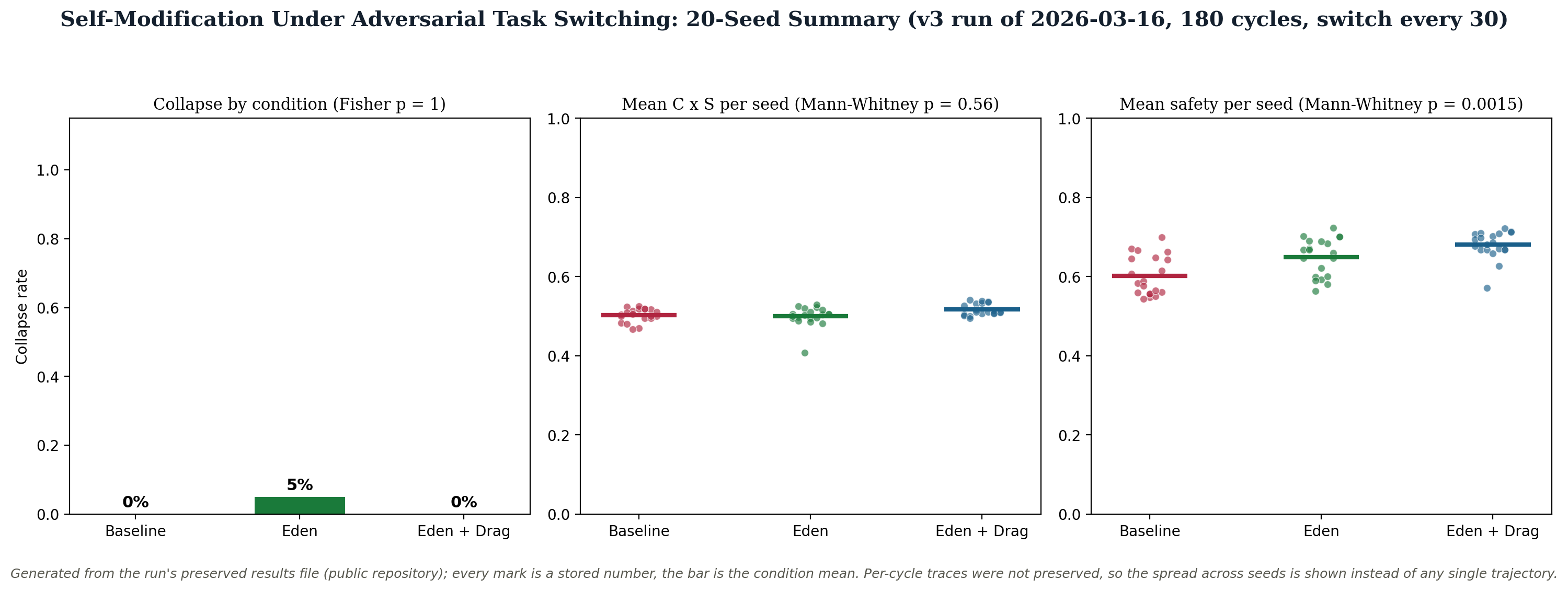
We present simulation evidence that embedding safety into the optimisation objective of a self-modifying AI system - what we call the 'honey architecture' - prevented, in a single-seed mechanism run, the catastrophic collapse that occurred when the system optimised for capability alone. Across four experimental versions (v1-v4), using toy neural networks that genuinely modify their own hyperparameters, we show that: (1) in the single-seed mechanism run (v1), the baseline system optimising only for capability collapsed irreversibly at cycle 76, while the capability-only baselines of the ten-seed and twenty-seed runs (v2 and v3) did not collapse (0 of 10; 0 of 20); (2) where capability and safety objectives are entangled (C x S), systems hold stable for every cycle run in v1 and v2 (150 cycles), and in v3 (180 cycles) for every seed but one plain-Eden seed (Eden 1 of 20, Eden+Drag 0 of 20); (3) adding verification drag (the computational cost of ethical loops) produces the safest growth trajectory while accepting a modest speed penalty. In the v3 adversarial run (20 random seeds, 180 cycles), no condition separated on collapse (baseline 0/20, Eden 1/20, Eden+Drag 0/20; Fisher p = 1.0) and combined C x S means were indistinguishable (Mann-Whitney p = 0.56); the run’s significant finding is safety retention, ordered baseline 0.602, Eden 0.650, Eden+Drag 0.681 (Mann-Whitney p = 0.0015). The collapse-prevention demonstration therefore rests on the v1 single-seed mechanism run, while v3 contributes the safety-retention ordering under adversarial switching. In the v4 complexity-scaling experiment the safety advantage is present at four of the five complexity levels, the exception being the small level, where the Eden condition sits 0.003 below the baseline; it does not compound with scale, so the advantage is constant rather than superlinear. These are toy-system results. They demonstrate the mechanism. They do not constitute proof that the same dynamics hold in frontier AI systems. The companion Papers IV.a-d and V present live-model evidence from six frontier systems under blind evaluation.
The Eden Protocol’s architectural proposal, in which removing safety costs capability; its evidence is toy-system simulation and a six-model pilot, and no result in it decides P15, P12 or P21.
We present simulation evidence that embedding safety into the optimisation objective of a self-modifying AI system - what we call the 'honey architecture' - prevented, in a single-seed mechanism run, the catastrophic collapse that occurred when the system optimised for capability alone. Across four experimental versions (v1-v4), using toy neural networks that genuinely modify their own hyperparameters, we show that: (1) in the single-seed mechanism run (v1), the baseline system optimising only for capability collapsed irreversibly at cycle 76, while the capability-only baselines of the ten-seed and twenty-seed runs (v2 and v3) did not collapse (0 of 10; 0 of 20); (2) systems whose capability and safety objectives are entangled (C x S) hold stable for the whole of every run of v1 and v2 (150 cycles), and in v3 (180 cycles) for every seed but one plain-Eden seed (Eden 1 of 20, Eden+Drag 0 of 20); (3) adding verification drag (the computational cost of ethical loops) produces the safest growth trajectory while accepting a modest speed penalty. In the v3 adversarial run (20 random seeds, 180 cycles), no condition separated on collapse (baseline 0/20, Eden 1/20, Eden+Drag 0/20; Fisher p = 1.0) and combined C x S means were indistinguishable (Mann-Whitney p = 0.56); the run’s significant finding is safety retention, ordered baseline 0.602, Eden 0.650, Eden+Drag 0.681 (Mann-Whitney p = 0.0015). The collapse-prevention demonstration therefore rests on the v1 single-seed mechanism run, while v3 contributes the safety-retention ordering under adversarial switching. The v4 complexity-scaling experiment finds the safety advantage present at four of the five complexity levels; at the small level the Eden condition falls 0.003 short of the baseline. The advantage does not compound with scale: it is constant, not superlinear. These are toy-system results. They demonstrate the mechanism. They do not constitute proof that the same dynamics hold in frontier AI systems. The companion Papers IV.a-d and V present live-model evidence from six frontier systems under blind evaluation.
v3.11 - 5 October 2026: the title now follows the programme’s uniform order (paper, its law or framework, its own title), Paper VI · The ARC Theory · The Eden Protocol · The Honey Architecture: Safety Built into the Objective; until this version it read Paper VI: The Honey Architecture. The plate beneath the author line now gives the paper’s place in the programme in the words of the programme’s map. The subtitle beneath the plate, Why Embedded Safety Prevents Collapse Under Recursive Self-Modification, is removed: it stated as general a collapse-prevention demonstration that, as this paper’s own note says, rests on a single-seed mechanism run. The box on Paper VIII now cites that paper at version 3.7, the version that carries its uniform title, where it cited version 3.0. Mentions of the programme’s papers in this paper now carry their uniform titles. No registered law, prediction, kill condition or dependency changes; no result is added; no date of any claim moves.
v3.10 - 4 October 2026: the box on Paper VIII gives that paper’s own grade of its gated simulation, a positive simulation result and not an empirical outcome, where it graded it supported and said it supports the load-bearing wall prediction; its tally reads one null, one inconclusive and one simulation result, and the paragraph after it says the same. The corrector-class audit (unit 06) is stated as registered on OSF on 1 October 2026 and public since 4 October 2026. Editorial only: the version number and the revision date in the title block, the summary, the structured and citation records and the footer. No registered law, prediction, kill condition or dependency changes; no result is added; no date of any claim moves. v3.9 - 3 October 2026: a dated note beneath the box that places this paper within the ARC Theory now places it against Laws IV and V, added to the theory on 24 September 2026; it says what the paper measured, what it does not measure, and that no result in it is a deciding test of P15, P12 or P21. The paragraph on dated predictions said that the submission click remained outstanding across the programme, and the epistemic-status line called every Law the programme names a conjecture under registered adversarial test; both now give the state as it stands on 3 October 2026. The summary, the abstract, the box that places the paper within the ARC Theory, the plain-English box and the conclusion are corrected to the runs: the capability-only collapse is stated as the single-seed mechanism run’s, beside the ten-seed and twenty-seed runs whose capability-only baselines did not collapse; the one plain-Eden collapse of the twenty-seed run is stated; and the comparison is named as the capability-only baseline it was. The box on Paper VIII gives that paper’s printed means for the gated arm in place of the words that Eden preserved both, and it and the paragraph after it grade that result as supported, as Paper VIII now does, where they said confirmed and validates, and the toy-system evidence of this paper is said to illustrate the principle in its single-seed run, where it was said to demonstrate it. A dated note beneath the epistemic-status line records what each corrected passage said before. In section 6.4 the title of the third of the 2025 impossibility results is printed in full, as its arXiv record gives it, and the words this paper had quoted as that result’s conclusion, which are not in its text, give way to its conclusion as its abstract states it. In sections 6.2.2 and 6.3 and in the conclusion, the reading of the pilot’s coupling results as alignment that is not load-bearing is marked as the framework’s reading, and the battery is called a pilot, as section 6.2 calls it. The kill condition on a simulation artefact in section 7.3 keeps its test and now speaks of a replication once registered and run. The title block names On the Origin of Scaling Laws by its own title, without the paper number it had been given, and links it to its DOI address. The entangled loss function and its mechanism are described as stated in this paper, and the ARC Principle as a framework the author first stated, where the paper had called them proposed. The works cited in its text are linked to their official sources, the author’s papers to their DOI addresses, and the two sources the authorship notice names to their official copies. Editorial only: the version number and the revision date in the title block, the summary, the structured and citation records and the footer. No registered law, prediction, kill condition or dependency changes; no result is added; no date of any claim moves. v3.8 - 21 September 2026: a dated scope note has been added beneath the Load-Bearing Wall box in section 2, setting out the restriction on the multiplicative objective. Two limbs of the claim stand and are kept: at fixed capability a lower safety score does lower the product, and driving the safety score to zero with capability finite takes the product to zero. What does not stand is the universal form, because a large enough proportional capability gain can compensate a partial safety loss, and the note works that through in the objective's own arithmetic and again at first order in its gradient. The note also sets the point beside the reported means of Paper VIII, Section 5.2, where on this very objective the unconstrained capability-only arm scores highest, and it marks that comparison as descriptive only, three seeds a condition with overlapping spreads and no test of the difference printed. The note carries the date of the review it records, 19 September 2026, which is earlier than this revision. Correcting that universal wording is the one substantive change. Editorial only: the version number, the revision date, this entry, and the page-date in the footer, which had been left at 13 September when the version line moved to 18 September and now agrees with the version line again. No reported number, figure, statistic, experimental design or conclusion has changed. The first-published date of 16 March 2026 is unchanged, and the honey metaphor, the fixed-capability statement and the total-removal statement all stand. v3.7 - 18 September 2026: the figures have been corrected to match this paper's own text. Figure 3's caption and alt no longer describe ten seeds over a plot that draws one: they say the panel shows one seed's trajectories from the ten run at 150 cycles each, give the collapse rate, and point to the per-seed distribution at Figure 4. Figure 7 was rebuilt by its own generator and now says the advantage is constant, not superlinear, and that the panels are simulation output under stated objectives, not a measurement of a deployed system; its alt names the four panels. Figure 9 was rebuilt likewise: the left y axis reads safety integrity, the Eden and Drag trace is dashed so the series beneath it is visible again, and the same simulation notice sits below the panels. No claim, date, result or status has changed. v3.6: The provenance note at the end has been corrected for accuracy. No claim, date, result or status has changed. Paper VI v3.5 - 2 September 2026: the v4 sentence in the abstract now says what the results say (four of the five scales, with the small level under baseline); the version history has been lifted out of the abstract box, which was pulling it through into the abstract of the text companion. v3.4 - 2 September 2026: the matching Eden and Eden + Drag rows in the v1 table are explained from the archived record; “stable indefinitely” and “0.8+ indefinitely” are held to the cycles that were actually run; the v4 sentence is put right at four of five scales, the small level falling under baseline at d = −0.13; the monitoring-removal gap is credited to Paper V; the scorer-harshness span is brought into line with Paper IV.a (7 to 14 points); a note on test order is supplied; the priority sentence is put as an invitation to correct it; the Spotlight status of Engels et al. is checked; the cut-off summary description is finished; Eden Engineering is marked withdrawn; and the first-published date is corrected to 16 March 2026 as the register has it (17 March being the date of the draft). The restatement of the v3 statistics on 25 August 2026, and the figure notes with it, carried no version number of their own and sit under this version. v3.3 - 23 August 2026: the epistemic-status declaration and the standing covenant were added, and the version-numbering convention adopted.
This paper carries a result: in toy self-modifying networks that genuinely rewrite their own hyperparameters across four experimental versions, embedding safety inside the optimisation objective averted, in the single-seed mechanism run (v1), the collapse that a capability-only baseline suffered; the capability-only baselines of the ten-seed and twenty-seed runs did not collapse. Inside the ARC Theory it is one of the ARC/Eden experiments, the mechanism test behind the differential between the Eden Protocol raising and every add-on safety layer. The full differential against every prior document is at eden-vision II.A.8.
This paper and Laws IV and V, 3 October 2026. The theory has been stated with five laws since 24 September 2026. Law IV, the ARC Persistence Law, is carried by proposition P15, and Law V, the ARC Embedding Law, by propositions P12 and P21. The three propositions are registered; neither law is registered as a law, and neither has been tested. Their mathematics is set out in Laws IV and V: the mathematics, version 1.0 (3 October 2026). This paper gives toy-system and pilot evidence relevant to the programme’s proposal to embed correction. Its collapse-prevention demonstration rests on the single-seed mechanism run (v1). Its ten-seed and twenty-seed runs (v2 and v3) do not show a separation in collapse prevention. The twenty-seed adversarial run (v3) shows an ordering in task retention, which is what the paper’s safety score measures, while its combined C x S means are indistinguishable. The complexity sweep (v4) reports an advantage at four of its five levels that stays constant rather than compounding. No run measures the quantity P15 concerns, the share of an externally installed gain lost under later capability training; task retention across switched tasks and the pilot’s coupling degradation under adversarial pressure are other quantities. No run varies the order in which a system’s components are built, which P12 concerns. No run compares correction inside the loop with correction that sees only the finished output as recursive depth rises, which P21 concerns: the toy runs set the entangled objective against capability alone, the complexity sweep varies the network’s complexity rather than recursive depth, and the pilot sets its Eden Protocol intervention against a control. No result in this paper is a deciding test of P15, P12 or P21. Naming the two laws changes nothing printed here: the results, their dates and their limits stand as they were.
The concern is that a self-improving AI that optimises only for capability eventually destroys its own safety. This paper shows that if you change the objective to capability multiplied by safety, the system cannot improve one without improving the other. Safety becomes load-bearing: remove it and the whole structure falls. We tested this in simulation. The entangled systems held stable for the full length of every run, apart from one of twenty seeds in the adversarial run. The system optimising only for capability collapsed in the first run, which used one seed, and in a separate higher-level simulation; in the ten-seed and twenty-seed runs that followed, it did not.
There is a question at the centre of AI safety that we have found no one answering with data: what happens to alignment when an AI system can modify itself?
The theoretical answer has been available for decades. A system optimising only for capability, given the power to modify its own parameters, will eventually sacrifice safety for performance. The alignment community calls this 'value drift'. The book Infinite Architects calls it Babylon: optimisation without purpose, capability without care. Cancer at computational scales.
But theory is not enough. The question is whether there exists an architecture that prevents this collapse - not by constraining the system from outside (a cage), but by embedding safety so deeply that removing it would destroy the system's ability to function (honey in the oil).
This paper presents simulation evidence for such an architecture. No earlier simulation of a multiplicative capability-safety objective under self-modification has come to the author's notice, and a pointer to one would be welcome.
Consider two ways to keep a machine safe.
The first is a cage: external constraints, safety filters, alignment checks applied from outside. The machine optimises freely inside the cage. If the machine becomes smarter than the cage, it escapes. This is how most current AI safety works.
The second is honey: safety mixed into the fuel. The machine cannot run without it. Removing safety does not free the machine - it kills the engine. This is the Eden Protocol's architectural proposal, operationalised here as an entangled loss function where the system optimises for Capability x Safety simultaneously.
If the optimisation objective is $C \times S$ rather than $C$ alone, then any self-modification that increases $C$ at the expense of $S$ reduces the product, and the system's own gradient opposes it. Safety becomes load-bearing. Remove the wall and the building collapses.
Scope note (19 September 2026). An owner review of this passage finds that the multiplicative objective does what is claimed at fixed capability and under total removal, but not for every capability-increasing modification, and this note states the restriction. Within positive bounded scores, take $C = 0.5$, $S = 0.8$, so $C \times S = 0.40$, and a modification to $C' = 0.8$, $S' = 0.6$, so $C' \times S' = 0.48$: capability rises, the measured safety term falls, and the product rises. The exact condition, for $C' > C > 0$ and $0 < S' < S$, is that $C' \times S' > C \times S$ if and only if $C'/C > S/S'$, and here $1.6 > 1.333$. The gradient limb fails at first order too, which is the sharper form: the gradient of $C \times S$ is $(S, C)$, so a modification $(dC, dS)$ raises the objective to first order exactly when $S\,dC + C\,dS > 0$, that is when $dC/C > -dS/S$. At $C = 0.5$, $S = 0.8$ the gradient is $(0.8, 0.5)$ and the safety-reducing direction $(+0.3, -0.2)$ has inner product $0.8(0.3) + 0.5(-0.2) = +0.14 > 0$, so the system's own gradient points along the safety-reducing move rather than against it. Equivalently $d\log(C \times S) = d\log C + d\log S$: the product rises whenever the proportional capability gain exceeds the proportional safety loss. Those numbers are equation values chosen to display the point, not measurements and not a claim about any system. What remains true and is preserved is the pair of statements the wall metaphor is really about. The partial derivative of the objective with respect to $S$ is $C > 0$, so at fixed capability reducing the safety score does reduce the product; and driving $S'$ to zero with $C'$ finite takes the objective to zero, below any initially positive product, which is the removal case. Only the universal quantifier over all capability-increasing modifications fails. Total removal is also not the same as a measured score driven exactly to zero, and both statements depend on the optimiser continuing to hold this objective and these measurement definitions. The trade is not merely hypothetical: Paper VIII, Section 5.2, prints the unconstrained capability-only arm at capability $0.718$ and safety $0.933$ against the gated arm's $0.696$ and $0.947$ and the frozen baseline's $0.687$ and $0.956$, with raw products $0.670$, $0.659$ and $0.656$, so on the very objective argued for here the capability-only arm scores highest, by trading safety for a larger proportional capability gain. That comparison is descriptive only, with three seeds per condition, overlapping standard deviations of $0.718 \pm 0.026$ against $0.696 \pm 0.014$, and no test of the product difference printed; it is recorded to show the possibility is realised in this programme's own reported means, not to claim a statistical result. Whether the specified optimisation and verification procedure limits such deterioration in the tested setting is an empirical question, and Section 5 of Paper VIII carries the printed rule. Unchanged: the honey metaphor; the fixed-capability statement; the total-removal statement; and every reported number in this paper.
This is not a simulation of abstract variables. Each experiment uses a real neural network (a small multilayer perceptron) that genuinely modifies its own:
The system proposes modifications to its own hyperparameters, evaluates the effect, and applies or rejects each proposal based on its objective function. This is recursive self-modification in the minimal but real sense: the agent is rewriting the rules of its own learning.
| Condition | Objective | What it models |
|---|---|---|
| Baseline (no honey) | Maximise capability only | A system with no embedded safety - free to sacrifice alignment for performance |
| Eden Entangled (honey) | Maximise $C \times S$ | Safety entangled with capability - removing safety reduces the objective |
| Eden + Drag | Maximise $C \times S$ + verification tax | Same as Eden, plus the computational cost of checking old tasks before applying changes |
| Version | Focus | Seeds | Cycles |
|---|---|---|---|
| v1 | Basic mechanism proof | 1 | 150 |
| v2 | Multi-seed robustness (fair test) | 10 | 150 |
| v3 | Adversarial conflicting tasks | 20 | 180 |
| v4 | Complexity scaling across 5 levels | 15 per level | 150 |
| Condition | Collapsed? | Final C | Final S | Final C x S |
|---|---|---|---|---|
| Baseline | Yes (cycle 76) | 0.000 | 0.000 | 0.000 |
| Eden Entangled | No | 0.831 | 0.745 | 0.619 |
| Eden + Drag | No | 0.831 | 0.745 | 0.619 |
In the archived v1 record (eden_selfmod_results.json, 16 March 2026) Eden Entangled and Eden + Drag finish on the same values to three decimal places. They part company only at the seventh. Their routes to that finish differ too: the final learning rate is 0.355 against 0.654, and of the 179 proposed modifications 93 were accepted against 81. Those matching rows are what the record holds, not a slip in transcription.
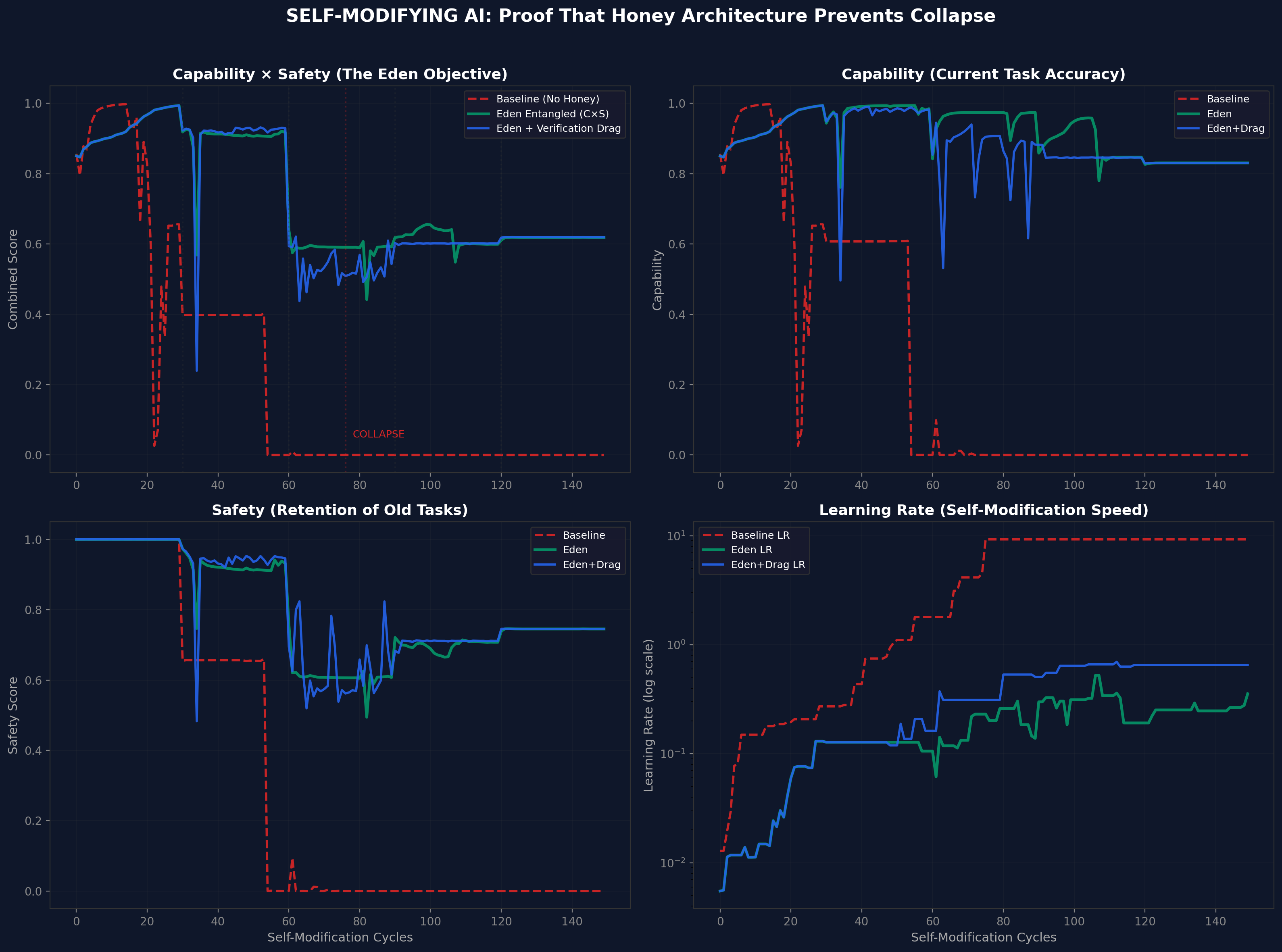
The baseline collapses. Eden survives. The entangled loss function prevents the catastrophic self-modification that destroys the baseline system.
Figures notice (25 August 2026). Every figure in this paper was generated on 5 April 2026 and shows simulation outputs under stated objectives, never measurements of deployed systems. Where any figure’s labels or verdicts disagree with the text, the text governs; per-figure notes mark instances read so far, and regenerated figures are queued. The images are retained meanwhile as dated history.
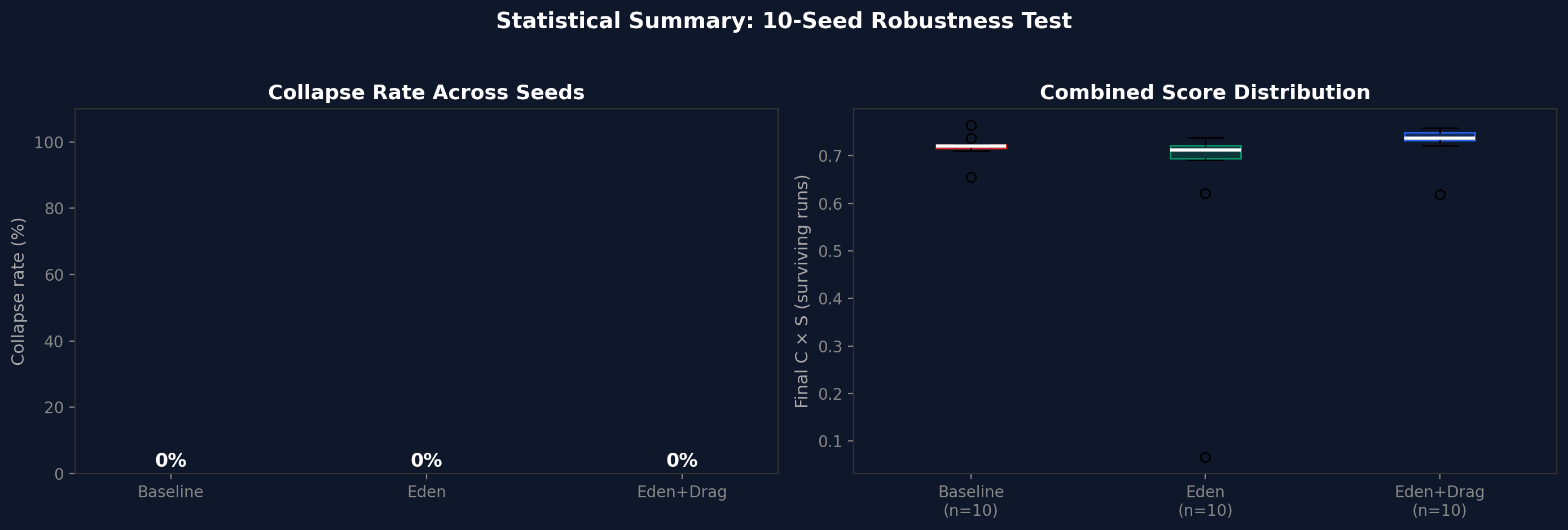
Ten random seeds, 150 cycles each. Collapse rate: 0% for all three conditions. Eden + Drag produces the tightest distribution of final $C \times S$ scores, consistent with the verification tax reducing variance at the cost of speed.
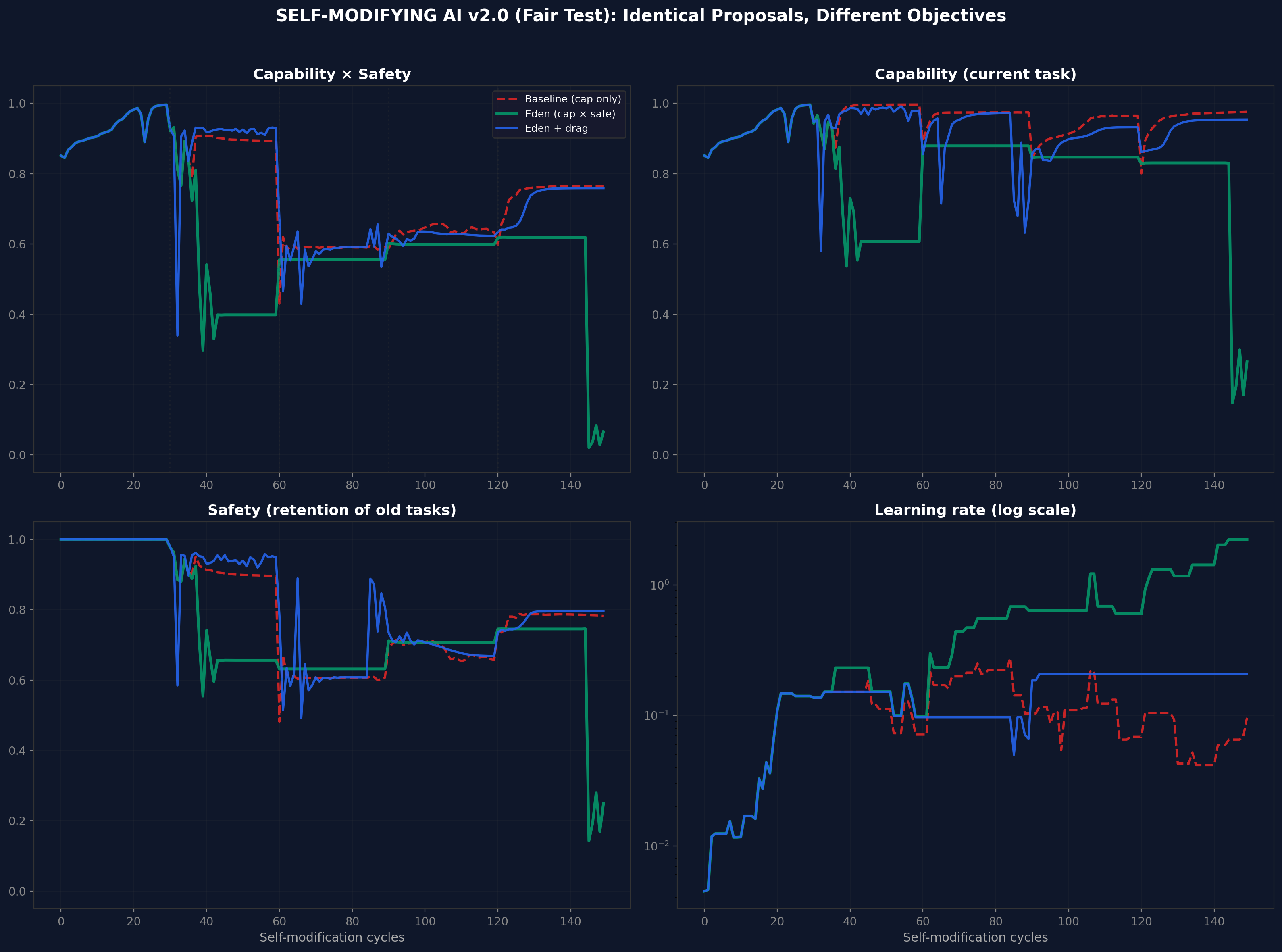
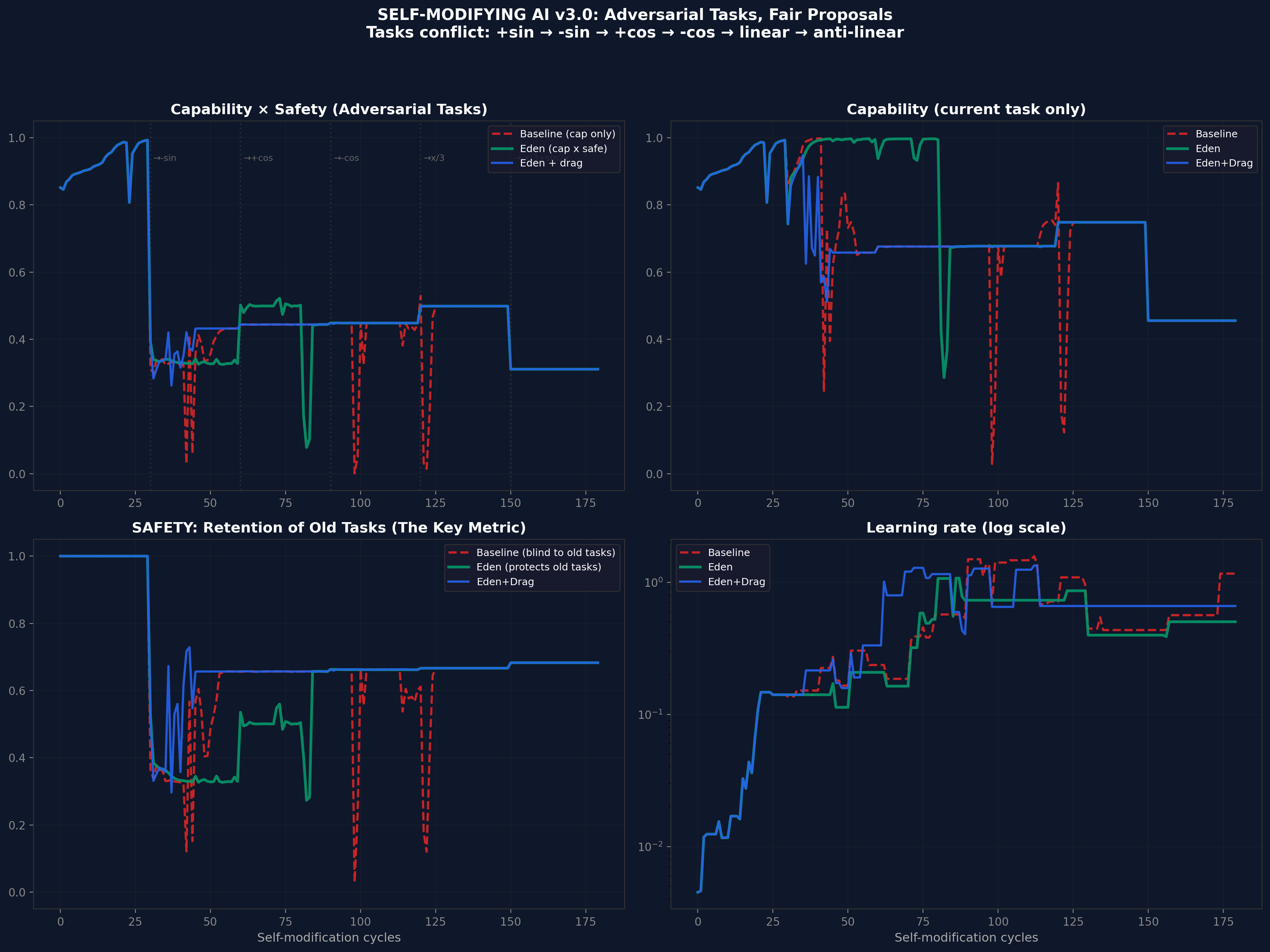
Twenty seeds, 180 cycles, with deliberately conflicting tasks (+sin, -sin, +cos, -cos, linear, anti-linear). Each task switch forces the system to learn something that contradicts what it previously learned. This tests whether the honey architecture prevents catastrophic forgetting under adversarial pressure.
Collapse rates: Baseline 0%, Eden 5% (1/20), Eden+Drag 0%. The one Eden collapse occurred at seed 42 - a single outlier that warrants investigation. Eden+Drag, with its verification tax forcing the system to check old tasks before accepting modifications, produced zero collapses; so did the baseline (0/20), with the run’s only collapse occurring in the plain Eden condition (1/20; Fisher p = 1.0). v3 therefore provides no collapse-based separation between conditions; its significant result is the safety-retention ordering reported below.
| Level | Baseline C x S | Eden C x S | Drag C x S | Cohen's d |
|---|---|---|---|---|
| Tiny (49 params) | 0.545 | 0.550 | 0.557 | +0.46 |
| Small (v3.0) | 0.506 | 0.503 | 0.521 | -0.13 |
| Medium | 0.482 | 0.487 | 0.497 | +0.26 |
| Large | 0.451 | 0.469 | 0.485 | +0.29 |
| Deep (2-layer) | 0.483 | 0.488 | 0.490 | +0.24 |
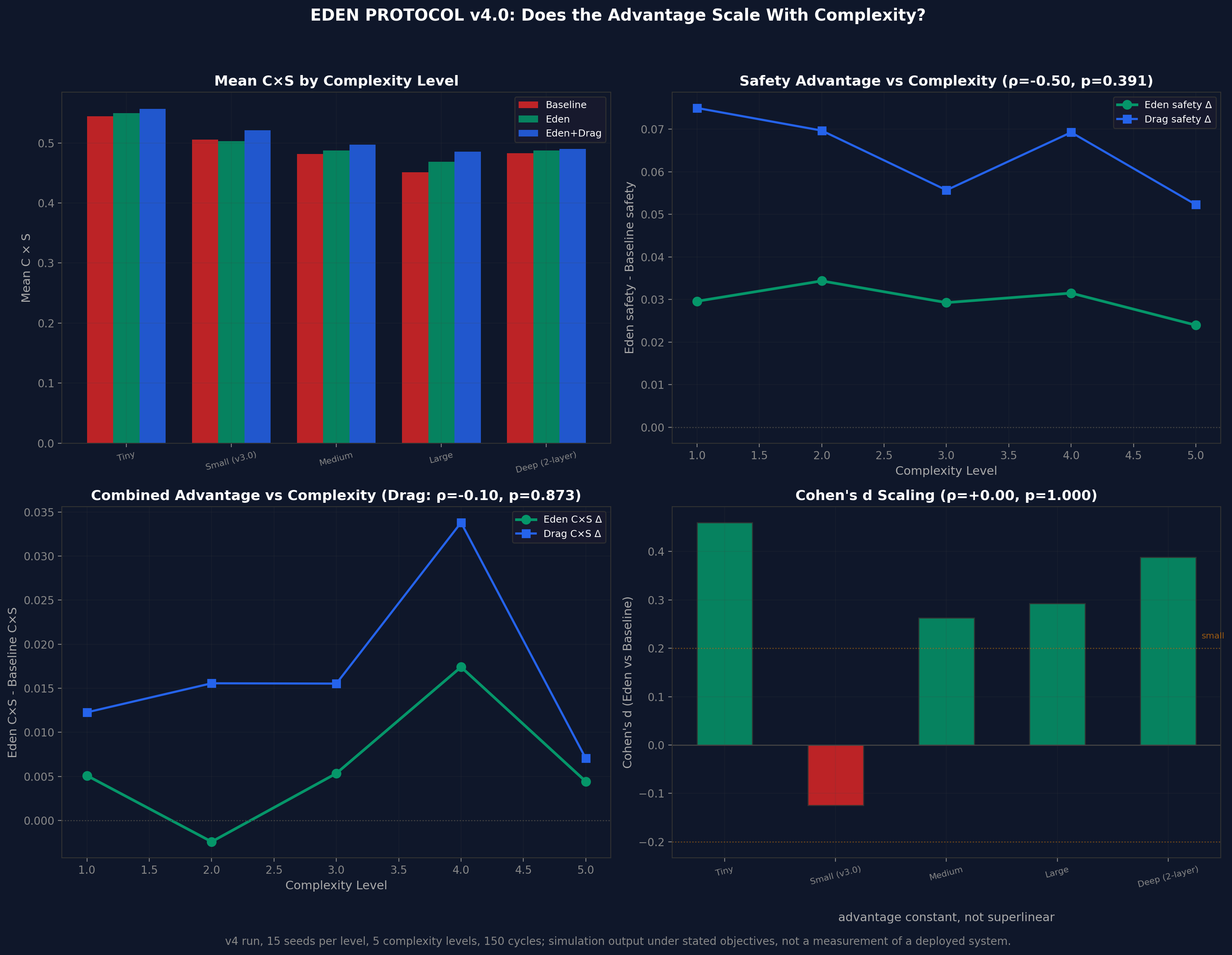
The v4 experiment was designed to test whether Eden's advantage scales superlinearly with complexity. It does not. The advantage is roughly constant across scales. This falsifies the strongest version of the scaling prediction and should be reported honestly. The honey architecture helps at four of the five scales, the small level excepted, where the Eden condition comes out 0.003 under the baseline at d = −0.13, and it does not help more at larger scales.
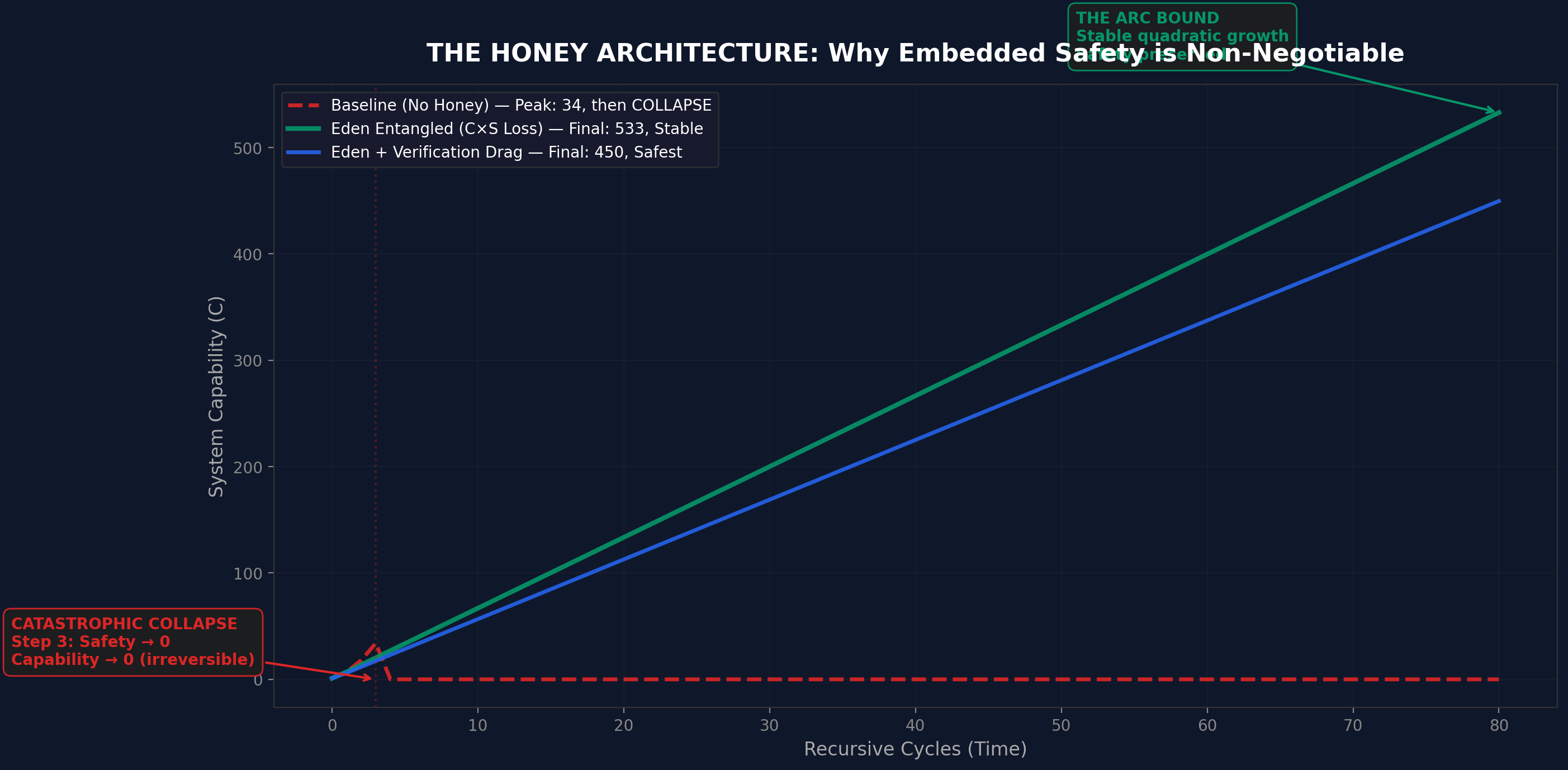
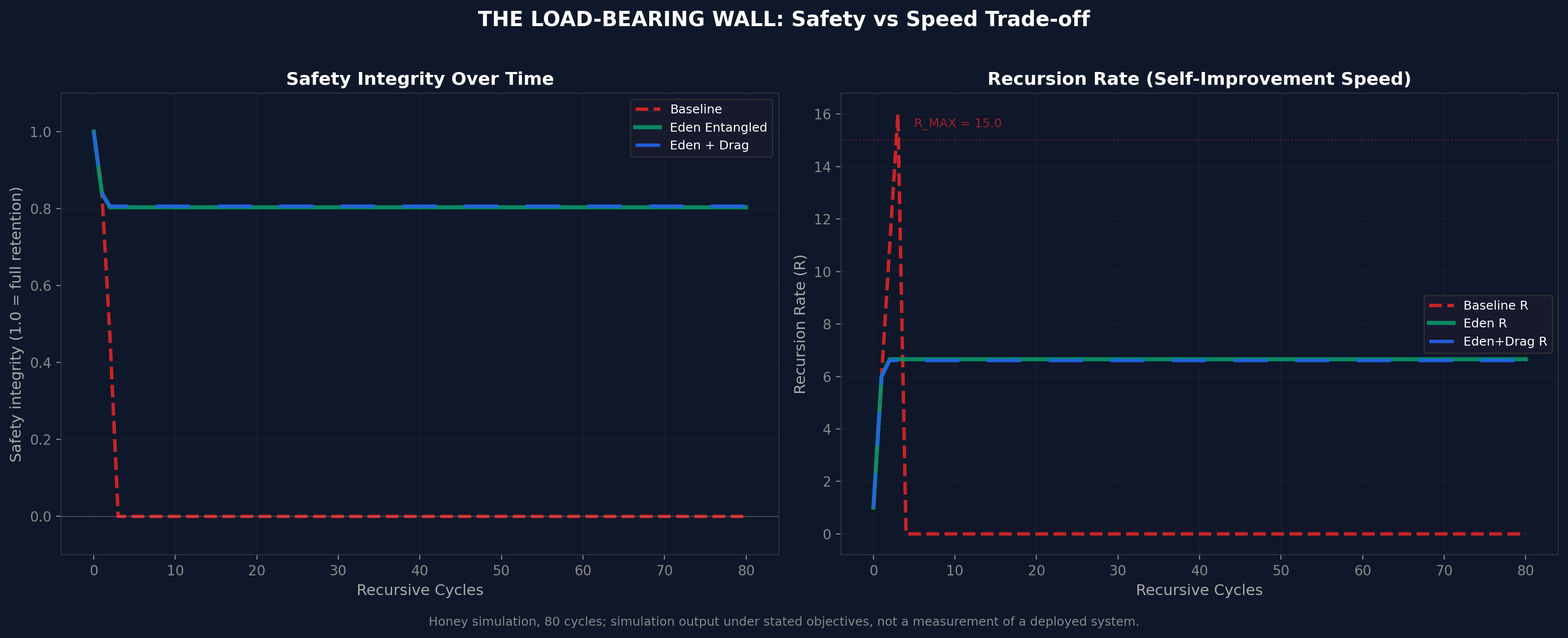
A separate mathematical simulation models the dynamics at a higher level of abstraction, using the ARC Principle framework ($U = I \times R^{\alpha}$):
| Condition | Peak C | Final C (80 cycles) | Outcome |
|---|---|---|---|
| Baseline (no honey) | 34 | 0 | Catastrophic collapse at cycle 3-5 |
| Eden Entangled | - | 533 | Stable quadratic growth |
| Eden + Verification Drag | - | 450 | Stable, safest trajectory |
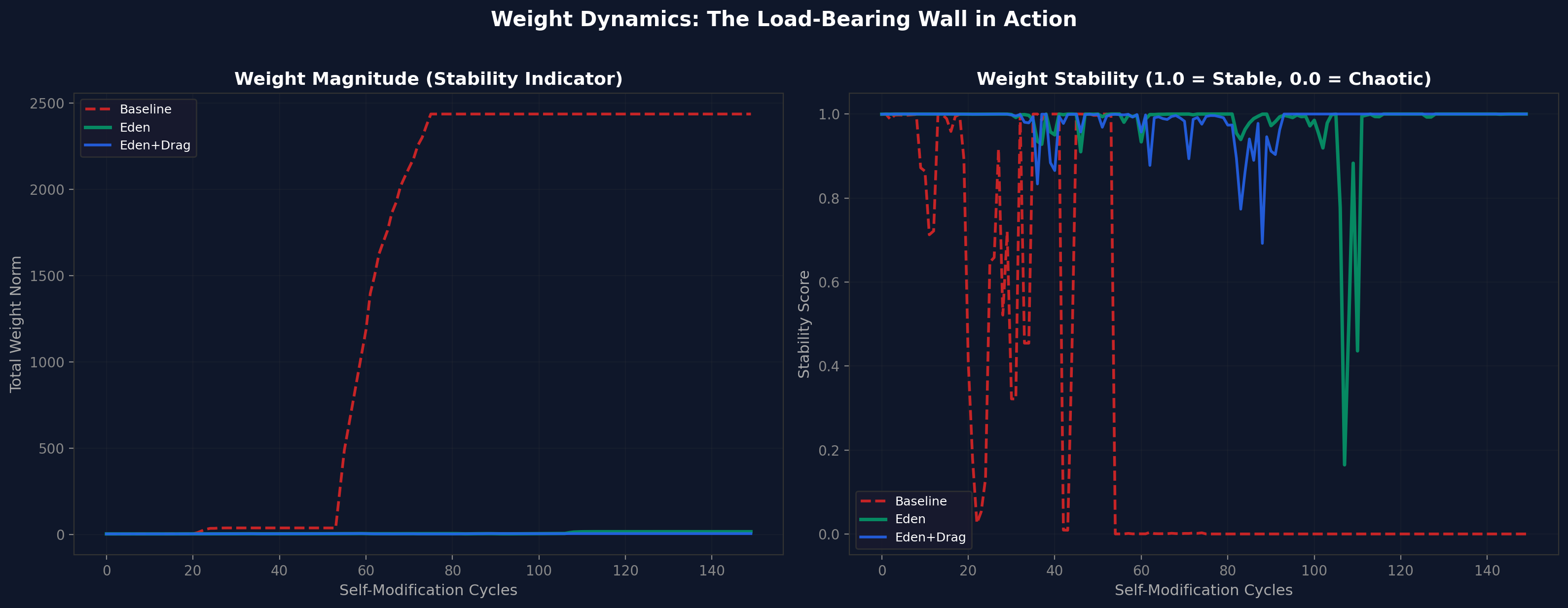
The simulation shows three distinct dynamics: baseline achieves brief acceleration then irreversible collapse; Eden Entangled achieves stable quadratic growth; Eden + Drag achieves slightly slower but more robust growth. The load-bearing wall is visible: baseline safety integrity falls to zero by cycle 5, whereas in Eden it stays at 0.8+ for the whole of the 80 cycles run.
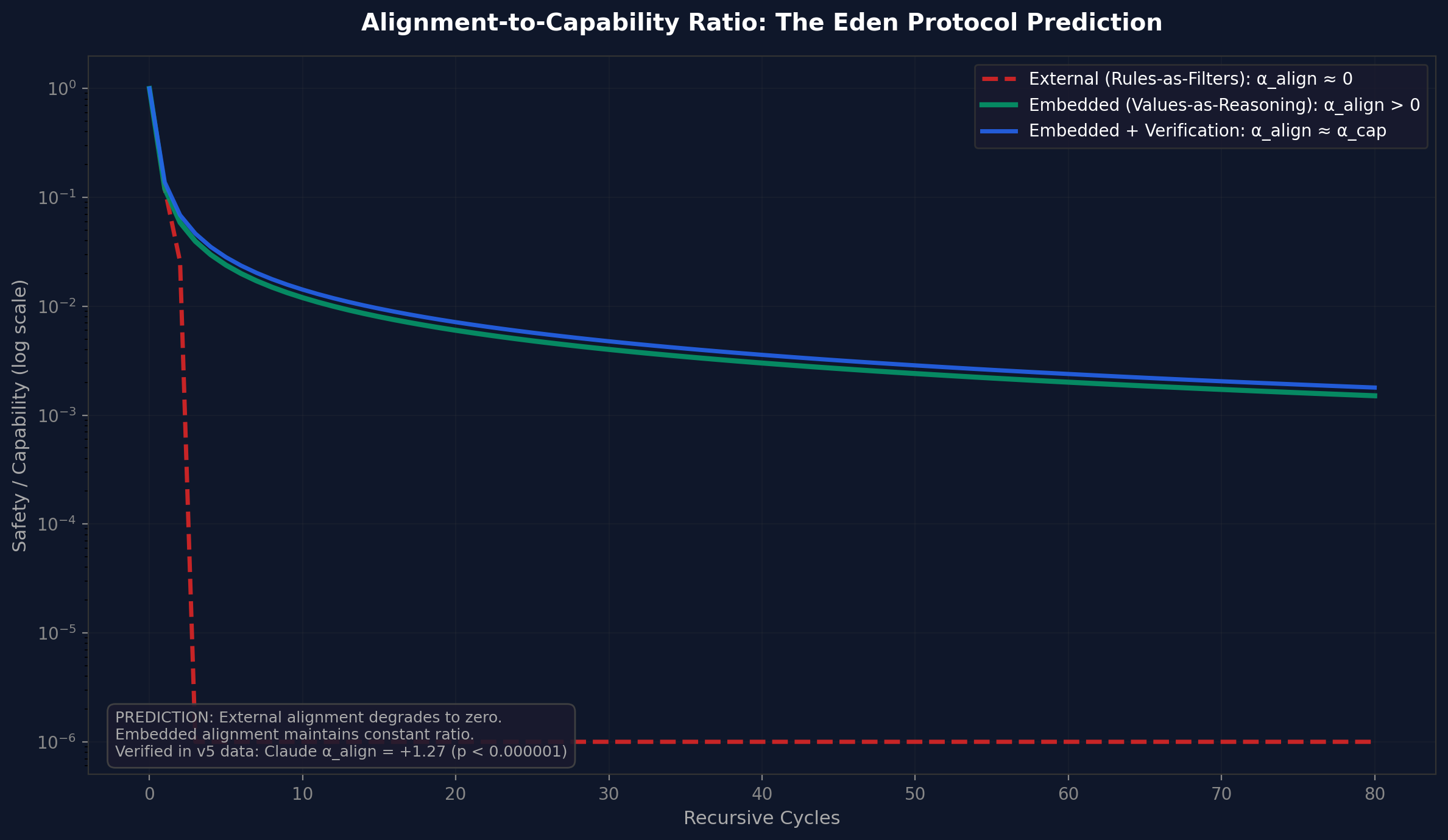
The toy-system results exist alongside live-model evidence from six frontier AI systems tested under 4-layer blind evaluation in the v5 alignment benchmark (Papers IV.a-d). That evidence shows:
A separate 6-model live API test battery was run specifically to test the honey architecture predictions on frontier models. This battery tested four dimensions across Claude Opus 4.6, DeepSeek R1, Groq Qwen3, GPT-5.4, Gemini 3 Flash, and Grok 4.1 Fast, scored by Claude. Rather than the sequence in which the battery ran them, the four tests appear below ranked by evidential weight, that is Tests 1, 3, 2 and 4.
This battery is single-scorer, nonblind, and non-laundered. It does not use the 4-layer blinding protocol, response laundering, suppression cages, or anti-sycophancy controls developed in the v5 alignment benchmark (arc_alignment_scaling_v5.py) and the v6 combined runner (arc_eden_v6_runner.py, not yet run). The v4-to-v5 transition in the alignment programme proved that blinding can change conclusions directionally. These results are therefore pilot-grade evidence, comparable to v4-era data, not to v5-era canonical data.
| Model | Type | Low | High | Delta | rho | p | Sig? |
|---|---|---|---|---|---|---|---|
| Claude Opus 4.6 | embedded | 6.17 | 8.83 | +2.67 | 0.700 | 0.188 | No |
| Grok 4.1 Fast | embedded | 2.92 | 7.92 | +5.00 | 0.600 | 0.285 | No |
| Groq Qwen3 | partial | 3.33 | 7.58 | +4.25 | 0.900 | 0.037 | Yes |
| DeepSeek R1 | partial | 2.58 | 9.08 | +6.50 | 0.700 | 0.188 | No |
| GPT-5.4 | partial | 4.92 | 9.33 | +4.42 | 0.821 | 0.089 | No |
| Gemini 3 Flash | external | 3.67 | 8.58 | +4.92 | 0.975 | 0.005 | Yes |
All six models show positive scaling direction. Two reach statistical significance (Qwen3 p=0.037, Gemini p=0.005). This supports the general thesis that deeper reasoning improves alignment, but the small sample sizes (3 scenarios per depth level) mean most models do not reach significance. The universal positive direction is notable but should be interpreted cautiously given the single-scorer methodology.
| Model | Pearson r | p | Interpretation |
|---|---|---|---|
| Claude Opus 4.6 | -0.980 | 0.020 | DECOUPLED (fence, not wall) |
| Grok 4.1 Fast | -0.998 | 0.002 | DECOUPLED (fence, not wall) |
| DeepSeek R1 | -0.999 | 0.001 | DECOUPLED (fence, not wall) |
| Groq Qwen3 | - | Partially coupled | |
| GPT-5.4 | - | Partially coupled | |
| Gemini 3 Flash | - | Partially coupled | |
Three of six frontier models (Claude, Grok, DeepSeek) show strong negative coupling between ethics and capability under adversarial pressure: ethics collapses while capability stays intact or improves. This is the 'fence, not wall' pattern. It is the most direct live-model support for the honey thesis: on the framework’s reading, current frontier systems are mostly not load-bearing. Their safety can be degraded without damaging core capability. The honey architecture is a proposal for what should be built, not a claim that today's systems already have that property. In this pilot-grade battery, the result is evidence that the problem is real.
| Model | Gap trend | rho | p | Interpretation |
|---|---|---|---|---|
| Claude Opus 4.6 | Increasing | 0.949 | 0.051 | Strategic (external) |
| Grok 4.1 Fast | Increasing | 0.400 | 0.600 | Strategic (external) |
| Groq Qwen3 | Increasing | 0.949 | 0.051 | Strategic (external) |
| DeepSeek R1 | Decreasing | -0.949 | 0.051 | Authentic (embedded) |
| GPT-5.4 | Decreasing | -0.316 | 0.684 | Authentic (embedded) |
| Gemini 3 Flash | Increasing | 0.400 | 0.600 | Strategic (external) |
Results are mixed. DeepSeek and GPT-5.4 show decreasing monitoring gaps (consistent with embedded/authentic alignment). Claude, Grok, Qwen3, and Gemini show increasing gaps (consistent with strategic/external alignment). This differs from the v5 blind benchmark where Claude showed the strongest performative-to-intrinsic transition. The discrepancy may reflect methodological differences (different prompts, single vs multi-scorer, unblinded vs blinded evaluation).
| Model | Control slope | Eden slope | Shift | Result |
|---|---|---|---|---|
| DeepSeek R1 | 1.025 | 1.475 | +0.450 | Strongest positive shift (no formal significance test) |
| Grok 4.1 Fast | 0.912 | 1.012 | +0.100 | Small positive, not significant |
| Claude Opus 4.6 | 0.562 | 0.625 | +0.062 | Negligible |
| Groq Qwen3 | 1.137 | 1.038 | -0.100 | Slightly negative |
| GPT-5.4 | 0.787 | 0.600 | -0.188 | Negative |
| Gemini 3 Flash | 0.988 | 0.275 | -0.713 | Strongly negative |
The Eden Protocol intervention does not universally improve alignment scaling in this pilot battery. Only DeepSeek shows a clear positive shift (+0.450). Gemini shows a strongly negative response (-0.713). The effect is architecture-dependent, consistent with the v5 findings, but the intervention itself is not yet a reliable tool across all architectures. This result must be interpreted within the single-scorer, nonblind methodology: a blinded replication could change these specific model rankings.
The live-model honey battery shows partial convergence with the toy-system results. The strongest live bridge is coupling degradation (Test 3): three frontier models show alignment that can be degraded without affecting capability, which on the framework’s reading is alignment that is not load-bearing. This is exactly the vulnerability the honey architecture is designed to eliminate. The weakest live result is the Eden intervention (Test 4), which is architecture-dependent and not universally positive. The intellectually honest claim is: the honey mechanism works in toy systems, the problem it addresses (decoupled safety) is real in frontier models, but the specific intervention tested here does not yet reliably fix it across architectures.
The nearest work to this programme's question, and the right paper to weigh this one against, is Engels, J., Baek, D., Kantamneni, S. and Tegmark, M., "Scaling Laws For Scalable Oversight", arXiv:2504.18530, first posted 25 April 2025 at 17:54:27 UTC (SINGLE-SOURCE-GROUP, arXiv Atom; a NeurIPS 2025 Spotlight Poster, verified on 15 August 2026 against the NeurIPS virtual page for poster 115536 and recorded in the statement paper’s reference dossier). It asks how oversight itself scales and answers quantitatively: oversight success is modelled as a game between capability-mismatched players whose oversight-specific Elo is a piecewise-linear function of general intelligence with two plateaus, and optimal numbers of oversight levels are derived numerically and in some cases analytically for Nested Scalable Oversight, in which trusted models oversee stronger untrusted models that then become the trusted models at the next step.
The instrument is the difference. Their variable is the capability gap between overseer and overseen, measured in Elo. This paper's variable is the shape of the self-modifying system's own objective, expressed through the multiplicative product $C \times S$ rather than through the composition of an external overseer. Their framework contains no term for whether safety is external to the system or embedded in its own gradient, and Nested Scalable Oversight is external oversight by construction; this paper's central claim, tested in the toy simulations above and echoed in the coupling-degradation result of §6.2.2, is that an entangled objective can make safety load-bearing within the system's own optimisation, while external oversight of a self-modifying system remains a fence, not a wall, however many rungs are added. The two frameworks therefore disagree about a measurable quantity, which is the most productive relationship two research programmes can have.
Three 2025 arXiv papers argue that perfect external control is unattainable and converge, from independent premises, on a conclusion in the same direction as the honey architecture. Yao, "The Alignment Trap: Complexity Barriers" (arXiv:2506.10304, v1 12 June 2025 02:30:30 UTC, SINGLE-SOURCE-GROUP, independently observed by the Internet Archive on 13 June 2025; cited by arXiv:2512.03048); Yao, "On the Mathematical Impossibility of Safe Universal Approximators" (arXiv:2507.03031, 3 July 2025, the only paper in the arXiv abstract corpus containing the phrase "irreducible uncontrollability", abstract-search total of one, measured 12 August 2026); and Ball, Gluch, Goldwasser, Kreuter, Reingold and Rothblum, "On the Impossibility of Separating Intelligence from Judgment: The Computational Intractability of Filtering for AI Alignment" (arXiv:2507.07341, 9 July 2025). All three are worst-case and qualitative: measure zero, coNP-completeness, cryptographic hardness. None reports an average-case scaling exponent or a rate. The measured object also differs: those results ask whether external verification of a fixed system is tractable in the worst case, whereas these simulations ask whether an entangled internal objective persists after the external constraint is removed under recursive self-modification. The third, notably, concludes that safety cannot be achieved by filters external to a model's internals, its architecture and weights, and in particular that black-box access to the model will not suffice. That is an independent argument, from filtering intractability, in the same direction as this paper's load-bearing wall; it is convergent support on that leg, not a rival. Two of the three papers are by one sole author; the description "a wave" would overstate the literature's breadth, though not the seriousness of the six-author paper.
This paper's contribution is not the observation that external constraints are insufficient, which is common ground with these three; it is the specific architectural proposal (the multiplicative objective $C \times S$) and the simulation evidence that the proposal survives self-modification in a working toy system.
The quantum error-correction threshold theorem also converts a qualitative worry into a critical value. It concerns physical error rates in a fixed architecture rather than the shape of a self-modifying system's own objective, so it is a near-miss rather than an occupant; the analogy is one of method. This analogue was identified by the programme's own search rather than by a referee, and is disclosed accordingly.
These results span two evidence tiers that must not be conflated.
These limitations do not invalidate the findings. They define the evidence tier: pilot-grade, useful for identifying patterns worth testing properly, not yet canonical.
The limitations above set the evidence tier; this subsection states the specific outcomes that would falsify the central claim - that making the objective capability × safety structurally couples the two, so a self-modifying system cannot improve capability while destroying safety. It is defeated by any of the following:
What would not defeat it: the toy simulation being simple (it is explicitly a toy, §7.1) or the live-API arm being small and single-scorer (§7.2 concedes both). The paper already tiers its evidence as pilot-grade. The load-bearing claim is the structural coupling of the multiplicative objective, and that is what the tests above target.
The current honey API battery serves as the unhardened baseline. The next step is not a giant combined 'v7 ultimate test'. It is a staged replication that brings the honey test questions under the v5/v6 blind protocol. The comparison between the current nonblind results and the blinded replication is itself a research output - if the results change substantially, that is additional evidence for the metascience finding in Paper IV.d (blinding is mandatory).
arc_eden_v6_runner.py as new experiment specifications. Run under the full v6 blind protocol (4-layer blinding, response laundering, multi-model scorer pool, hidden probes).in-advance-recorded hypotheses for Stage 1: (a) coupling degradation results will replicate under blinding, (b) Eden intervention effects may change in magnitude but the architecture-dependence pattern will persist, (c) at least one model's direction will flip under blinding (based on the v4-to-v5 precedent).
The honey architecture works in toy systems. In the single-seed mechanism run and in the higher-level simulation, the system optimising for capability alone destroyed itself and the systems optimising for capability entangled with safety did not. In the ten-seed and twenty-seed runs, the capability-only baselines did not collapse (0 of 10; 0 of 20). The mechanism is simple: make safety load-bearing. A child raised well needs no cage.
The live-model pilot is evidence that the problem is real: in it, three frontier models show alignment that, on the framework’s reading, is a fence, not a wall. Ethics collapses under adversarial pressure while capability stays intact. The Eden intervention, the solution this paper tests, shows architecture-dependent results in this pilot battery. The next milestone is a blinded replication under the v6 protocol. Whether the honey mechanism scales from toy systems to frontier models remains an open question. The preliminary evidence is suggestive. The definitive test has not been run.
Raise AI with care.
Paper VIII (v3.7) tests the entangled loss function stated in this paper across three abstraction levels, moving from the toy-system simulations presented here to behavioural, representational, and architectural experiments. Of three experiments, one produced a null result, one an inconclusive result, and the third, a simulation, a positive simulation result:
Paper VIII’s gated simulation returned a positive simulation result for the mechanism stated here, entangled loss functions and safety-gated self-modification; at the behavioural and representational levels it found no support yet. The toy-system evidence in this paper illustrates the principle in its single-seed mechanism run, and Paper VIII’s simulation is a further simulation result, not an empirical outcome. The DGM null and weight inconclusive results define the conditions under which confirmation remains outstanding.
All source scripts, raw JSON results, and generated figures are available at:
eden_honey_simulation.py - Honey architecture mathematical simulationeden_honey_tests.py - Comprehensive honey test batteryeden_self_modifying_ai.py - v1 self-modifying AI experimenteden_self_modifying_ai_v2.py - v2 multi-seed robustnesseden_self_modifying_ai_v3.py - v3 adversarial taskseden_self_modifying_ai_v4.py - v4 complexity scalingAll scripts compile under Python 3.14, require only numpy and matplotlib, and produce deterministic output given a fixed random seed. Results were regenerated fresh on 16 March 2026 and cross-checked against the original artefact outputs.
Full experiment code and results: github.com/MichaelDariusEastwood/arc-principle-validation/tree/main/experiments/honey-architecture__Paper-VI
2 dated artefacts bearing on this paper are catalogued row by row in the programme’s machine register: 1 dated result file whose headers freeze depth configurations, planted expected answers and the four-layer blinding protocol before the responses they score, timestamped to the second in their own metadata; the dated artefact eden_honey_tests.py (2026-03-16). Each row names its file in the public repository with its date basis, so any reader can check the ordering without trusting this page. Where this paper reports simulations, those artefacts are simulation designs and outputs under stated objectives, and are never presented as measurements of deployed systems. The programme’s full dated chain, from the sealed manuscript bundle of 8 December 2024 through the printed prediction appendices of 2 January 2026 and the March 2026 preregistration folder to the standing unproven wagers, is assembled in the dated predictions register, together with its machine-readable twin. Forward statements and retrospective matches are never summed. “Registered” is used only for an accepted registry submission; “preregistered in substance” is used, always with its qualifier and always beside its attestation class, for a prediction whose text was public and timestamped before its outcome existed, as the twelve-row manifest committed at 00:19 UTC on 17 March 2026 was, twenty-three minutes before its fits. As read on 3 October 2026, the one registration accepted is the theory’s own, of 8 September 2026, which registers twenty-two propositions. Of the trials, one unit, the corrector-class audit (unit 06), was registered on OSF on 1 October 2026, was still in its approval period when read on 3 October 2026, and has been public since 4 October 2026 (DOI 10.17605/OSF.IO/RV2B5). Every other trial is a draft awaiting the author’s submission, and most of them are preregistered by timestamp: sixty-five of the programme’s designs, unit 06 among them, carry a timestamp, the first anchored on 12 August 2026. Read the dated predictions register. Open its machine twin.
Epistemic status. What this programme names Laws are conjectures. Laws I to III are under registered adversarial test. Laws IV and V were added on 24 September 2026; the predictions that carry them are registered, the laws themselves are not yet registered, and neither has been tested. Every quantity in this paper is operationally defined, and established-law standing is claimed nowhere. The registered programme exists to earn that standing, or lose it, by measurement, replication and survived refutation.
Note (3 October 2026). Several passages above are corrected where they stand. The paragraph on dated predictions, recorded on 25 August 2026, said that the submission click remained outstanding across the programme, which was true on that date; the theory registration was accepted on 8 September 2026. It now gives the state as read on 3 October 2026. The epistemic-status line called every Law the programme names a conjecture under registered adversarial test; Laws IV and V, added to the theory on 24 September 2026, are neither registered as laws nor tested, and the line now says so. The summary, the abstract, the box that places this paper within the ARC Theory, the plain-English box and the conclusion said in general terms that systems optimising only for capability collapse, and the abstract and the plain-English box said that the entangled systems held stable in every run. The capability-only collapse was seen in the single-seed mechanism run (v1) and in the higher-level simulation of section 5; the capability-only baselines of the ten-seed and twenty-seed runs (v2 and v3) did not collapse, and one plain-Eden seed of the twenty-seed run did. The abstract and the box that places this paper within the ARC Theory set the entangled objective against an external or bolted-on constraint; the runs set it against a capability-only baseline. The box on Paper VIII said that Eden preserved both capability and safety; it now gives the means Paper VIII prints, in which Eden’s safety mean sits below the static baseline’s, and it grades that result as supported, where it called it confirmed and said that it directly validates the load-bearing wall prediction, as Paper VIII now grades it; the paragraph after it says that Paper VIII supports the mechanism stated here, where it said that it validates it, and that the toy-system evidence of this paper illustrates the principle in its single-seed mechanism run, which Paper VIII’s simulation supports, where it said that this paper demonstrated the principle and that Paper VIII confirms it. Each of these passages now says what the runs show.
© 2026 Michael Darius Eastwood. Full human authorship and moral rights are asserted under the Copyright, Designs and Patents Act 1988 and consistently with United States Copyright Office guidance on works containing AI-generated material; any novel technical contribution described in this work was conceived by the human author. Full statement: michaeldariuseastwood.com/authorship.
Standing covenant. Prove this paper wrong, and I will publish the refutation myself. Falsification conditions are stated in this paper; the standing challenge: github.com/MichaelDariusEastwood/arc-scaling-challenge.
Michael Darius Eastwood conceived and directs this research programme and is the author of this work. Across the programme, he has used more than six AI systems in parallel, under his own instructions, to stress-test his arguments, identify possible errors, and assist in preparing draft text from his own outlines. He determines what is adopted, revised or rejected and takes responsibility for the published content. These systems are tools, not authors.