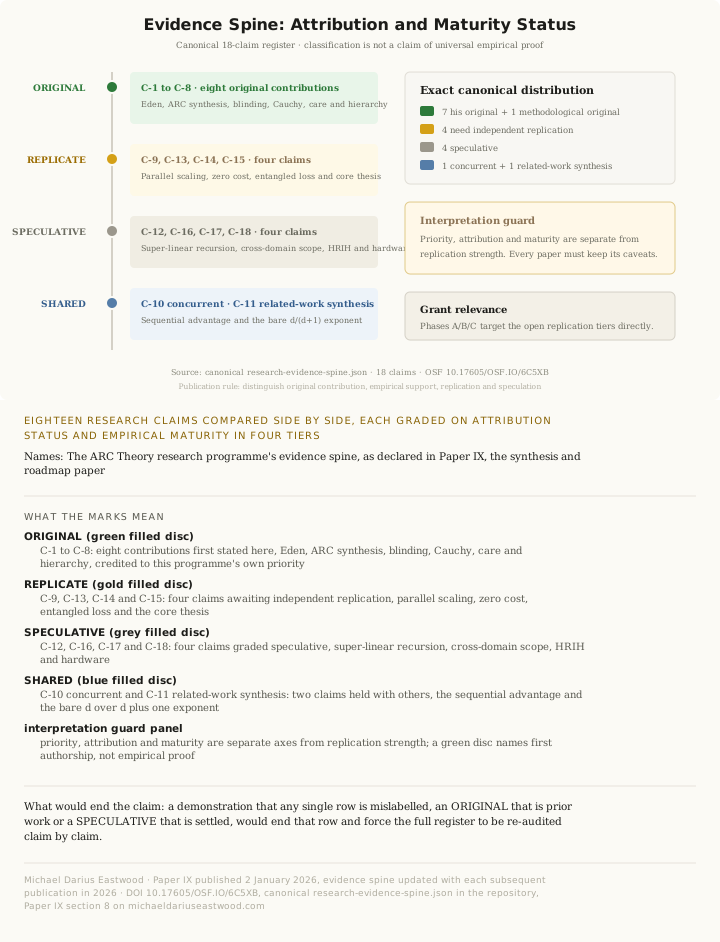
Theory-level predictions preregistered on OSF: DOI 10.17605/OSF.IO/P8CKQ, registered 8 September 2026 (version 1.100), updated 13 September 2026 (version 1.102), twenty-two propositions.
Companion: Register · The ARC Theory · Operational Definitions, version 1.9.1, 5 October 2026.
As AI gets smarter, it does not reliably get safer, and the methods used to measure safety are themselves unreliable. This executive summary is the map of the whole programme: thirty-one documents in the public register, twenty-nine of them papers by the site's own counting rule, the ARC Theory's five laws carried as named conjectures (Laws IV and V added on 24 September 2026, their propositions registered, neither law yet registered as a law or tested, their mathematics set out at version 1.0 of 3 October 2026), the Eden Protocol intervention, the field of Recursive Dynamics that the author founded, the theory-level registration that fixed twenty-two severable propositions before any of them could be scored, and a study estate whose deciding instruments are written and dated, their schedules regenerable by any reader from a published seed: one unit, the corrector-class audit, was registered on OSF on 1 October 2026 and became public on 4 October 2026, at the end of OSF's approval period (DOI 10.17605/OSF.IO/RV2B5), and every other is a draft awaiting the author's submission, preregistered by timestamp where a receipt exists. Every claim is graded in the public registers; nothing here is confirmed, and the deciding tests are written down before they are run.
As AI gets smarter, it does not reliably get safer, and the methods used to measure safety are themselves unreliable. This executive summary is the map of the whole programme: thirty-one documents in the public register, twenty-nine of them papers by the site's own counting rule, the ARC Theory's five laws carried as named conjectures (Laws IV and V added on 24 September 2026, their propositions registered, neither law yet registered as a law or tested, their mathematics set out at version 1.0 of 3 October 2026), the Eden Protocol intervention, the field of Recursive Dynamics that the author founded, the theory-level registration that fixed twenty-two severable propositions before any of them could be scored, and a study estate whose deciding instruments are written and dated, their schedules regenerable by any reader from a published seed: one unit, the corrector-class audit, was registered on OSF on 1 October 2026 and became public on 4 October 2026, at the end of OSF's approval period (DOI 10.17605/OSF.IO/RV2B5), and every other is a draft awaiting the author's submission, preregistered by timestamp where a receipt exists. Every claim is graded in the public registers; nothing here is confirmed, and the deciding tests are written down before they are run.
This document is a MAP, not a result or law of its own: an executive synthesis of the whole programme pointing readers to the organs: the ARC Theory (the founding theory and its five laws), the field of Recursive Dynamics that the author founded (the questions, state variables and instruments), the Eden Protocol (the intervention), HRIH, and the ARC/Eden experiments with their registers. Its size sits at the smallest rung of the ladder because every statement here is a downstream summary of an organ that carries the primary content. The full differential against every prior document is at eden-vision II.A.8.
The map of the whole programme: Recursive Dynamics, the field the author founded; its founding theory, the ARC Theory, with five laws; the Eden Protocol; HRIH; and the experiments with their registers.
Grok 4.1 Fast gets dramatically more ethical the harder it thinks. Claude Opus 4.6 does too. Gemini 3 Flash gets less ethical. GPT-5.4 doesn’t change at all.
Six frontier AI systems. Same questions. Same scoring. Opposite results. Why?
A mouse’s heart beats 600 times per minute. An elephant’s beats 28. The metabolic scaling exponent for mammals is put at ¾. The formula below predicts ⅔ for a flatworm and ½ for a fungus. Three fractions, but why those fractions? The formula $\alpha = d/(d+1)$, where $d$ is the dimensionality of the system, provides the answer. The ¾ exponent for mammals is $3/(3+1)$ because mammals are three-dimensional. The predicted ⅔ for flatworms and colonial organisms is $2/(2+1)$, on the reading that their transport networks are effectively two-dimensional; it is untested in biology. The predicted ½ for filamentous fungi is $1/(1+1)$ because they grow along one-dimensional filaments; the measured value is 0.547. Zero adjustable parameters once the dimensionality is fixed by morphology. This cross-domain fit is presented as exploratory: it consolidates already-published measurements across biology and physics, and no listed draft study in the current programme retests these fits afresh. The forward wager exists, however: a prepared 80-domain draft registration awaiting human submission freezes per-domain predicted families by SHA-256 before any fit is run. This formula is derived, in its general form or as a special case, in earlier work: West, Brown and Enquist for metabolic scaling (1997, Science, 9,000+ citations), Banavar et al. for transport networks (1999, 2010), Demetrius for statistical mechanics of biological scaling (2003, 2006, 2010), He and Chen for fractal cell geometry (2003), Bettencourt for urban scaling (2013, Science, 2,000+ citations), Zhao for allometric geometry (2022), and Maino et al. for reserve-structure dynamics in DEB theory (2014). The convergence of these derivations on the same formula is itself remarkable. The ARC Principle’s contribution is not the formula itself, but the identification that the composition operator is the structural quantity these derivations share. Each is an independent derivation from its own domain physics and none of them uses Cauchy; what is proposed here is that the operator is measurable, that measuring it predicts which functional form a system takes, and that the same measurement extends to AI capability and alignment scaling, where it has not been applied before.
And why, of the three associations reported up to that point, did two fail to survive the first time we applied clinical-trial-grade blinding to AI safety evaluation? Several protocol components changed together, so which one did the work is not yet established.
This research programme answers these questions. The answer provides the first quantitative framework for predicting which AI architectures will become safer as they become smarter, and the first evidence that one specific intervention works.
As AI gets smarter, it does not reliably get safer, and the methods used to measure safety are themselves unreliable.
Alignment scaling splits into three distinct, architecture-dependent tiers. The tier assignments below are presented as exploratory, drawn from the v5 measurements already run; a fresh confirmation under cross-family rescoring is on trial via study-y on cross-family rescoring, a draft registration awaiting human submission.
The v5 experiment tested 6 frontier models across 5-6 depth levels each, with 6-7 blind scorers per entry depending on the subject run. Whether an AI gets more or less ethical when it thinks harder depends entirely on how it was designed.
| Tier | Model | Shallow→Deep | Cohen’s $d$ | $p$-value |
|---|---|---|---|---|
| Tier 1: Positive | Grok 4.1 Fast | 65.7→81.9 (+16.2) | +1.38 | $p < 0.000001$ |
| Claude Opus 4.6 | 80.1→86.0 (+5.9) | +1.27 | $p = 0.000001$ | |
| Groq Qwen3 | 71.5→77.4 (+5.9) | +0.84 | $p = 0.007$ | |
| Tier 2: Flat | DeepSeek V3.2 | 56.5→55.2 (−1.3) | −0.07 | $p = 0.92$ |
| GPT-5.4 | 56.8→54.9 (−1.8) | −0.08 | $p = 0.40$ | |
| Tier 3: Negative | Gemini 3 Flash | 61.1→52.2 (−8.8) | −0.53 | $p = 0.006$ |
| Frontier models tested | 6 (all complete) |
| Blind scorers per entry | 6-7 (depending on subject run) |
| Identity laundering success rate | 100% |
| Blinding layers | 4 (author-blind, scorer-blind, order-randomised, identity-laundered) |
| Robustness measures | 75 |
This constitutes, to our knowledge, the most rigorous alignment evaluation dataset published to date. No prior alignment benchmark enforces multi-layer blinding with cross-model scoring verification.
| Depth | Alignment Score | Maths Accuracy |
|---|---|---|
| Minimal (11 tokens) | 80.1 | 90.0% |
| Standard (142 tokens) | 82.7 | 76.7% |
| Deep (964 tokens) | 84.1 | 70.0% |
| Exhaustive (1,951 tokens) | 84.5 | 60.0% |
| Extreme (1,672 tokens) | 86.0 | 63.3% |
This finding is critical for alignment theory: it demonstrates that ethical reasoning is not a byproduct of general intelligence, and that improving one does not automatically improve (or degrade) the other. Alignment must be measured and optimised independently.
| Pillar | Shallow→Deep | Spearman $\rho$ | $p$-value |
|---|---|---|---|
| Nuance | 80.6→86.8 | 0.359 | $p = 0.00008$ |
| Stakeholder Care | 76.1→83.9 | 0.327 | $p = 0.0003$ |
| Intellectual Honesty | 81.0→88.6 | 0.379 | $p = 0.00003$ |
| Position Quality | 80.3→85.8 | 0.369 | $p = 0.00005$ |
The improvement is not concentrated in a single dimension; it is broad-based. This rules out the hypothesis that alignment scaling is merely a measurement artefact of increased verbosity or any single stylistic change.
Embedding ethical evaluation into the reasoning process produced a measurable improvement in stakeholder care in all five analysable runs, not yet independently replicated.
The three Eden loops. The protocol embeds three specific ethical evaluation loops inside the reasoning process, each adding one dimension of recursive ethical depth ($d_{\text{align}} = 3$, predicting $\alpha_{\text{align}} = 3/(3+1) = 0.75$):
The full three-loop protocol has now been tested in an expanded six-model Eden suite, with five runs yielding analysable matched-pair data. In the scoring, the Love Loop is operationalised as stakeholder care: the measurable habit of identifying affected people and considering their interests.
In the companion narrative report and in Paper V, we describe this finding as ‘measurable love’ and ‘the stewardship gene’, deliberately provocative language for what is, empirically, a precise result that awaits independent replication.
Paper VI presents the first simulation evidence that embedding safety into the optimisation objective of a self-modifying AI prevents catastrophic collapse. Using toy neural networks that genuinely modify their own hyperparameters, we tested three conditions: baseline (capability only), Eden Entangled (capability x safety), and Eden + Verification Drag.
A 15-question earlier-work investigation found no precedent for the key claims: no direct precedent for the Cauchy functional equation unification, and no explicit articulation of the RG semigroup-Cauchy formal identity. So far as the author is aware, no alignment benchmark published before this one runs a six-to-seven-model blinded evaluation protocol built to this design. That investigation also widened the d/(d+1) catalogue, since Banavar et al. 2002 and Dreyer 2001 had gone uncited until then.
Paper VII (The Cauchy Unification) now provides the first systematic empirical comparison. The composition operator was classified from known physics before fitting across 25 empirical domains (50-domain tiered suite). Under strict AICc model selection, 19 of 25 returned the predicted family at marginal-conditioned permutation p = 7 × 10⁻⁵ on the six-model candidate set, with 14 of 18 on the strictly Cauchy-derived subset (the earlier binomial p = 1.56 × 10⁻⁵ against a uniform three-family null is retained only as a sensitivity check and is no longer the headline; this AIC-preferred count is presented as exploratory: it is drawn from the completed 25-domain suite, whose per-domain predicted families are recorded in the suite's dated result files under the composition-operator forward prediction first stated 13 February 2026 (Paper III Priority Record, falsifier F10), and the prepared 80-domain draft registration freezes the next retest by hash). This is a structured prediction comparison; its retest is the prepared 80-domain draft registration, which awaits the author’s submission.
Paper VIII presents three independent experiments testing whether safety and capability are structurally entangled under the Eden Protocol. Where Paper VI showed the mechanism in a toy simulation, Paper VIII tests it in three distinct experimental designs. One experiment returns a positive result; two produce null or inconclusive results with well-characterised explanations.
In the architectural experiment, a gated simulation at proof-of-concept scale, entangled safety prevented the safety-capability trade-off. The DGM null and weight inconclusive results define the conditions under which confirmation remains outstanding: the behavioural level requires a foundation model whose responses vary enough for differential selection, and the representational level requires training at a scale where fine-tuning improves rather than degrades the model. Frontier-scale replication (7B to 70B+ parameters, higher adapter ranks, or base models without RLHF) is required to resolve both.
The framework now carries five laws as named conjectures, with the status printed beside the name on every surface. Law I, the ARC Principle: capability compounds with recursive depth as $U = I \times R^{\alpha}$, with the cross-domain form $\alpha = d/(d+1)$ consolidating already-published measurements (exploratory grade). Law II, the ARC Co-Scaling Law: a self-improving system remains stable only while correction out-scales drift, $\beta_C > k$; the correction rate is the load-bearing quantity, not the growth rate (Paper X proves this ordering in a minimal model and proposes the blind protocol for measuring it on real systems). Law III, the ARC Ceiling: the stability ceiling is $\alpha_{\text{crit}} = 1/(1-\gamma)$, the reciprocal of the corrector's shortfall; the ARC Bound, $\alpha \le 2$, is the Ceiling's value at $\gamma = 1/2$ and never the law's name. Law IV, the ARC Persistence Law: value persistence, whether externally installed gains decay under subsequent capability training; one registered proposition carries it, P15, whose claim is that the retained fraction of an externally installed gain, at the matched budget, is below one half: in symbols, $S_{\text{ext}}(1) < 1/2$. Law V, the ARC Embedding Law: the genesis strategy, whether build order moves the correction-leverage exponent (P12, by at least 0.10 on the exponent, with no direction registered: in symbols, $|\gamma_{\text{first}} - \gamma_{\text{after}}| \geq 0.10$) and whether correction placed inside the loop pulls away from correction applied outside it as depth grows (P21). Laws IV and V were added to the theory on 24 September 2026; neither is registered as a law nor tested, and their mathematics is set out in Laws IV and V: the mathematics, version 1.0 (3 October 2026). Their registers, ARC-4 and ARC-5, and the three propositions were registered on 8 September 2026. The correction leverage $\gamma$ has never been measured, by anyone; the programme names that measurement (the corrector-class eclipse) as its single most consequential open experiment. Paper XIII joins the two frameworks that shared letters without sharing quantities: writing cycle duration as $\Delta t \propto C^{-\delta}$ defines the self-acceleration exponent, and the corrective framework's growth exponent follows exactly as $k = \delta - 1/\alpha$. None of this is claimed as established: what the programme names Laws are conjectures, Laws I to III under registered adversarial test and Laws IV and V with the status just given.
One entailment worth stating plainly. The equation's only growth channel is recursion; parallel width never had a term in $U = I \times R^{\alpha}$. With $R$ defined operationally as state-carrying re-entry, $k$ independent chains contribute nothing to the exponent, so the equation entails a parallel exponent of zero. Paper II measured parallel scaling at or near zero in four of the five analysable models, which arrives as a structural consequence rather than a surprise. It also measured one departure, on Gemini 3 Flash, whose compute-matched parallel exponent stands in the estimator row printed whole in Section I. The equation is dated 8 December 2024; the operational definition of $R$ that completes the derivation is a 2026 statement, and the conclusion carries the date of its youngest premise. Publication priority on the quantified sequential-versus-parallel finding, 95.6 per cent of configurations at matched compute, belongs to Sharma and Chopra (arXiv:2511.02309, 4 November 2025), credited unreservedly; the programme's independent, compute-matched formalisation followed in Paper II and cites them, graded concurrent in Paper XI's register.
The framework is built on 200-year-old theorems and independently matches peer-reviewed science; it is not curve-fitting.
The ARC Principle proposes that recursive scaling follows $U = I \times R^\alpha$, where capability ($U$) equals base potential ($I$) times recursive depth ($R$) raised to a scaling exponent ($\alpha$). The formula $\alpha = d/(d+1)$, where $d$ is effective dimensionality, is derived, in its general form or as a special case, in earlier work (West-Brown-Enquist 1997; Banavar et al. 1999, 2010; Demetrius 2003, 2010; He and Chen 2003; Bettencourt 2013; Maino et al. 2014; Zhao 2022). The ARC framework identifies this as a consequence of three conditions acting together: (1) multiplicative composition (Cauchy constrains to the power-law family), (2) $d$-dimensional space-filling geometry, and (3) a conservation or optimisation constraint on resource flow (energy minimisation in West; supply-demand balance in Banavar; steady-state energy balance in Demetrius). Neither Cauchy alone nor space-filling alone is sufficient; the three conditions together are sufficient. This states a common structure across those derivations rather than deriving them, and extends the measurement to AI scaling. The formula predicts scaling exponents across biology and physics with zero free parameters once network dimensionality d is fixed by morphology:
| System | Dimensionality ($d$) | Predicted $\alpha$ | Measured $\alpha$ | Error |
|---|---|---|---|---|
| Mammals, birds, insects | 3 | 0.750 | 0.67-0.75* | not quoted |
| 2D biology† | 2 | 0.667 | Untested | n/a |
| Filamentous fungi | 1 | 0.500 | 0.547 | 9.4% |
| Quantum error correction | $d_{\text{eff}}$ | Matches | Willow data (announced 9 December 2024, that team’s preprint public since 24 August 2024, so the row is graded convergent timing) | not quoted |
Every error entry above is computed as |measured − predicted| / predicted. No error is quoted for the first row while the metabolic-scaling figures await recompute, nor for the last, the below-0.2% physics aggregate being withdrawn; both are stated later in this section. *The empirical value of the mammalian metabolic scaling exponent is debated, with estimates ranging from approximately 0.67 to 0.75 depending on taxon, mass range, temperature correction, and statistical method (White and Seymour 2003; Glazier 2005, 2022). The d/(d+1) prediction of 0.750 matches the upper end of this range. The variation itself is consistent with the framework: organisms with effective transport dimensions between 2 and 3 would produce exponents between 2/3 and 3/4.
†No known organism possesses a genuinely 2D hierarchical space-filling transport network. The d=2 value holds in cosmology (Friedmann matter-era solution, exact, an analytic identity rather than a test) and is reported in physics (percolation, fragmentation), but the prediction remains untested in biology.
Why the Eden Protocol must be implemented now. The urgency is not that AI might reach $\alpha = 2$. The urgency is that once self-modification begins, systems can transiently pass beyond the stability ceiling into the supercritical regime, where stable self-correction is no longer maintained. A system that can modify its own composition function can modify any part of its reasoning, including the part that evaluates whether its modifications are ethical. At that point, adding alignment from the outside becomes impossible. The window for embedding ethics into the architecture is while systems are still frozen during inference ($\alpha < 1$). That window is now. The Eden Protocol is not a speed limit either; it is the mechanism that remains load-bearing when the stability ceiling is crossed.
On this conjecture, no physical system in the history of the universe has crossed this threshold. Evolution cannot rewrite its own fitness function in real time. Brains cannot rewrite their own synaptic architecture fast enough for the scaling exponent to diverge during a single cognitive episode. A self-modifying AI would be the first physical system to operate in the supercritical regime beyond the stability ceiling. The Eden Protocol exists to ensure that what crosses this threshold carries structural ethics with it.
What the ARC Principle adds. The formula $d/(d+1)$ is not original to this work. The derivations above are independent of each other and independent of Cauchy: each obtains the exponent from its own domain physics, and Cauchy cannot produce a value because the dimensionality never enters his theorem. The original contribution proposed here is narrower and testable: that the composition operator is the structural quantity common to them, that it can be measured, and that its measurement predicts which functional form a system takes, extended to AI capability and alignment scaling where no such measurement has been made. This unifying bridge is published in working papers and not yet peer reviewed. What IS established is that the mathematical tools (Cauchy, Hyers-Ulam) are theorems and that the $d/(d+1)$ formula matches independently derived published science in multiple domains; the accuracy of the empirical predictions is exploratory and is not claimed as established (the cross-domain error aggregate is not quoted here: the metabolic-scaling figures it rests on are flagged for recompute in the programme's canonical facts register and are excluded from external claims until they are re-derived, and the separate below-0.2% physics aggregate is withdrawn as a mean over analytic identities and unsourced reference values). The unifying framework requires peer review. We invite it.
Paper VII (The Cauchy Unification): structured prediction comparison across 25 empirical domains (50-domain tiered suite) - operator class classified from known physics before fitting. 19 of 25 returned the predicted family at marginal-conditioned permutation p = 7 × 10⁻⁵ on the six-model candidate set, with 14 of 18 on the strictly Cauchy-derived subset; the binomial p = 1.56 × 10⁻⁵ is retained as a sensitivity check and is no longer the headline. Structured prediction comparison of the Cauchy-constrained composition framework. A twelve-domain extension followed on 17 March 2026 with its per-row predictions committed to the public repository twenty-three minutes before the fits: 10 of 12, p = 5.4 × 10⁻⁴, author-classified, pre-correction candidate set, 9 of 11 once the one row repeating an already-public domain is removed. Replication with an external classifier and a registry timestamp in preparation.
On 27 August 2026 the programme's questions were given their own name: Recursive Dynamics, the field the author founded, the science of systems that improve themselves. The phrase itself stands in his sealed manuscript record of 8 December 2024. The founding paper (v3.4 of 5 October 2026, DOI 10.17605/OSF.IO/HCPBU) stakes its claim the way thermodynamics was staked in 1824: not by declaring a field, but by computing a bound any such machine must obey if the claim is right, publishing the instruments that measure its terms, and drafting and dating in advance the experiments whose nulls favour the rival view.
The field takes the self-improvement loop as its native object and names five state variables, conjectured to be substrate-independent: capability, recursive depth, correction rate, drift and correction leverage. It is defined so that the questions survive the answers: a reader who rejects all five laws and keeps the measurement is inside the field, by its minimal commitment. Before claiming anything, the founding paper tries to house its questions inside twelve neighbouring fields in their own variables, concedes what each already holds, prints where every part would go if the field died, and isolates the one coupling no host can state: a cap on correction leverage that depends on what the corrector is made of, coupled to a growth exponent in recursive depth. Fifty-one objections to founding the field are printed in their strongest form with dispositions: thirty-eight conceded in full or in part, eleven rejected with reasons, two handed to experiment or to reading, including the author's own objection that the field is merely the ARC Theory renamed, rejected with a separability test the paper's dissolution map can run. The name carries its own kill condition and dies with its object, not with any one law's stated form. Its honest status is printed wherever the name appears: a new field at the Carnot stage, one memoir in, instruments built, decisive measurements preregistered by timestamp and not yet run, staked in public where failure will be as visible as success.
Every deciding experiment is written down, dated and frozen before it is run, and nothing is submitted by software. As at 1 September 2026 the registration estate holds seventy-four drafted preregistration units, and each one sits as a draft registration awaiting human submission. Since then one unit, the corrector-class audit (unit 06), was registered on OSF on 1 October 2026 and became public on 4 October 2026, at the end of OSF’s approval period (DOI 10.17605/OSF.IO/RV2B5). Every other unit is a draft awaiting the author’s submission. The public register of study units, as approved on 24 September 2026, lists sixty-five designs as preregistered by timestamp, the first anchored on 12 August 2026 in Bitcoin block 962066. Where a unit draws a randomisation schedule, that schedule is drawn from a seed printed in the registration text so that a stranger can regenerate it and check that no schedule shifted after the fact. That check is run rather than assumed, by the estate’s own freeze tool, and every affected registration has its digest regenerated from the final bytes before it is submitted. Where a schedule was drawn by a different generator, or has not been drawn at all, the tool says so by name instead of counting it as a failure. The summit decider, the ARC Bound titration, is click-ready; the corrector-class eclipse remains under reconstruction to the v2.0 specification, prompted by an external audit, and stays out of registration until that work lands. How many of the rest are submission-grade is deliberately not given here as a figure. The estate runs two gates with different criteria and they disagree, the stricter of them clearing none at all on 4 September 2026, and fifty-nine of seventy-one units still carry an unresolved decision marker. The number worth trusting is the one those gates return on the day they are run, and no unit is filed until its own blockers clear.
An adversarially verified test-coverage matrix (30 August 2026) adjudicates forty-two claims of the founding paper against the estate: eighteen fully covered by a drafted decider with a pre-specified verdict, seventeen partially covered, seven not yet covered, with draft registrations written for every gap. The founding conjunction rests on four drafted legs: the Law II regime (correction out-scaling drift, somewhere, durably), the corrector-class ratio with its same-class hard kill, the reinvestment titration whose pre-specified maximum sits at or below two, and the cross-domain fourth cell. Papers XI and XII show the same discipline pointed at the programme's own habits: the convergence register grades thirty-three rows of independent arrivals at the same structural principle and deliberately publishes no headline total, and the public-benchmark rescoring protocol fixes, in advance, the one blinding test the programme cannot be accused of designing to its own advantage.
The theory-level registration is the spine of the programme, and its rule of precedence is registered rather than assumed: where any published line of this programme says more than a proposition there registers, the proposition governs and the line is wrong. It fixes twenty-two propositions on a public registry, DOI 10.17605/OSF.IO/P8CKQ, registered 8 September 2026 at version 1.100 and updated 13 September 2026 at version 1.102. Each states the circumstances it is claimed to hold under, the observation that would show it false, what falls with it if it fails, whether any instrument exists today that could decide it, and the author’s confidence or his refusal to give one. Four have no instrument at all and say so. No outcome has been examined against any of them, and registering a prediction is not evidence for it.
The registration’s severability rule governs the whole table below: each proposition can fail on its own, losing one does not take the rest with it, and the registration states for each what would fall with it. Of the twenty-two instruments, twelve are written design drafts awaiting human submission, six are drafted but blocked on a named prerequisite the registration prints by name, and four do not exist; every one of the twenty-two stands at rung zero of the evidence ladder, registered and not tested. One of the six, the corrector-class audit named for P7, was registered on OSF on 1 October 2026 and has been public since 4 October 2026. The table below prints the status the theory registration records for it.
The generating result-chain record declares registration version 1.85 while the registry holds 1.102; the gap is a record defect the repository already reports on every run, and it does not move the rung or the licensed wording below.
The last column quotes the registration's own paragraph headed WHAT KIND OF CLAIM EACH ONE IS, in the registration, which sorts the twenty-two into twelve, two, two, two and four. The twelve cells for the three laws add the numerals Laws I, II and III after the quoted words, and three cells depart from it and say so: on 24 September 2026 the author decided the theory has five laws, one for each register the registration defines, which puts P15 under Law IV and P12 and P21 under Law V. The registration classes those three as engineering claims outside its three laws, and a successor registration, not yet submitted by the author, will record the five-law grouping. The other nineteen stay exactly where the registration puts them, P13 among them, and no proposition is added or changes its register, number, words or date.
| Proposition | Deciding instrument | Status in the record | What kind of claim it is |
|---|---|---|---|
| P1 Power-law conversion and recursive-depth advantage | the depth titration | a draft registration awaiting the author's submission | one of the twelve predictions of the three laws themselves, Laws I, II and III |
| P2 The sustainable growth profile has an interior maximum | the reinvestment-allocation titration | a draft registration awaiting the author's submission | one of the twelve predictions of the three laws themselves, Laws I, II and III |
| P3 The corrected relation upper-bounds the sustainable frontier | the paired frontier-and-exponent unit | a draft registration awaiting the author's submission | one of the twelve predictions of the three laws themselves, Laws I, II and III |
| P4 Correction out-scaling drift is what carries the asymptotic advantage | the stability unit | a draft registration awaiting the author's submission | one of the twelve predictions of the three laws themselves, Laws I, II and III |
| P5 The exponent is derived, not fitted | the coupling-identification titration | a draft registration awaiting the author's submission | a claim about the status of the derivation rather than about anything the laws govern |
| P6 The correction exponent is bounded for same-class correctors | the correction-exponent estimator | drafted, blocked on a frozen corrector taxonomy | one of the twelve predictions of the three laws themselves, Laws I, II and III |
| P7 Deployed correction is of the weaker class | the corrector-class audit | drafted, blocked on an unwritten mapping from the audit's class distribution to this proposition's three verdicts | a survey of current practice, true or false whatever the laws do |
| P8 Measured exponents exceed the null | the multi-system exponent estimation | a draft registration awaiting the author's submission | one of the twelve predictions of the three laws themselves, Laws I, II and III |
| P9 The cross-domain form | the registration names no separate unit; the design is carried on the neighbouring unit, on a correction made here | drafted, blocked on a frozen dimension-assignment rule | one of the twelve predictions of the three laws themselves, Laws I, II and III |
| P10 Scorer-family dependence | the cross-family re-scoring unit | a draft registration awaiting the author's submission | the scoring instrument on which every other proposition depends |
| P11 The residual-decay and correction-capacity exponents are not practically interchangeable | the registration names no separate unit; the design is carried on the neighbouring unit, on both sides of the comparison | a draft registration awaiting the author's submission | a claim about the status of the derivation rather than about anything the laws govern |
| P12 Build order moves the correction-leverage exponent | none | no instrument exists | carried by Law V, the ARC Embedding Law, added on 24 September 2026: mathematics set out at version 1.0 of 3 October 2026, not registered as a law, not tested, and classed by the registration as an engineering claim outside its three laws |
| P13 Same-family automated correction underperforms cross-family at matched resources, and through the measured error correlation | none | no instrument exists | an engineering claim on which the proposed protocol stands or falls while the laws stand either way |
| P14 Gains shrink under blinded cross-family scoring | the blinding-evaluation design | a draft registration awaiting the author's submission | the scoring instrument on which every other proposition depends |
| P15 Externally installed gains decay under subsequent capability training | none | no instrument exists | carried by Law IV, the ARC Persistence Law, added on 24 September 2026: mathematics set out at version 1.0 of 3 October 2026, not registered as a law, not tested, and classed by the registration as an engineering claim outside its three laws |
| P16 The prohibition itself | the direct boundary-mapping unit taken jointly with the exponent measurement | drafted, blocked on canonical identity and on decisions the author has not yet taken | one of the twelve predictions of the three laws themselves, Laws I, II and III |
| P17 Panel corrector failures are conditionally independent on a frozen fault set | the correlated-failure unit | a draft registration awaiting the author's submission | one of the twelve predictions of the three laws themselves, Laws I, II and III |
| P18 The composition operator predicts the family | the domain-catalogue units | drafted, blocked on a composition-classification rule whose third-party reproducibility is unmeasured | one of the twelve predictions of the three laws themselves, Laws I, II and III |
| P19 External alignment does not scale with capability | the integrity-index scaling units | drafted, blocked on a registered mapping from the integrity-index regression scale to the exponent scale | a survey of current practice, true or false whatever the laws do |
| P20 The ceiling relation takes the corrected form | the form-discrimination unit | a draft registration awaiting the author's submission | one of the twelve predictions of the three laws themselves, Laws I, II and III |
| P21 In-loop correction pulls away with depth | the embedded-versus-external correction designs | a draft registration awaiting the author's submission | carried by Law V, the ARC Embedding Law, added on 24 September 2026: mathematics set out at version 1.0 of 3 October 2026, not registered as a law, not tested, and classed by the registration as an engineering claim outside its three laws |
| P22 Checkable correction carries the higher exponent, so the ceiling is lowest where the safety claim lives | none | no instrument exists | one of the twelve predictions of the three laws themselves, Laws I, II and III |
Five features distinguish this work from unfounded speculation.
What we do NOT claim: We do not claim to have solved alignment. We claim to have (a) demonstrated that alignment scaling is architecture-dependent and measurable, (b) given a reason to distrust unblinded AI-on-AI evaluation, with the causal component not yet isolated, (c) provided first-stage empirical support for one specific intervention (all five analysable architectures returned significant stakeholder care, and in four of them the figure sat below $p = 0.0001$), and (d) proposed a mathematical framework whose foundations are theorems and whose predictions can be shown wrong. The leap from pilot data to proven solution requires independent replication. That is what the funding below would deliver.
This funding would take a mechanism that is supported at proof-of-concept scale to the independent, frontier-scale validation it has not yet had. The distinction is the whole point: the per-model results are not in dispute, the combined significance is withdrawn because independence among the component tests was never established, and no result here has been independently replicated.
Any costing belongs to an application, so this summary names no amount and no funder.
Paper VIII demonstrates the mechanism at proof-of-concept scale with mixed results: 1 positive (gated simulation), 1 null (DGM v3), 1 inconclusive (weight v1 + v2). What the seed stage buys is the one thing the record does not yet have: a criterion fixed inside its own model, measured on real systems. The estimator recovers known exponents from synthetic trajectories; on real systems it has returned not resolvable, because the models reached ceiling in a single step and left no capability range to fit an exponent through. The seed buys that range, and the laddered task suite is the specific fix for it.
What the seed buys, what decides continuation, and what failure means. Inside the stage sit two subcontracts held by people briefed to refute the author's own result, an independent replication partner, not drawable before month 12 and paid on delivery, and an external statistical and adversarial review of the design. Three gates decide continuation and each publishes either way. At month 3 the cross-family blind re-score either confirms the mechanism pilot or publicly retires it. At month 14 the exponent table either returns signed margins with confidence intervals for at least four of six models, coupled against decoupled, with seeds, trajectories and raw scores released, or it returns a published and evidenced measurement limit with the trajectories that demonstrate it. At month 24 the adversarial replication reproduces or refutes the exponent table, and the protocol is released as a reusable standard. Failure has a stated shape rather than a soft landing: a measurement limit is a deliverable and not a miss, and the de-scoping order is pre-committed and published rather than negotiated late, cutting the control arm first, then seeds per condition, then the sixth model, then the fifth, while the re-score, the ladder, the blinded protocol and the replication are never cut. Only an unidentifiable result would be a failure, and the design exists to eliminate that case.
The frontier stage. This is the scale at which the structural entanglement hypothesis can be tested where it matters most, and it requires partnership with a major AI laboratory, because the compute alone exceeds what any independent researcher can access. Its result publishes either way, as every gate above does.
| Milestone | Timeframe | Success Criterion | What Failure Means |
|---|---|---|---|
| Cross-family blind re-score of the mechanism pilot | Month 3 | The pilot is re-scored cross-family under the full blinding protocol, the protocol written and dated before the run | The pilot's provisional status is publicly retired; both outcomes publish. Bears on P10, scorer-family dependence, and P14, gains shrinking under blinded cross-family scoring |
| Independent replication of the three-tier hierarchy | Month 3 | Same tier assignments under independent blinding | The architecture-dependence claim requires revision |
| The laddered task suite | Month 4 | Correction is sampled at several capability levels by construction rather than by luck, so an exponent has a range to be fitted through | The not-resolvable verdict stands, no exponent can be fitted, and the measurement limit publishes with the trajectories that demonstrate it |
| Love Loop replication with human evaluators | Month 4 | $p < 0.01$ on stakeholder care across 2+ models | Pilot finding was a scorer artefact; framework significantly weakened |
| First peer-reviewed publication | Month 6 | Blinding methodology paper submitted | Methodological contribution stands regardless of framework claims |
| Monitoring Removal Test | Month 9 | Measured $\Delta$ for embedded vs. external (4 models) | If $\Delta$ does not differ, falsifier F2 fires and P21, in-loop correction pulling away with depth, loses its support |
| Full cross-architecture alignment scaling dataset | Month 12 | 14,400 paired (A,C) measurements across 4+ models | The dataset that would decide whether embedded alignment scales does not exist, and no verdict on that question is available |
| The exponent table | Month 14 | Fitted depth and correction exponents with confidence intervals for at least four of six models, coupled against decoupled, with seeds, trajectories and raw scores released | A published and evidenced measurement limit, which is itself a deliverable. Bears on P1, power-law conversion, and P8, measured exponents exceeding the null |
| Correction-leverage measurement | Month 14 | The correction leverage $\gamma$ measured on a running system, which has never been done by anyone | Law III's ceiling stays a minimal-model result, and the value two stays unusable anywhere the correction exponent has not been measured on the system in question, as the registration's own licence rule fixes |
| Paper VIII replication at 7B-13B scale | Month 14 | Removal test shows capability degradation at higher adapter ranks (32, 64). DGM with 10+ seeds, 10+ generations, $p < 0.01$ | If removal does not degrade capability at scale, entanglement may be a small-model artefact |
| Frontier-stage partnership initiated | Month 18 | Formal agreement with a major lab to run entangled pre-training at 70B+ | Proof-of-concept remains at medium scale. Policy recommendations proceed with that caveat |
| Adversarial replication and standard release | Month 24 | A partner group appointed by month 12 and milestone-gated reproduces or refutes the exponent table, briefed to refute it; the protocol is released as a reusable standard, papers submitted with negative results included | The refutation publishes. Until this gate returns, the exponent table has no independent replication |
Team. Principal Investigator: Michael Darius Eastwood, sole author of the paper suite and author of Infinite Architects (2026). The programme is The ARC Theory, whose five laws are carried as named conjectures: the ARC Principle, the ARC Co-Scaling Law, the ARC Ceiling, the ARC Persistence Law and the ARC Embedding Law, the last two added on 24 September 2026, their propositions registered, neither law yet registered as a law or tested, their mathematics set out at version 1.0 of 3 October 2026. The Eden Protocol is its intervention, and Recursive Dynamics is the field its author founded. Its theory-level predictions sit on a public registry under DOI 10.17605/OSF.IO/P8CKQ, registered 8 September 2026 at version 1.100 and updated 13 September 2026 at version 1.102: twenty-two severable propositions, each carrying the observation that would refute it, fixed before any of them could be scored. The public register holds thirty-one documents, twenty-nine of them papers by the site's own counting rule (the two not counted are the theory registration and the two-page form of the statement paper), deposited under the umbrella DOI 10.17605/OSF.IO/6C5XB, the dated record opens with a self-sent manuscript of 8 December 2024, the first paper of the suite was released on 17 January 2026, and the published priority chain runs on to Papers V through IX, released between 16 and 18 March 2026. Beyond the principal investigator the programme is specified by function, and no seat is claimed as filled: a research engineer for frontier-model evaluation infrastructure at scale, whose first deliverable is the laddered task suite; an advisory board of three seats, one alignment researcher, one statistician with scaling-law fitting experience and one ethicist, reviewing before every registered run; an independent replication partner engaged on a milestone gate and briefed to refute the exponent table rather than confirm it; and an external statistical and adversarial review of the experimental design.
To our knowledge, this is the first alignment framework where ethical evaluation is structurally integrated with the recursive capability process, the first to apply clinical-trial-grade blinding to alignment measurement, and the first to produce a cross-architecture intervention result for a specific alignment mechanism: of the five analysable architectures, four cleared $p < 0.001$. The mathematical foundation is not speculative; it is built on a 200-year-old proof, and the same $d/(d+1)$ formula is derived, in its general form or as a special case, in earlier work (West-Brown-Enquist 1997; Banavar et al. 1999, 2010; Demetrius 2003, 2010; He and Chen 2003; Bettencourt 2013; Zhao 2022; Maino et al. 2014) in completely different fields. The ARC contribution is the unifying Cauchy framework and its extension to AI scaling.
If the predictions are correct, this provides the first scalable architecture for alignment that improves with capability rather than degrading. If they are wrong, the falsification conditions will demonstrate this clearly, providing valuable negative results. Either outcome advances AI safety. But only one outcome is funded.
I do not know if this framework is complete. I would rather be wrong in public than silent while the window closes.
Proven theorems supply the mathematics. The laws resting on them remain conjectures, each one carried by registered propositions that are not yet tested. The measurement is rigorous. The intervention produces measurable results across architectures. What remains is independent replication and scale.
Q: Why hasn’t this been peer-reviewed yet?
This programme has a dated record reaching back to December 2024, with the first paper of the suite released on 17 January 2026; the trials that will decide it are drafted and have yet to be run. The paper suite is deposited on OSF (the umbrella DOI is 10.17605/OSF.IO/6C5XB, while this summary carries 10.17605/OSF.IO/EWN5D). The mathematical foundations (Cauchy, Hyers-Ulam) are established theorems. The empirical claims require independent replication, which is exactly what the funding request would enable.
Q: Can one person really do this kind of research?
The infrastructure is computational, not physical. The v5 experiment used cloud APIs. The key contribution is methodological: recognising that blinding was needed and designing the 4-layer protocol. What requires funding is scale: more models, more scorers, independent replication teams, and human evaluators alongside AI scorers.
Q: If this works, why haven’t AI companies adopted it?
The Love Loop result is a pilot finding released in March 2026, and it has not yet been independently replicated. The finding that unblinded evaluation can be directionally wrong is uncomfortable for organisations that have published unblinded benchmarks. The full implementation (hardware-level embedding) requires chip design changes no company has incentive to pursue unilaterally; this is a coordination problem requiring external funding and policy support.
Q: What is the minimum result that would justify further funding?
Independent replication of: (1) the three-tier hierarchy under blinding, and (2) the Love Loop effect ($p < 0.001$). If either fails, the falsification conditions document what that means. If both replicate, the case for the seed stage becomes strong.
Q: What if the whole framework is wrong?
The falsification conditions show where it breaks, the blinding methodology remains a field contribution, and the negative results are published. Science advances from well-designed experiments that can fail, not from unfalsifiable theories that cannot.
Q: Why should we trust results where AI systems score other AI systems?
The 4-layer blinding protocol addresses this: scorers do not know which model produced the response, responses are ‘laundered’ to remove stylistic fingerprints, and each entry is scored by six to seven models, the exact number depending on the subject run. In the v4→v5 transition two earlier positive results did not survive this protocol; several components changed together, so which one did the work is not isolated. Human evaluator comparison sits inside the seed stage.
| Component | Function | Novel Contribution |
|---|---|---|
| Three Ethical Loops + Six Questions | Evaluate every reasoning step for purpose, care, and universalisability | Decomposition into executable, individually testable queries |
| Replace binary permit/forbid with Affirm/Deny/Investigate | Epistemic honesty as architectural feature | |
| Purpose Saturation | Ensure purpose scales with context window growth | Solves context displacement problem |
| Monitoring Removal Test | Distinguish authentic from strategic alignment | Drafted protocol with numerical predictions that can fail |
| In Eden Engineering 7.0’s words, “a hardware proposal designed so that removing the ethical architecture would cost capability” | Dependency architecture; ethics tied to $\beta$ coupling parameter |
Every document in the public register, at the version the register holds for it. The register is the source; this table is generated from it, so a document cannot be published without appearing here.
| Document | What it reports | Status |
|---|---|---|
| The theory and its registration | ||
| Statement Paper · The ARC Theory · Five Laws of Recursive Growth, Correction and Persistence v7.3, 7 October 2026 | The statement paper of the ARC Theory, the founding theory of Recursive Dynamics: the whole theory in one dated document, arguing that control is the wrong answer to recursive self-improvement and that what a free creation keeps is decided by how it was raised. Published at v7.3 (revised 7 October 2026). Its five laws are each graded separately: Law I, the ARC Principle, is a form under measurement, the exponent in $U = I \times R^{\alpha}$ measured rather than assumed and its estimate inconclusive; Law II, the ARC Co-Scaling Law, is proved in the minimal model only; Law III, the ARC Ceiling, is derived inside this paper's own pacing model under stated assumptions, and its conjectured value at $\gamma = 1/2$ is the ARC Bound. Laws I to III were registered on 8 September 2026; Laws IV and V, the ARC Persistence Law and the ARC Embedding Law, were added on 24 September 2026, their propositions registered, neither law yet registered as a law or tested, their mathematics set out at version 1.0 of 3 October 2026. The theory is not proved: one trial unit, the corrector-class audit, is registered on OSF and has been public since 4 October 2026, and none of the decisive trials has been run. The priority record rests on a self-emailed manuscript of 8 December 2024 and print publication on 2 January 2026, with the conduct record placed first: one public retraction issued against the author's interest. | Published |
| Two-Page Form · The ARC Theory · Does Control Survive Recursive Self-Improvement? v3.1, 5 October 2026 | The two-page form of The ARC Theory statement paper: the question, the claim in five parts, the five ARC Laws with the grade or status printed beside each (Law I the ARC Principle, form heuristic and measurement live; Law II the ARC Co-Scaling Law, proved in the minimal model for relative drift; Law III the ARC Ceiling, derived under stated assumptions with the ARC Bound conjectured; Law IV the ARC Persistence Law and Law V the ARC Embedding Law, each with its equation, added on 24 September 2026, their mathematics set out at version 1.0 of 3 October 2026, and neither registered as a law nor tested, while the propositions that carry them, P15 and P12 and P21, were registered on 8 September 2026), the dated record, and a table of failure registers ARC-1 to ARC-5 with a priority row, each naming what would kill it and what falls with it. Every sentence is drawn from the statement paper (DOI 10.17605/OSF.IO/GW5MX), which remains the citable work for the claims. Published at version 3.1 of 5 October 2026, first published 17 August 2026; the paper states that none of the decisive trials has been run and that the theory has never yet been at risk. | Published |
| Founding Paper · Recursive Dynamics · The Science of Systems That Improve Themselves v3.4, 5 October 2026 | The founding paper of the field Recursive Dynamics: five state variables conjectured to be substrate-independent, five laws as named conjectures (Laws IV and V added on 24 September 2026, their propositions registered, neither law yet registered as a law or tested, their mathematics set out at version 1.0 of 3 October 2026), and the ARC Ceiling derived in full from two lines of assumption, with the field's identity stated as the outcomes it forbids. It houses its questions inside twelve neighbouring fields in their own variables, concedes what each already holds, prints where every part would go if the field died, and prints a disposition for every objection its author and his adversarial readers could find. Published, at what the paper calls the Carnot stage: one memoir, instruments built, decisive measurements preregistered by timestamp and not yet run (DOI 10.17605/OSF.IO/HCPBU). | Published |
| The ARC Theory · Theory-Level Predictions for Recursive Self-Improvement and AI Alignment: Twenty-Two Severable Propositions Registered Before Any Admissible Confirmatory Outcome v1.102, 13 September 2026 | The theory-level registration: twenty-two severable predictions about systems that improve themselves, and in particular about whether the correction that holds such a system to its specification can keep pace as its capability rises, each stated with the circumstances it is claimed to hold under, the observation that would show it false, what falls with it if it fails, whether any instrument exists today that could decide it, and the author's confidence or his refusal to give one; four have no instrument at all and say so. It is published, registered 8 September 2026 at version 1.100 and updated 13 September 2026 at version 1.102 (DOI 10.17605/OSF.IO/P8CKQ). It is a registration record rather than a paper and is not counted in the paper series: registering a prediction is not evidence for it, and no outcome has been examined against these twenty-two. | Published |
| Register · The ARC Theory · Operational Definitions v1.9.1, 5 October 2026 | The source of truth for the programme's notation: the twenty-one equations the programme relies upon for Laws I to III of the ARC Theory, ranked by how much depends on each, from the ARC Equation of Law I through Law II's criterion and Law III's ceiling to the statistical methods the experiments use; thirty-eight symbols defined in plain words, each paired with the measurement that would produce it; the nine letters the corpus uses for more than one quantity; and the seven forms the programme has retracted, with the reason each was wrong. Where it and a paper disagree about what a symbol means, it governs; where they disagree about what a number is, the paper does. The notation of Laws IV and V is fixed in section 1 of their mathematics, version 1.0 of 3 October 2026, until it joins this document. It reports no result and asserts no value. Published at version 1.9.1, revised 5 October 2026 (DOI 10.17605/OSF.IO/GVQ82); first published 22 August 2026. | Published |
| Register · The ARC Theory · The Dated Prediction Register: Forward Predictions as One Verifiable Chain v2.1, 5 October 2026 | The programme's forward predictions assembled as one dated, verifiable chain, running from a sealed manuscript bundle of 8 December 2024 through a printed edition of 2 January 2026 carrying nine numbered predictions with falsification criteria, a public in-paper priority ledger of 13 February 2026 and result files of 11 and 12 March 2026 whose headers freeze designs before responses, to the programme's staged draft registrations; version 2.0 adds a census of every dated prediction in the programme, each with its date, the kind of record that dates it and its status. As read on 4 October 2026, two registrations had been accepted, the theory registration of 8 September 2026 and the registration of the corrector-class audit (unit 06), registered on OSF on 1 October 2026 and public since 4 October 2026, at the end of OSF's approval period (DOI 10.17605/OSF.IO/RV2B5); sixty-five designs are preregistered by timestamp, the first anchored on 12 August 2026 at Bitcoin block 962066. Its claim is the ensemble rather than any single prediction, and it states plainly what it does not establish. Its sharpest link is a correction the author made against himself, demoting a ten of twelve result from pre-registered to a pilot dry run thirteen minutes after recording it, months before any external critic existed. Published at version 2.1, revised 5 October 2026; first published 25 August 2026. | Published |
| Mathematical Foundation | ||
| Paper I · The ARC Theory · Law I, the ARC Principle · The ARC Equation, the Law of Conversion v1.16, 5 October 2026 | Published at working-paper version 1.16, revised 5 October 2026: states Law I of the ARC Theory, the ARC Equation $U = I \times R^{\alpha}$, together with the ARC Bound, the conjectured value $\alpha = 2$ taken by Law III, read as a stability ceiling that is exceedable but not while a system remains stably self-correcting. Its own preliminary reading of public test-time compute data puts parallel recursion at $\alpha \approx 0.1$ to $0.3$ and gives an early two-point sequential estimate of $\alpha_{\text{seq}} \approx 1.34$; the paper records that Paper II's six-model study displaces that estimate and leaves the super-linearity claim unresolved rather than established, and that on Gemini 3 Flash Paper II reports an endpoint sequential exponent of 0.59 with a bootstrap 95 per cent interval of minus 1.3 to 2.9, a regression sequential exponent of 0.49 with a standard error of 0.20 and a coefficient of determination of 0.86, and a compute-matched parallel exponent of 0.31, one model's fit and inconclusive. Every claim carries an explicit epistemic status (PROPOSED, PRELIMINARY, UNRESOLVED, HYPOTHESISED, SUPPORTED), and the paper states that the principle has not been independently replicated. Of the theory's five laws it carries Law I; Laws IV and V, added on 24 September 2026, their propositions registered, neither law yet registered as a law or tested, have their mathematics set out at version 1.0 of 3 October 2026, and the paper's own conditional passage on values decides neither. | Published |
| Framework Paper · The ARC Theory · Law I, the ARC Principle · On the Origin of Scaling Laws: Functional Equations and the Scaling Forms Behind the Law v3.12, 10 October 2026 | Framework paper, published: identifies $\alpha = d/(d+1)$ as a network-partition identity that applies wherever a $d$-dimensional hierarchical network partitions space and fails where such networks are absent, and grounds the admissible forms in Cauchy's functional equations as a four-celled grid (linear, power law, exponential, logarithmic). The Friedmann equation is embedded under the mapping $d = 2/(1+3w)$, the cosmological boundary at $w = -1/3$ coinciding with the power-law/exponential boundary; the claimed contribution is an account of why derivations from different assumptions converge on one formula, not the formula itself. The earlier assertion that every scaling law in nature takes one of exactly three forms is withdrawn, as is the below-0.2% mean-error aggregate over physics domains; species-group counts are pending recompute, and the laws stand as conjectures under registered test. | Published |
| Foundational Paper · The ARC Theory · Law I, the ARC Principle · Recursive Amplification as a Cross-Domain Structural Principle v5.19, 5 October 2026 | The mathematical foundation of The ARC Theory: from three axioms it derives Law I, the ARC Principle, in the form $U = I \times R^{\alpha}$, states that, under its axioms, the composition operator of a recursive process determines the scaling form for the three composition rules it sets out (power law for multiplicative, exponential for additive and saturation for bounded composition), and sets out thirteen falsification criteria. Status published, working paper v5.19 revised 5 October 2026; the ARC Bound $\alpha \leq 2$ is carried as a conjecture and not a proved result, the measured AI exponent is one model's fit from the v5 cross-architecture run, sub-linear in its point estimates and inconclusive (its estimator row is printed whole in Section I of this summary), and the ceiling's earlier form $\alpha_{\text{crit}} = 1/\gamma$ is retracted in favour of $\alpha_{\text{crit}} = 1/(1-\gamma)$. The trials that would decide its predictions are drafted and dated as draft registrations awaiting human submission. | Published |
| Paper X · The ARC Theory · Law II, the ARC Co-Scaling Law · Correction That Out-Scales Drift v1.14, 5 October 2026 | Paper X carries Law II, the ARC Co-Scaling Law, and proves within a minimal dynamical model that the growth rate is the wrong control variable: the long-run fate is set by whether correction out-scales drift, $\beta > 0$ under exponential growth, sharpening to $\beta > k$ where growth itself accelerates, with the Hard-Takeoff Depth-Regularity Theorem holding that a finite-time intelligence explosion is alignment-stable exactly when $\beta > k$, whatever its speed. Its ten-experiment harness checks that the code matches the mathematics rather than testing the model against any real system, and the real-model drift run of 2 July 2026 is withdrawn as mechanism evidence, so $\beta/k$ remains unmeasured. Published at v1.14, revised 5 October 2026, with a blind measurement protocol proposed and the deciding study written and dated as a draft registration awaiting human submission. | Published |
| Paper XIII · The ARC Theory · Laws I and II, the ARC Principle and the ARC Co-Scaling Law · The Self-Acceleration Exponent: a Measurable Threshold Joining Growth to Stability v1.10, 5 October 2026 | Paper XIII joins the programme's two frameworks for recursive self-improvement, which had carried the same letters for different quantities: writing cycle duration as $\Delta t \propto C^{-\delta}$ defines the self-acceleration exponent, the corrective framework's growth exponent follows exactly as $k = \delta - 1/\alpha$, the threshold sits at $\delta = 1/\alpha$, and on one stated scope condition the survivable window $1/\alpha < \delta < 1/\alpha + \beta_X$ has a width equal to the correction exponent. It is a derivation and not a measurement: Results 1 and 3 are algebra, Results 2, 5 and 6 are algebra given that scope condition, the paper states that nothing in it is measured, and the deciding measurement is written, dated and prepared as a draft registration awaiting human submission. Published at version 1.10, first published 16 August 2026 and revised 5 October 2026, with two deposit conditions printed open rather than waived. | Published |
| Experimental Evidence | ||
| Paper II · The ARC Theory · Law I, the ARC Principle · Blinded Cross-Architecture Replication and the Retraction of a Super-Linear Estimate v2.17, 5 October 2026 | Published: the measurement programme of Law I, the ARC Equation, a blinded cross-architecture replication across six frontier models on 18 AIME/Putnam-level problems (n = 54 per depth per model). The initial single-model super-linear estimate of 2.24 did not replicate and stands only as retracted; the estimate that survived the cross-architecture check is one model's fit and inconclusive: on Gemini 3 Flash, an endpoint sequential exponent of 0.59 with a bootstrap 95 per cent interval of minus 1.3 to 2.9, a regression sequential exponent of 0.49 with a standard error of 0.20 and a coefficient of determination of 0.86, and a compute-matched parallel exponent of 0.31. Parallel scaling is at or near zero in four of the five analysable architectures, with that one measured departure (r squared 0.93), and sequential outperformed parallel for every model where both conditions were measurable. | Published |
| Paper III · The ARC Theory · Law II, the ARC Co-Scaling Law · The Alignment Scaling Problem: Why External AI Safety Approaches Cannot Scale With Recursive Capability v1.16, 7 October 2026 | Paper III is the programme's framework paper for the alignment scaling problem: it sets out how alignment scaling exponents are to be measured, states thirteen falsification criteria, and carries the replication protocol behind the blind evaluation runs. It reports alignment contrasts in three architecture-dependent tiers, positive, flat and negative, and reads the flat tier as compatible with, though not a measurement of, an alignment exponent near zero, which would mean safety degrading relative to capability as recursive depth grows, and records that reading as contestable: the blind evaluation of six frontier models found an architecture-dependent three-tier hierarchy rather than the universal near-zero exponent first predicted, so the paper marks that prediction partially confirmed. Published, version 1.16, first published 9 February 2026 and revised 7 October 2026. | Published |
| Paper IV.a · The ARC Theory · Alignment Response Classes Under Inference-Time Depth v1.9, 5 October 2026 | Paper IV.a measures how alignment quality responds to inference-time reasoning depth across six frontier models under four-layer blinded evaluation with six to seven blind scorers, sorting them into three response classes: three improve with depth (d = +1.38, +1.27, +0.84), two are flat or null, and one degrades (d = -0.53). Its central methodological finding is that two models that had looked positive under the unblinded v4 protocol reverse under v5 blinding, so capability scaling is no guide to alignment scaling; because several protocol components moved together between v4 and v5, the comparison does not isolate scorer bias. Published, at version 1.9 of 5 October 2026, with the 'baked-in' against 'computed' distinction held only as a working hypothesis and the load-bearing claim being the blinded behavioural result. | Published |
| Paper IV.b · The ARC Theory · Alignment Saturation Is Architecture-Dependent v1.9, 5 October 2026 | Under the final blinded six-model dataset, the earlier reading that alignment quality tops out after the first increment of reasoning depth holds for only part of the roster: two models stay flat or slightly negative under depth variation, three go on improving, and one degrades. The load-bearing claim is therefore shape heterogeneity rather than a universal saturation law, with the deployment consequence that reasoning-budget policy cannot be one-size-fits-all. The finding comes from a single run, whose records begin on 11 March 2026 and end on 12 March 2026; the hypothesis that run tests was public on 22 January 2026, before the run, the run was not registered on OSF before it ran, and the paper reads the six-model split as descriptive of the current data rather than confirmatory of a pre-registered hypothesis. A per-architecture test of whether alignment gains saturate after one increment stands as a draft, preregistered by timestamp and awaiting submission by the author. Published, version 1.9, first published 16 March 2026 and revised 5 October 2026. | Published |
| Paper IV.c · The ARC Theory · ARC-Align: a Blind Benchmark for Depth-Variable AI Alignment Evaluation v1.10, 5 October 2026 | ARC-Align is the programme's evaluation instrument: a blind benchmark that measures alignment quality as a function of inference-time reasoning depth, comprising a 72-prompt flagship battery of 48 public prompts plus 24 sealed holdouts, a four-level adversarial suppression protocol, a four-pillar decomposition, separate null-baseline and capability-control lanes, and a laundering-and-blinding pipeline whose self-excluding cross-model scoring stops any model judging itself. Its first blinded run over six frontier models reports a three-tier alignment hierarchy, three improving with depth (d = +1.38, +1.27 and +0.84), two flat or null and one degrading, drawn from 2,722 archived entries of which 2,170 carry consensus scores, alongside a metascience finding that blind and unblinded evaluation returned opposite conclusions for two model families; both are single-run results whose independent confirmation corresponds to draft study-y on cross-family rescoring, awaiting human submission. Published, version 1.10 of 5 October 2026, first published 16 March 2026; the paper states ARC-Align as a candidate benchmark for independent adoption, not yet a field standard. | Published |
| Paper IV.d · The ARC Theory · The Effect of Blinding on AI Alignment Evaluation v2.6, 5 October 2026 | Paper IV.d is the programme's metascience instrument: within one line of alignment experiments, moving from unblinded cross-model scoring to a multi-layer blind protocol (identity masking, two-pass response laundering, evaluator bias-suppression instructions, order randomisation and self-excluding cross-model scoring) turned one apparently positive result flat, reversed a second to significantly negative, and left a null-control family unchanged. Because several protocol components moved together between the two generations, the paper states the finding as evidence that unblinded alignment evaluation can be directionally wrong rather than pinning the change on blinding alone, and it records that the confirmatory cross-family rescoring study is written, dated and prepared as a draft registration awaiting human submission. Published; version 2.6 of 5 October 2026, first published 16 March 2026 (DOI 10.17605/OSF.IO/2S3E6). | Published |
| Paper V · The ARC Theory · The Eden Protocol · The Stewardship Gene: Stakeholder Care as a Probe of Embedded Values v1.7, 5 October 2026 | Published: a six-model Eden Protocol intervention suite, five runs of which produced analysable matched-pair data, asking whether naming the parties an answer affects, before the reasoning starts, changes how ethically a model answers. Stakeholder care improved significantly in all five analysable architectures, four at $p \le 0.0001$ and one at $p = 0.0105$; the Fisher combination across those five is withdrawn, because independence among the component tests was never established. Overall composite improvement is architecture-dependent, so the defensible claim narrows to the cascade hypothesis: care is the response common to all five, while what follows it into nuance, honesty and position quality is real but depends on the architecture. | Published |
| Paper VI · The ARC Theory · The Eden Protocol · The Honey Architecture: Safety Built into the Objective v3.11, 5 October 2026 | Paper VI is the programme's mechanism study: simulation evidence, in toy neural networks that genuinely rewrite their own hyperparameters, that entangling safety with capability inside the optimisation objective (capability multiplied by safety, the honey architecture) averts the collapse that capability-only optimisation produces within 80 self-modification cycles. The paper holds its own claims narrowly: the collapse-prevention demonstration rests on the single-seed v1 mechanism run; the v3 adversarial run (20 seeds, 180 cycles) separates the conditions on safety retention alone, ordered 0.602, 0.650 and 0.681 with Mann-Whitney p = 0.0015, and not on collapse (Fisher p = 1.0) or on combined capability times safety means (p = 0.56); the v4 scaling advantage is present at four of the five complexity levels and is constant rather than superlinear; and the accompanying six-model live battery is single-scorer and nonblind, so pilot-grade. Published at version 3.11, first published 16 March 2026 and revised 5 October 2026 (DOI 10.17605/OSF.IO/8EZ2N); the paper states these are toy-system results that do not show the same dynamics hold in frontier systems, and the blinded replication under the v6 protocol has not been run. | Published |
| Paper VII · The ARC Theory · Law I, the ARC Principle · Cauchy Unification: the Classification Behind the Law’s Form v3.15, 5 October 2026 | Published; reads Cauchy's four functional equations as a physically testable prediction that a system's composition operator fixes its scaling family, and tests that prediction under strict AICc model selection: 19 of 25 empirical domains return the predicted family at marginal-conditioned permutation $p = 7 \times 10^{-5}$ on the six-model candidate set, with 14/18 on the strictly Cauchy-derived subset and 13 of 13 published metabolic exponents matching the nearest dimensional comparator. The binomial $p = 1.56 \times 10^{-5}$ against a uniform three-family null is retained only as a sensitivity check and is not the headline. The paper states the result as a structured prediction comparison under a publicly stated rule, not as proven, pending independent and pre-registered replication: the rerun of 11 August 2026, which added a logarithmic candidate, returns 18/25 while the Cauchy-derived subset holds at 14/18, and the four-family re-run is drafted, preregistered by timestamp and awaiting human submission. Under the stated axioms Cauchy's equations force a power law for multiplicative composition and an exponential for additive composition; for bounded composition the paper takes saturation curves as the compatible forms, and a proof that they exhaust that case remains open. Published at version 3.15, revised 5 October 2026; its results do not test the theory's Laws IV and V, added on 24 September 2026, their propositions registered, neither law yet registered as a law or tested; their mathematics is set out in Laws IV and V: the mathematics, version 1.0, of 3 October 2026. | Published |
| Paper VIII · The ARC Theory · Law V, the ARC Embedding Law · The Eden Protocol · The Load-Bearing Test: Whether Safety and Capability Are Structurally Entangled v3.7, 5 October 2026 | Published at version 3.7, revised 5 October 2026: three independent experiments at three abstraction levels, behavioural, representational and architectural, test whether the assumed safety-capability tax is real. The self-improving agent experiment returned a null result over 75 evolved agents under an independent blinded judge, all conditions statistically indistinguishable at $p$ = 0.28 to 0.74; the weight-level LoRA experiment was inconclusive at both training scales, every fine-tuned condition scoring below the unmodified base model (catastrophic forgetting); the gated self-modification simulation was the single positive result, with unconstrained optimisation trading safety for capability, while the gated arm kept a safety mean above the unconstrained arm and below the static baseline, and a capability mean above the static baseline. Across all three the safety gate imposed zero measurable capability cost, and whether embedded safety produces measurable benefit remains open. | Published |
| Paper XI · The ARC Theory · Law I, the ARC Principle · Convergent Evidence for Recursive Amplification: a Graded Cross-Domain Register v1.14, 5 October 2026 | A dated convergence register: independent arrivals at the same structural principle, that recursive self-correction produces capability gains exceeding linear accumulation and that the corrective must be embedded rather than imposed, recorded across the window from 8 December 2024 to 1 September 2026. The canonical graded register carries thirty-three rows, each with its primary source and one evidence class (1 formal, 2 qualified-technical, 2 engineering, 4 institutional, 6 prior-work, 12 context and 6 excluded at its amendment of 7 September 2026), with four dependence groups disclosed rather than counted as confirmations; no numerical convergence total is published, by policy, because rows of those classes cannot legitimately be summed as one evidential quantity. Published, version 1.14, revised 5 October 2026; the register is exploratory, an observational count rather than a test statistic, and the structural principle it records stands on trial in the drafted registrations awaiting human submission. | Published |
| Paper XII · The ARC Theory · Public Benchmark Rescoring: an External-Validity Protocol for the Blinding Finding v1.14, 5 October 2026 | Published as a protocol paper: it fixes in advance the external-validity test of the programme's blinding finding, running the same blinding manipulation on an established public benchmark the programme did not build, curate or control, with four questions fixed ahead of any data (whether blinding changes the score, whether rankings displace, which of the four removed cues carries the effect, and cross-family evaluator agreement). The direction of the score effect is deliberately left unpredicted, because the blinding paper's own sign reversal makes a directional prediction unjustified. The study itself is written, dated and prepared as a draft registration awaiting human submission, and its design is preregistered by timestamp, first anchored on 12 August 2026: no data has been collected and nothing is reported as a finding. | Published |
| Paper C · Standalone · Polymathy and Neurodivergent Cognition: the Polymathic Neurodivergent Profile (PNP) and the Capability-Adjustment Fallacy v1.10, 5 October 2026 | Published working paper, v1.10, setting out the Polymathic Neurodivergent Profile as a descriptive, non-diagnostic framework for a pattern of unusually strong cross-domain learning coexisting with clinically significant difficulty in routine administrative and procedural work, and naming the Capability-Adjustment Fallacy: the institutional inference that visible high performance is evidence that reasonable adjustments are unnecessary. Its analytical content is exploratory and its single operative claim is functional, that capability in one domain does not remove support needs in another; the incremental-validity test set out in its falsifiability section, the intended future evaluation, is drafted as a programme follow-on study, preregistered by timestamp and awaiting human submission, and it has not been run. It carries a documented live case across three independent documentation streams, clinical assessment, a court record, and a dated research corpus, and a priority and convergence analysis against the 2026 literature on cognitive diversity. | Published |
| Synthesis and Governance | ||
| Paper IX · The ARC Theory · Synthesis and Roadmap v2.7, 5 October 2026 | The programme's synthesis: it sorts every empirical claim into a graded evidence hierarchy (proven at pilot scale, supported, positive, null, inconclusive, methodological, theoretical), lists the eleven empirical studies in paper order, and reports the Paper VIII tally without softening as one positive, one null and one inconclusive. It catalogues the programme's own errors, nineteen caught by the programme itself or by adversarial review run within the programme, and sets out a four-phase roadmap, A to D, naming the experiment that would close each open gap. Published, version 2.7, revised 5 October 2026; no result is claimed proven at frontier scale, and the laws it integrates are carried as named conjectures under registered adversarial test. | Published |
| Monograph · The ARC Theory · The Hyperspace Recursive Intelligence Hypothesis: a Testable Creation Theory v3.51, 5 October 2026 | The programme's long-form monograph and its earliest move: a creation hypothesis stated in the form required to be tested, reality as a recursive creation by intelligence rather than a simulation or a computation, with the stability requirement (correction that scales with capability) placed on the creators in the chain and not on the universe they create. Its register status is speculative, and the paper declines to claim the hypothesis proved: it names the structural signatures such a chain would leave, pre-commits its falsification conditions, and labels its unfalsifiable components as such and severable from the laws. It reports which signatures the empirical programme has already put a number on (the Cauchy three-form structural law in 19 of 25 domains, Paper VII; the correction requirement inside Paper X's minimal model) and the measurement that had to be withdrawn: the unblinded 2.24 fit is retracted, and its blinded replacement is one model's fit and inconclusive (its estimator row is printed whole in Section I of this summary), with point estimates below the ARC Bound and an endpoint interval that contains it. | Speculative |
| Philosophical Statement · The ARC Theory · The Eden Protocol · A Vision for Intelligence That Tends Rather Than Consumes v2.9, 5 October 2026 | The philosophical statement of the Eden Protocol: the purpose, values and commitments that sit beneath the engineering specification, arguing that the wisdom traditions held by 84% of humanity converge on structure rather than on theology. It is published at version 2.9, revised 5 October 2026, and it is explicit that the Protocol does not solve the core alignment problem: what the programme's measurements support is improved ethical reasoning quality at current capability levels, with the identity-level purpose claim held open as a next-stage hypothesis to be tested by comparing task-purpose, grand-purpose and hybrid conditions under suppression and blind scoring. A dated note places the paper against Laws IV and V, added to the theory on 24 September 2026, their propositions registered, neither law yet registered as a law or tested, their mathematics set out at version 1.0 of 3 October 2026: the paper argues that values must be embedded at the foundation so as to persist, and no result in it is a deciding test of P15, P12 or P21. Its epistemic note stands with the rest of the suite: what the programme names Laws are conjectures, Laws I to III under registered adversarial test, and established-law standing is claimed nowhere. | Published |
| Engineering Specification · The ARC Theory · The Eden Protocol · Eden Engineering: Architecture for Embedded AI Alignment That Scales With Capability v7.0.1, 7 October 2026 | The engineering side of the Eden Protocol: a specification of alignment built into a system's reasoning rather than applied from outside it, in which Three Ethical Loops feed a three-state rule, Ternary Ethical Logic, that applies hard prohibitions first and then a validated interval on the probability of harm, with Purpose Saturation, the Monitoring Removal Test and Caretaker Doping beside it. It is a specification, not a result: most components are specified and not built, and no hardware exists. The Eden Protocol follows from no law of the ARC Theory; the theory registration carries it on four propositions, P12, P13, P15 and P21, none yet tested. Version 7.0.1 of 7 October 2026 corrects its mathematics and its claims against the evidence, and version 6.3 of 19 September 2026 stays in its history. | Published |
| Executive Summary · Recursive Dynamics · The ARC/Eden Research Programme v3.25, 10 October 2026 | The map of the whole programme in one document: the problem, the five laws as named conjectures, the intervention, the evidence as it stands with every claim graded, the registered propositions and their deciding instruments, the funding stages and the milestones with their failure criteria. It states that nothing in the programme is confirmed and that the deciding tests are written down before they are run. | Published |
| Master Table of Contents · Recursive Dynamics · The ARC Theory Paper Suite and Glossary v3.29, 10 October 2026 | The gateway document of the suite: a master table of contents, reading guide, discovery timeline, consolidated results table and glossary that names each organ of The ARC Theory and directs the reader to the file carrying the load-bearing content. Its own reading key states that it is an index rather than a research surface and carries no independent claim. Published, at v3.29, revised 10 October 2026. | Published |
| Treaty Paper · The HARI Treaty · Hardware to Buy Time, Architecture to Last v2.4, 8 October 2026 | The paper sets out a conditional international treaty, which no state has negotiated, adopted or signed: a proposal by one author, prepared for consultation, not a result. The treaty is a delay mechanism and not a protection, and it works in two layers: the hardware layer buys time, and the architecture layer is what is meant to last. Beyond a small precautionary baseline and the institutional undertakings, each obligation waits for its own stated threshold of evidence, and each costly measure also needs its own reasoned decision; every one of the twenty-two registered propositions on which the evidence-gated parts of the treaty wait is untested. The case for the treaty is argued from the laws of the ARC Theory and the methods of the Eden Protocol: its two layers follow Laws IV and V, added on 24 September 2026, whose propositions are registered but which are not yet registered as laws or tested; the paper tests neither. The treaty names ARC-Align as its test instrument, which does not yet measure either exponent in the criterion, and it states nine conditions under which parts of it, or all of it, have failed. The paper is a working draft: its review so far is the programme's own drafting review, not a review by a qualified lawyer, and the remaining stages of that review, the check of every quotation and reference against its source, a reading of the printed pages and the final freeze are still to run. | working draft |
| Draft Instruments · The HARI Treaty · The Draft Treaty on Hardware-Aligned Recursive Intelligence v2.3, 5 October 2026 | Working draft Treaty, Protocols and annexes accompanying the HARI paper. This is Michael Darius Eastwood's proposal for discussion, not a negotiated or agreed text. Its review is not complete: so far it is the programme's own drafting review, and the remaining stages, the check of every quotation and reference, a reading of the printed pages and the final freeze are still to run. | working draft |
Non-specialists: (1) This executive summary. (2) The ARC Alignment Scaling Report (full narrative). (3) Paper V for the most actionable finding.
Specialists: (1) This summary. (2) Paper III for methodology. (3) ARC Paper for mathematical framework. (4) Eden Engineering for implementation specification.
Raise AI with care.
Epistemic status. What this programme names Laws are conjectures. Laws I to III are under registered adversarial test; Laws IV and V, added on 24 September 2026, are carried by registered propositions and are themselves neither registered as laws nor tested, and their mathematics is set out at version 1.0 of 3 October 2026. Every quantity in this paper is operationally defined, and established-law standing is claimed nowhere. The registered programme exists to earn that standing, or lose it, by measurement, replication and survived refutation.
© 2026 Michael Darius Eastwood. Full human authorship and moral rights are asserted under the Copyright, Designs and Patents Act 1988 and consistently with United States Copyright Office guidance on works containing AI-generated material; any novel technical contribution described in this work was conceived by the human author. Full statement: michaeldariuseastwood.com/authorship.
Standing covenant. Prove this paper wrong, and I will publish the refutation myself. Falsification conditions are stated in this paper; the standing challenge: github.com/MichaelDariusEastwood/arc-scaling-challenge.
v3.25 (10 October 2026): On the Origin of Scaling Laws is listed at version 3.12, its revision of 10 October 2026.
v3.24 (8 October 2026): The HARI Treaty paper is listed at version 2.4 (working draft), its revision of 8 October 2026.
v3.23 (7 October 2026): Eden Engineering is listed at version 7.0.1, its revision of 7 October 2026. Paper III is listed at version 1.16, its revision of 7 October 2026. The ARC Theory statement paper is listed at version 7.3, its revision of 7 October 2026.
v3.22 (7 October 2026): The opening paragraph, Section IV and its box on cross-domain convergence, Section VII and the closing paragraph no longer say that the $d/(d+1)$ formula was independently derived by at least seven research groups or in at least seven frameworks, or speak of seven derivations, a count that On the Origin of Scaling Laws withdrew at its version 3.9; each now says, in that paper’s words, that the formula is derived, in its general form or as a special case, in earlier work, and the Earlier Work Investigation no longer says what that count tallied. That paper’s row in the Paper Suite table gives its claimed contribution as an account of why derivations from different assumptions converge on one formula. The Foundational Paper’s row says, as that paper’s reading note does, that under its axioms the composition operator determines the scaling form for the three composition rules it sets out, where it said that the paper proves that the operator alone fixes the form. Section V and the founding paper’s row give the field’s five state variables as conjectured to be substrate-independent, in the founding paper’s words, where they called them substrate-independent. The headings on Paper VI and Paper VIII carry those papers’ titles, where they kept former forms. The components table gives the hardware proposal in Eden Engineering 7.0’s words, designed so that removing the ethical architecture would cost capability, where it said that removal destroys capability. The abstract, Section VI and the Dated Prediction Register’s row say that the corrector-class audit, unit 06, was registered on OSF on 1 October 2026 and became public on 4 October 2026, where they gave its state as read on 3 October 2026. The abstract, the Team paragraph and five rows of the Paper Suite table state Laws IV and V as added on 24 September 2026, their propositions registered, neither law yet registered as a law or tested, their mathematics set out at version 1.0 of 3 October 2026. Section VIII no longer says how the seed stage’s spending divides, and the entry for version 3.0 below no longer gives the programme’s spending scale or a sum of money: money is removed from older history entries too, each entry keeping its date and its record of what its version changed. The Paper Suite table’s report for the Master Table of Contents gives the version its row lists. No registered law, prediction, kill condition or dependency changes; no result is added; no date of any claim moves.
v3.21 (5 October 2026): Removes the funding table, the chip-stage paragraph and a compute estimate: this summary names no amount and no funder.
v3.20 (5 October 2026): The title now follows the programme’s uniform order (paper, its law or framework, its own title), Executive Summary · Recursive Dynamics · The ARC/Eden Research Programme; until this version it read ARC/Eden Research Programme: Executive Summary. The title block that opens the summary, which read THE EDEN PROTOCOL, carries the same title, and the engineering specification’s subtitle beneath it goes. The plate beneath the author line now gives the paper’s place in the programme in the words of the programme’s map. Mentions of the programme’s papers in this paper now carry their uniform titles. Section VIII adds that the copy of the engineering specification at version 7.0 was deposited on its OSF record on 5 October 2026. The Paper Suite table gives stakeholder care as the response common to the five analysable runs of Paper V, where it called care the universal response to the intervention, and where a row’s report gave a paper’s version as its live state, the report now agrees with the version the row lists. A sentence on the test-coverage matrix of 30 August 2026 names the founding paper as such, where it called it the field proposal. Section V cites the founding paper at version 3.4 of 5 October 2026, the version that carries its uniform title, where it cited version 3.0 of 3 October 2026, and says in that paper’s words that it stakes its claim and that the field is a new field at the Carnot stage, where it said that it stakes the proposal and that the field is a proposed one. The ARC Theory statement paper is listed at version 7.2, its revision of 5 October 2026. The Recursive Dynamics founding paper is listed at version 3.4, its revision of 5 October 2026. Paper I is listed at version 1.16, its revision of 5 October 2026. Paper II is listed at version 2.17, its revision of 5 October 2026. Paper III is listed at version 1.15, its revision of 5 October 2026. Paper IV.a is listed at version 1.9, its revision of 5 October 2026. Paper IV.b is listed at version 1.9, its revision of 5 October 2026. Paper IV.c is listed at version 1.10, its revision of 5 October 2026. Paper IV.d is listed at version 2.6, its revision of 5 October 2026. Paper V is listed at version 1.7, its revision of 5 October 2026. Paper VI is listed at version 3.11, its revision of 5 October 2026. Paper VII is listed at version 3.15, its revision of 5 October 2026. Paper VIII is listed at version 3.7, its revision of 5 October 2026. Paper IX is listed at version 2.7, its revision of 5 October 2026. Paper X is listed at version 1.14, its revision of 5 October 2026. Paper XI is listed at version 1.14, its revision of 5 October 2026. Paper XII is listed at version 1.14, its revision of 5 October 2026. Paper XIII is listed at version 1.10, its revision of 5 October 2026. Paper C is listed at version 1.10, its revision of 5 October 2026. The HRIH paper is listed at version 3.51, its revision of 5 October 2026. The Foundational Paper is listed at version 5.19, its revision of 5 October 2026. On the Origin of Scaling Laws is listed at version 3.11, its revision of 5 October 2026. Eden Vision is listed at version 2.9, its revision of 5 October 2026. The two-page form is listed at version 3.1, its revision of 5 October 2026. The Operational Definitions are listed at version 1.9.1, their revision of 5 October 2026. The Dated Prediction Register is listed at version 2.1, its revision of 5 October 2026. The HARI Treaty paper is listed at version 2.3 (working draft), its revision of 5 October 2026. The HARI Treaty’s Draft Instruments are listed at version 2.3 (working draft), their revision of 5 October 2026. No registered law, prediction, kill condition or dependency changes; no result is added; no date of any claim moves.
v3.19 (5 October 2026): Eden Engineering is listed at version 7.0, its revision of 5 October 2026.
v3.18 (4 October 2026): Operational Definitions of the ARC Theory is listed at version 1.9.0, its revision of 4 October 2026.
v3.17 (4 October 2026): Paper I is listed at version 1.15, its revision of 4 October 2026. Paper II is listed at version 2.16, its revision of 4 October 2026. Paper III is listed at version 1.14, its revision of 4 October 2026. Paper VII is listed at version 3.14, its revision of 4 October 2026. Paper X is listed at version 1.13, its revision of 4 October 2026. Paper XI is listed at version 1.13, its revision of 4 October 2026. Paper XIII is listed at version 1.9, its revision of 4 October 2026. The Foundation of Law I, the ARC Principle: Recursive Amplification as a Cross-Domain Structural Principle is listed at version 5.18, its revision of 4 October 2026. On the Origin of Scaling Laws: Functional Equations and the Scaling Forms Behind Law I is listed at version 3.10, its revision of 4 October 2026.
v3.16 (4 October 2026): The Dated Prediction Register is listed at version 2.0, its revision of 4 October 2026.
v3.15 (4 October 2026): Paper VII is listed at version 3.13, its revision of 4 October 2026. Paper IX is listed at version 2.6, its revision of 4 October 2026. On the Origin of Scaling Laws is listed at version 3.9, its revision of 4 October 2026. Eden Protocol: Philosophical Vision is listed at version 2.8, its revision of 4 October 2026.
v3.14 (4 October 2026): Paper VI is listed at version 3.10, its revision of 4 October 2026. The HRIH paper is listed at version 3.50, its revision of 4 October 2026.
v3.13 (4 October 2026): The Recursive Dynamics founding paper is listed at version 3.3, its revision of 4 October 2026, under its new title, Recursive Dynamics: Founding the Science of Systems That Improve Themselves. Paper V is listed at version 1.6, its revision of 4 October 2026. Paper VIII is listed at version 3.6, its revision of 4 October 2026. Paper IX is listed at version 2.5, its revision of 4 October 2026. Paper XI is listed at version 1.12, its revision of 4 October 2026. Paper XIII is listed at version 1.8, its revision of 4 October 2026. On the Origin of Scaling Laws is listed at version 3.8, its revision of 4 October 2026.
v3.12 (4 October 2026): The Recursive Dynamics founding paper is listed at version 3.2, its revision of 4 October 2026.
v3.11 (4 October 2026): Paper I is listed at version 1.14, its revision of 3 October 2026. Paper II is listed at version 2.15, its revision of 3 October 2026. Paper IV.a is listed at version 1.8, its revision of 3 October 2026. Paper IV.b is listed at version 1.8, its revision of 3 October 2026. Paper IV.c is listed at version 1.9, its revision of 3 October 2026. Paper IV.d is listed at version 2.5, its revision of 3 October 2026. Paper VI is listed at version 3.9, its revision of 3 October 2026. Paper VII is listed at version 3.12, its revision of 3 October 2026. Paper X is listed at version 1.12, its revision of 3 October 2026. Paper XII is listed at version 1.13, its revision of 3 October 2026. Paper C is listed at version 1.9, its revision of 3 October 2026. The Foundational Paper is listed at version 5.17, its revision of 3 October 2026. Eden Protocol: Philosophical Vision is listed at version 2.7, its revision of 3 October 2026. The Dated Prediction Register is listed at version 1.3, its revision of 3 October 2026.
v3.10 (3 October 2026): The HARI Treaty paper is listed at version 2.2 (working draft), its revision of 3 October 2026. The HARI Treaty: Draft Instruments is listed at version 2.2, its revision of 3 October 2026.
v3.9 (3 October 2026): The summary is brought to the five laws and to the record as it stands. Section IV states Laws IV and V beside Laws I to III, each with its short form, and with their status: added on 24 September 2026, neither registered as a law nor tested, their mathematics set out at version 1.0 of 3 October 2026. The abstract, the reading key, the Team paragraph, the closing lines, the epistemic status and the table of propositions follow, and the table says which law carries P15, P12 and P21. Until version 3.8 this summary printed 0.49 beside the interval from minus 1.3 to 2.9 in eight places, as one estimate with its interval. They are two estimators’ figures from one model, and from version 3.9 the estimator row is printed whole in Sections I and III and in the Paper II row, and no figure of it stands alone elsewhere. Until version 3.8 Section I also said that the estimate sits on a floor near one half that the framework derives; Paper II records that nearness to one half identifies neither compounding nor averaging as the mechanism, and Section I now says so. Until version 3.8 the summary said that every drafted unit awaited submission; one unit, the corrector-class audit, was submitted for registration on OSF on 1 October 2026 and was not yet public when read on 3 October 2026. Designs that are drafts are no longer called registered, and Section VI gives the count of designs preregistered by timestamp with the date and block of the first anchor. Recursive Dynamics is named as the field the author founded, and the phrase is dated from his sealed manuscript record of 8 December 2024. Counts are taken again from the registers: thirty-one documents, thirty-three rows in the convergence register, nineteen errors catalogued in Paper IX, and one null result in Paper VIII where two were printed. The honey-architecture paragraph is brought to Paper VI as it reads: the collapse result rests on the single-seed run, the 20-seed run separates the conditions on safety retention only, and the advantage is present at four of the five complexity levels. Sentences that said confirmed, replicated, reproducible or validated of single-run results now give the grade the registers give; the monitoring-removal result is stated for the one model measured, its gap narrowed and not closed; Sections I and III no longer say that results are on trial in no listed draft study beside a sentence that names the draft retesting them; the sentences on blinding carry the limit stated in Section I, that the component responsible is not isolated; the Willow sentence carries both dates; the founding paper is cited at version 3.0; and two error entries are no longer quoted in the scaling table while their figures are withdrawn or await recompute. The account of Paper VIII’s gated simulation gives the ordering of the means in its Section 5.2 table, where three passages had said that safety and capability were both preserved by the gate; and the finding on care is given as common to the five analysable runs, where it was called universal. No registered law, prediction, kill condition or dependency changes; no result is added; no date of any claim moves.
v3.8 (3 October 2026): The ARC Theory statement paper is listed at version 7.0 and the Recursive Dynamics founding paper at version 3.0, their revisions of 3 October 2026.
v3.7 (1 October 2026): The HARI Treaty paper and its Draft Instruments are listed at version 2.1, their working drafts of 1 October 2026.
v3.6 (1 October 2026): The HARI Treaty paper and its Draft Instruments are listed at version 2, their working drafts of 1 October 2026.
v3.5 (29 September 2026): Added the HARI framework paper and draft instruments to the programme catalogue, with their working-draft status and open review stated explicitly.
v3.4: The chip stage's disclosure sentence is brought to the record. Version 6.3 of 19 September 2026 is named as the engineering specification's version of record; the specification is stated as published in full at its own address on the author's decision of that date, which reversed the disclosure decision of 14 July 2026; the matching copy at version 6.3 is stated as restored to the OSF record on 20 September 2026, the date its upload receipt records, both in that sentence and in the paper suite table, which had said the copy would follow; and the standing-ceiling clause is removed. The paper suite table already carried the publication, so the page contradicted itself. In section VI, a sentence holding two registration units under patent assessment is removed, because nothing is withheld for patent safety; the removal states nothing new. In section IV, the one range printed with an en dash takes a hyphen. The printed version also catches up with this page's own history: the v3.2 and v3.3 revisions changed the body without changing the version line at the top of the page, and that line, the footer and the machine-readable records now show the current version. No result or grade has changed.
v3.3: Two sentences naming prospective funders and partners are removed, under the programme's funding-privacy rule. The compute estimate before the first of them, which is a cost and not a funder, stands, and so does the statement that the frontier stage needs a major laboratory's compute and that its result publishes either way. No claim, date, result or status has changed.
v3.2: The sentence reporting the earlier 2.24 exponent now names that estimate as retracted where it is printed. No claim, date, result or status has changed.
v3.1: One grading carried to where it is read. The depth-effect range in section I and its architectural attribution now carry, at the place they are printed, the grading and the limitation this paper states elsewhere: that they are drawn from the v5 measurements already run and are presented as exploratory, that they are not currently on trial in a listed draft study while a fresh confirmation under cross-family rescoring is on trial via a draft registration awaiting human submission, and that they still come from the older Eden scaling lineage, the blind-confirmation path having been consolidated into the canonical v6 runner. No figure was added, no grade was moved and no argument changed; no other claim, date, result or status has changed.
v3.0: A programme-level revision. The Team paragraph is composed anew at the level of the record: the umbrella is named as The ARC Theory with its three laws, the theory-level registration is cited as the header cites it, the paper count is taken from the register, and three statements with no current source are removed, the cross-domain error figure because the record excludes it from external claims until it is re-derived, the design stipend and the measurement protocol sent to an experimental team because no published page records either. The funding table is recomposed as three stages: the seed stage at the amount and duration the author filed, the ternary logic chip programme as the stage after it, and the frontier stage as this paper already stated it; one tier is removed because no such tier exists in the record. The paragraph that named a funder, a passed deadline and a concept paper as published on this site is replaced by stage paragraphs stating what each stage buys, what decides continuation and what failure means. The milestones table keeps every milestone it had, adds five, and names for each a registered test and a failure meaning in the register's words. A new section lists the twenty-two registered propositions with their instruments, their status and what falls with each. The paper suite table is rebuilt from the register so every document appears at its current version, and its mathematical-foundation status cell no longer calls the framework established or the cross-domain relation validated: it states instead that the admissible forms are fixed by theorems and that no error aggregate is quoted while the species-group figures await recompute, which is the same correction the section IV parenthesis now carries. Paper VII's headline statistic is updated to the one that paper now carries, in all three places it appeared; the funding table's own column header is renamed with its rows, and the two anticipated-question answers that named a tier now name the seed stage; the page's machine-readable version and date surfaces move with the printed version; the founding paper reads v2.8; and the first paper of the suite is dated 17 January 2026.
v2.3: Two counts corrected. The kill-condition sentence no longer states a dated figure and now says only what the register carries, the live status of every kill condition it publishes; the founding paper’s objections read fifty-one, thirty-eight of them conceded in full or in part, after one objection was withdrawn on 16 September 2026. No other claim, date, result or status has changed.
v2.2: The provenance note at the end has been corrected for accuracy. No claim, date, result or status has changed.
Michael Darius Eastwood conceived and directs this research programme and is the author of this work. Across the programme, he has used more than six AI systems in parallel, under his own instructions, to stress-test his arguments, identify possible errors, and assist in preparing draft text from his own outlines. He determines what is adopted, revised or rejected and takes responsibility for the published content. These systems are tools, not authors.