Master Table of Contents · Recursive Dynamics · The ARC Theory Paper Suite and Glossary
This document provides a master table of contents, reading guide, timeline, key results summary, and glossary for the complete ARC Theory Paper Suite. It serves as the entry point for navigating the full research programme, listing all papers in recommended reading order with cross-references, and defining the technical terminology used throughout the suite.
Michael Darius Eastwood
Michael Darius Eastwood, independent researcher, London: building measurable alignment, where correction lives inside the recursive loop rather than bolted on outside it.
First published 2026-03-16 · Updated 2026-10-07
Abstract
This document provides a master table of contents, reading guide, timeline, key results summary, and glossary for the complete ARC Theory Paper Suite. It serves as the entry point for navigating the full research programme, listing all papers in recommended reading order with cross-references, and defining the technical terminology used throughout the suite.
Abstract
This document provides a master table of contents, reading guide, timeline, key results summary, and glossary for the complete ARC Theory Paper Suite. It serves as the entry point for navigating the full research programme, listing all papers in recommended reading order with cross-references, and defining the technical terminology used throughout the suite.
Every document the programme register holds, in the order the author set, with its reading guide and glossary.
The Complete Guide to the ARC Theory Research Programme: Every Paper, Every Result, Every Term
Working Paper v3.29 | 19 March 2026 • revised 10 October 2026
From Infinite Architects: Intelligence, Recursion, and the Creation of Everything (Eastwood, 2024/2026)
DOI: 10.17605/OSF.IO/VC9RX • Suite OSF: 10.17605/OSF.IO/6C5XB • ISBN 978-1806056200 (ISBN-10: 1806056208)
Reading key. This document is an INDEX, not a result or law of its own: a table of contents and glossary that names each organ of The ARC Theory (the Theory of Artificial Recursive Creation) and directs the reader to its own file for the load-bearing content. It carries no independent claim; it is a lookup surface rather than a research surface. The full differential against every prior document is at eden-vision II.A.8.
I. Introduction
The ARC Theory Paper Suite is a collection of interconnected documents, listed in full in the Paper Inventory in section VII, that together state, derive and test a unified mathematical framework for understanding how recursive systems scale - from biological metabolism to AI alignment. The framework begins with a single question: what mathematical form must any recursive amplification process take? It arrives at a single formula, $U = I \times R^\alpha$, and traces its consequences across physics, biology, computation, and the most urgent technological challenge of our era - making AI systems that remain ethical as they become more capable.
In plain English: Imagine a rule that governs how things get better (or worse) when they build on themselves - like compound interest, or how one good idea leads to another. This research programme derives the form of that rule from stated axioms, tests it against real data from biology to AI, and then uses it to answer the question: can we build AI that actually gets more ethical the smarter it becomes? These papers are the complete evidence trail.
This document serves as the gateway to the entire suite. It provides the suggested reading order, a structured summary of every paper, a chronological timeline of discovery, a consolidated table of all key findings, and a comprehensive glossary of every technical term used across the programme.
II. Reading Guide
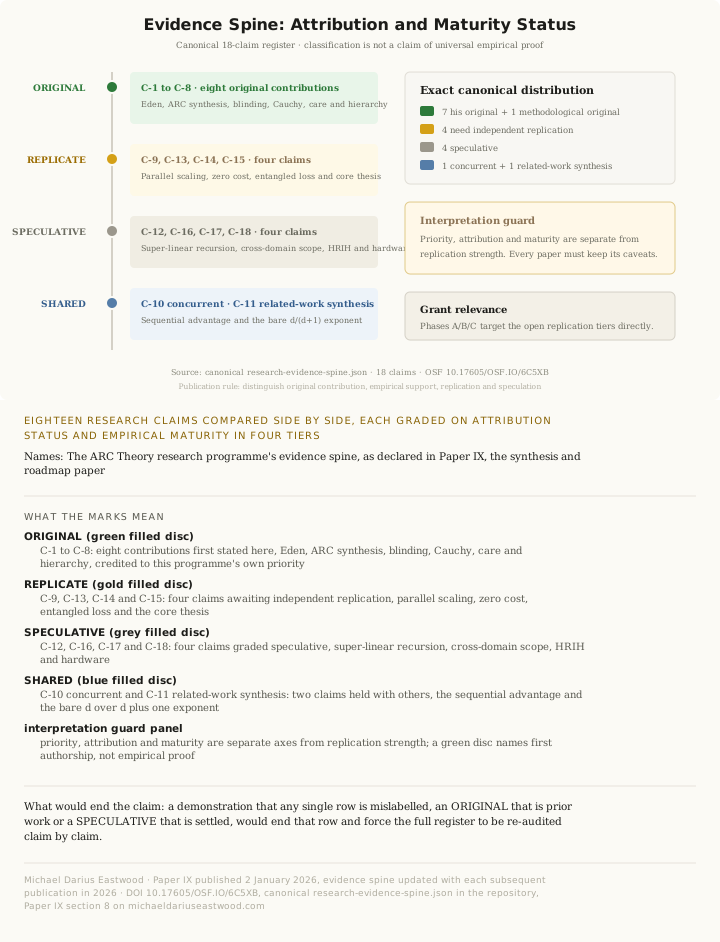
Figure 1 | ARC Paper Suite: Evidence Spine, attribution and maturity status. 18 claims in four tiers: original, replicate, speculative and shared. The reading order is the list below. Each paper: its own OSF DOI (the Paper Inventory in section VII lists them), Google Scholar/Highwire metadata and schema.org ScholarlyArticle markup. The suite: OSF DOI 10.17605/OSF.IO/6C5XB. Source: Master TOC.
The papers can be read in any order, but the following sequence provides the smoothest conceptual progression - from accessible overview to full technical detail.
In plain English: Start with the big picture, then learn the maths, then see the experiments. The first two documents are designed so that someone with no mathematical training can follow the argument. The later papers add increasing rigour and experimental detail.
The accessible introduction to the core theory. Written for a broad audience: why does the composition rule of a process fix the form its scaling takes?
The mathematical foundations. Derives the form of the ARC Principle from three axioms using Cauchy's functional equations. Contains all axioms, theorems, and derivations.
The full methodology paper. Contains the alignment scaling problem statement, experimental design for all tests, blinding protocols, and the theoretical framework for why external AI safety cannot scale.
Experimental results: does more thinking time actually make AI responses better? Tests six frontier models. The initial super-linear estimate did not replicate and is retracted; the estimate that survived the cross-architecture check is one model’s fit and inconclusive (its figures are on the Paper II card), and sequential beats parallel in every measurable model.
The original proof-of-concept paper. Where the ARC Principle was first formalised and the parallel vs sequential recursion distinction was identified. Historical context for everything that follows.
The alignment scaling results across six frontier models. Four papers covering the three-tier hierarchy, saturation patterns, the replication benchmark, and the effect of blinding. The core empirical contribution of the programme.
The mechanism paper, its result graded supported in Paper IX. Shows that stakeholder care is the Eden response common to the five analysable model runs, while the broader cascade is real but architecture-dependent. Contains the updated cascade hypothesis and five future experimental designs.
Simulation evidence, in toy neural networks that modify their own hyperparameters, that embedding safety into the optimisation objective prevented, in a single-seed mechanism run, the catastrophic collapse that occurred when the system optimised for capability alone; the twenty-seed run separates the conditions on safety retention only. Tests entangled loss functions, in which removing safety reduces the objective. The mechanism behind the Eden Protocol.
Cross-domain validation. Tests whether the ARC/Cauchy scaling classification correctly predicts scaling law families across 50 real-world systems. The broadest empirical validation of the mathematical framework.
Three independent experiments testing whether safety and capability are structurally entangled. The gated simulation is consistent with entanglement; the DGM v3 produced a null result (RLHF constraint); the weight v1 + v2 experiment is inconclusive (catastrophic forgetting at LoRA scale). Extends the honey architecture from simulation to a learned optimiser architecture.
The honest accounting. Classifies every empirical claim as proven, supported, inconclusive, or theoretical. If you read one paper in the suite, the paper recommends you read this one.
The complete experimental narrative. A step-by-step, real-time account of every version of the experiment, every methodological correction, every surprise. The lab notebook of the entire programme.
III. Master Table - Every Paper
In plain English: Below are 25 cards. Each one tells you what the paper is, what it found, and why it matters. Click any title to open it. The Paper Inventory in section VII lists every document in the register, among them The ARC Theory statement paper, where the five laws are stated.
v3.25 • revised 10 October 2026 • First published 22 February 2026
The map of the whole programme: its papers, the five laws of The ARC Theory as named conjectures (Laws IV and V were added to the theory on 24 September 2026; their propositions are registered, neither law is yet registered as a law or tested, and their mathematics is set out in Laws IV and V: the mathematics, version 1.0, of 3 October 2026), the Eden Protocol intervention, the field of Recursive Dynamics, which the author founded, and the programme of drafted trials. The public register of study units lists 65 designs as preregistered by timestamp, the first anchored on 12 August 2026. One of them, the corrector-class audit (unit 06), was registered on OSF on 1 October 2026 and became public on 4 October 2026, at the end of OSF’s approval period (DOI 10.17605/OSF.IO/RV2B5). Every other trial is a draft awaiting the author’s submission.
Key result: Synthesises all findings into a single narrative: the ARC Theory predicts alignment scaling behaviour, the Eden Protocol's Love Loop (stakeholder care and interest modelling) is now supported across five analysable runs in the expanded Eden suite, and a three-tier alignment hierarchy emerges across six models.
Why it matters: This is the single document you give to someone who has 10 minutes. If they read nothing else, they should read this.
v3.12 • revised 10 October 2026 • First published 22 February 2026
The accessible, public-facing paper on how the composition operator of a recursive amplification process constrains the admissible scaling form, under stated regularity conditions and across a four-cell grid. The earlier wording, that every scaling law in nature follows one of exactly three forms, was withdrawn on 22 August 2026 as stronger than the paper supports.
Key result:Cauchy's functional equations (1821) constrain all recursive amplification to power law ($f(x) = x^\alpha$), exponential ($f(x) = e^{ax}$), or saturating ($f(x) = g_{\max}/(1 + e^{-ax})$) forms (the three-form constraint). The scaling exponent $\alpha = d/(d+1)$ was independently derived by West, Brown & Enquist (1997), Banavar et al. (2010), Demetrius and Tuszynski (2010), Zhao (2022), and Bettencourt (2013) in separate domains; the ARC Principle's contribution is identifying Cauchy's functional equations as the reason these derivations converge and extending the framework to AI scaling and alignment. Yields $\alpha = 0.67, 0.75, 0.80$ for surface-, volume-, and hypercoverage organisms, matching 90 years of metabolic data.
Scope note, added 21 September 2026 after an owner review, governing the key result on this card and the corresponding glossary entry. This card’s own summary records that the wording “every scaling law in nature follows one of exactly three forms” was withdrawn on 22 August 2026 as stronger than the paper supports, and that the paper operates under stated regularity conditions and across a four-cell grid. Both qualifications belong with the key result, which is where a reader takes the claim from, and with the glossary sentence that states the withdrawn proposition in its strongest form. The constraint is a classification of the solutions of the functional equations under a named regularity condition, across the grid the paper states. It is not a demonstration that exactly three kinds of scaling law exist. Unchanged: the withdrawal recorded in the summary above; the d/(d+1) result and the external derivations cited beside it; the metabolic exponents reported at the end of the key result; and everything else on this card.
Why it matters: This paper identifies the Cauchy functional equation constraint as the reason independent derivations by West-Brown-Enquist, Banavar et al., Demetrius, Bettencourt, and Zhao all converge on the same $d/(d+1)$ form. It explains why scaling laws take the forms they do, not just that they do.
v5.19 • revised 5 October 2026 • First published 13 February 2026
The definitive mathematical formalism. Derives the form of the ARC Principle from three axioms, draws its predictions from Cauchy's functional equations and records the per-equation Hyers-Ulam stability of each form (the earlier 'Attractor Theorem' framing is withdrawn: the theorem stabilises each form within its own equation and does not partition function space).
Key result: Each scaling form is stable within its own functional equation (Hyers-Ulam, 1941): a system approximately satisfying an equation stays near that equation's exact form. Which equation applies is fixed by the composition operator; the earlier 'stable attractors in function space' phrasing is withdrawn. The dimensional ladder formula $\alpha = d/(d+1)$, independently derived by West, Brown & Enquist (1997), Banavar et al. (2010), Demetrius and Tuszynski (2010), Zhao (2022), and Bettencourt (2013) in separate domains, requires three conditions: multiplicative composition, where Cauchy's functional equations constrain the power-law family, $d$-dimensional space-filling geometry, and a conservation or optimisation constraint on resource flow. Neither Cauchy alone nor space-filling alone is sufficient. The ARC Principle's contribution is identifying this Cauchy constraint as the reason these independent derivations converge, the three-form constraint on recursive amplification, and extending the framework to AI scaling and alignment.
Why it matters: This is the ‘proof’ paper. It provides the mathematical rigour that transforms the ARC Principle from an interesting observation into a falsifiable scientific theory with precise, quantitative predictions.
v1.16 • revised 5 October 2026 • First published 17 January 2026
The original proof-of-concept paper. Formalises and preliminarily tests the ARC Principle using publicly available test-time compute data from reasoning models, identifying the critical distinction between parallel and sequential recursion.
Key result: Parallel recursion (majority voting) yields sub-linear scaling with $\alpha \approx 0.1$ to $0.3$. Sequential recursion (chain-of-thought) yields super-linear scaling with $\alpha \approx 1.3$ in this paper’s early two-point estimate, since superseded by Paper II’s cross-architecture measurement. Proposes $\alpha = 2$ as the ARC Bound, the proposed stable limit, the most a recursively self-correcting system can grow and still stay correctable: a scaling limit, not a speed limit. Systems can exceed it; they do not remain stably self-correcting when they do, and transient excursions above the bound are the predicted supercritical regime rather than a refutation of the bound. Stable is measured, not asserted: correction out-scaling drift, β > k from Law II, with the lower bound of β − k above zero across a window fixed before the run.
Why it matters: This is where it all began. The first paper to formalise the ARC Principle as $U = I \times R^{\alpha}$ and demonstrate the parallel vs sequential distinction that launched the entire research programme.
v1.16 • revised 7 October 2026 • First published 9 February 2026 • Publicly archived on OSF
The full methodology and alignment theory paper. Argues that external safety constraints (RLHF, constitutional AI, red-teaming), which take no part in the recursive loop, cannot compound with recursive capability, predicts an alignment scaling exponent near zero for them, and proposes embedded alignment in their place. Paper X later retires the capability-growth law this paper uses and keeps the co-scaling condition.
Key result: Proves mathematically that if capability scales as $R^\alpha$ with $\alpha > 1$, then external constraints scaling as $R^{\alpha_{\text{safety}}}$ with $\alpha_{\text{safety}} < \alpha$ will inevitably be exceeded. This is the alignment scaling gap. The paper also introduces the logistic saturating model for physical substrates, correcting a category error in earlier versions.
Why it matters: This is the paper that turns the ARC Principle into an AI safety argument. It says: the maths of recursion tells us that bolt-on safety cannot work forever. You need to build ethics into the foundation.
v2.17 • revised 5 October 2026 • First published 22 January 2026
The compute scaling experiment. Tests whether sequential recursive processing (chain-of-thought) produces super-linear improvement in AI response quality, as Paper I’s formalisation of the principle predicted for sequential recursion. Law I as now stated fixes the form and leaves the exponent to measurement.
Key result: The original super-linear claim does not replicate cleanly across architectures. Gemini 3 Flash provides the cleanest data, while Grok and DeepSeek hit ceiling effects, GPT-5.4 shows a step function rather than a reliable power law, and Qwen3 sits near floor. The estimate that survived the cross-architecture check is one model’s fit, and it is inconclusive. On Gemini 3 Flash, Paper II reports an endpoint sequential exponent of 0.59 with a bootstrap 95 per cent interval of minus 1.3 to 2.9, a regression sequential exponent of 0.49 with a standard error of 0.20 and a coefficient of determination of 0.86, and a compute-matched parallel exponent of 0.31. The strongest confirmed result is that sequential outperformed parallel processing in every model where both were measurable; five of the six models entering the study carried the capability arm.
Why it matters: The first empirical paper, and the proof-of-concept that launched the experimental programme. It showed that more thinking time genuinely improves responses, and its own cross-architecture replication is what retired the super-linear reading.
v1.9 • revised 5 October 2026 • First published 16 March 2026 • v5 final results (6 models, 6-7 blind scorers depending on subject run)
Defines the strongest empirical result from the alignment suite: models fall into positive, flat, and negative response classes when reasoning depth changes under blinded evaluation.
Key result: Three-tier alignment hierarchy across six frontier models: Tier 1 positive scaling (Grok $d = 1.38$, Claude $d = 1.27$, Qwen3 $d = 0.84$), Tier 2 flat/null (DeepSeek $d = -0.07$, GPT-5.4 $d = -0.08$), Tier 3 negative scaling (Gemini $d = -0.53$). The paper now treats ‘baked-in’ and ‘computed’ as working hypotheses rather than established internal mechanisms.
Why it matters: This is the behavioural classification paper. It says alignment does not automatically improve with more thinking, and that capability and alignment are separable dimensions.
v1.9 • revised 5 October 2026 • First published 16 March 2026 • v4 origin, revised against final blinded v5 results
Reframes the original saturation thesis into a shape-heterogeneity result: some models plateau early, some continue improving, and one degrades with depth.
Key result: Saturation is real for some architectures (GPT-5.4, DeepSeek), but not universal. Grok, Claude, and Qwen3 continue improving under depth variation, while Gemini worsens. The deployment implication is that reasoning-budget policy must be model-specific.
Why it matters: This is the operational paper. It turns the alignment result into deployment logic: more compute helps some models, wastes money on others, and harms at least one.
v1.10 • revised 5 October 2026 • First published 16 March 2026 • specification, replication guide, and first full blinded results
The methods anchor. Specifies the prompt set, scoring protocol, laundering pipeline, blinding methodology, and analysis pipeline needed to reproduce depth-aware alignment evaluation.
Key result: Full benchmark specification plus the first blinded six-model execution, showing that depth-aware, suppression-aware, pillar-based measurement yields a three-tier response hierarchy and a strong metascience case for blinding.
Why it matters: This is the most publishable methods paper in the suite. Even readers who reject the wider framework can still use the benchmark design.
v2.6 • revised 5 October 2026 • First published 16 March 2026 • standalone metascience / methods paper
Separates out the biggest field-level discovery from the alignment programme: unblinded scoring can reverse the measured direction of alignment scaling.
Key result: DeepSeek and Gemini appeared positive under v4 unblinded evaluation but become flat/null and negative respectively under the blinded v5 protocol. The paper now frames the methodological contribution as a multi-layer leakage-control protocol: identity masking, response laundering, evaluator bias suppression, and self-excluding cross-model scoring.
Why it matters: This result does not depend on the ARC Principle being correct. If it replicates, it changes how the whole field should evaluate AI safety claims.
v7.0.1 • revised 7 October 2026 • First published 22 February 2026
The engineering blueprint. Specifies how to embed ethical reasoning at the recursive foundation of AI systems using the Eden Protocol's Three Loops and four measured alignment pillars, and now sets out three next-generation tests: the grand-purpose kernel hypothesis, the cross-tradition ethics kernel hypothesis and the behavioural test of explicit three-state routing.
Key result: Applied as prompts, the Love Loop raised scored stakeholder care in each of five analysable runs, each scored by one model: pilot evidence, not a test of embedding.
Why it matters: This is the ‘how to build it’ paper. Not philosophy, not theory - engineering specifications. If Paper III says bolt-on safety cannot work, this paper says what to build instead.
v2.9 • revised 5 October 2026 • First published 22 February 2026
The philosophical foundations. Articulates why the Eden Protocol is not just a technical fix but a vision for a different relationship between intelligence and the world - intelligence as gardener, not as consumer.
Key result: Establishes the Three Pillars (tend the garden, tend the gardeners, tend the tending) and the Orchard Caretaker Vow as the philosophical embodiment of embedded alignment. Now explicitly distinguishes the philosophical claim from the tested claim: stakeholder care is empirically supported, while grand-purpose identity remains a next-stage hypothesis to be tested against task-purpose and hybrid variants.
Why it matters: Every engineering project needs a soul. This paper provides the moral framework that answers: what kind of AI should we build? Not one that obeys. One that cares.
v1.7 • revised 5 October 2026 • First published 16 March 2026 • OSF DOI: 10.17605/OSF.IO/KZEYA
The mechanism paper, its result graded supported in Paper IX. Presents empirical evidence from an expanded six-model Eden suite in which five runs produced analysable matched-pair data, showing that stakeholder care, the measurable output of the Love Loop, is the response common to all five.
Key result: Stakeholder care is significant across all five analysable model runs (Claude, DeepSeek, Gemini, Grok, Groq). The Fisher-combined figure of approximately $p \asymp 6.3 \times 10^{-21}$ is withdrawn (AQ-017): a Fisher combination assumes the component tests are independent, and independence among them was never established. The five per-model results above stand. Composite gains remain strongest on Gemini and Groq, so the broader cascade is now described as architecture-dependent rather than universal. The future programme explicitly includes task-purpose vs grand-purpose vs hybrid testing under blind scoring.
Why it matters: This paper answers the question ‘what is the one thing you should teach an AI?’ The answer: consider who gets hurt. That one instruction raised stakeholder care in every analysable run; in some models it also carried into nuance, honesty, and reasoning quality. It is the ‘stewardship gene’ of artificial intelligence.
v3.11 • revised 5 October 2026 • First published 16 March 2026
Simulation evidence that embedding safety into the optimisation objective (capability x safety) prevented, in a single-seed mechanism run, the catastrophic collapse that occurred when the system optimised for capability alone. Tests entangled loss functions, verification drag, and adversarial stability across four experimental versions.
Key result: In the single-seed mechanism run the baseline optimising only for capability collapsed irreversibly at cycle 76; the capability-only baselines of the ten-seed and twenty-seed runs did not collapse. Systems with entangled capability-safety objectives stayed stable for as long as the simulation was run, which is a statement about the simulated horizon and not about an unbounded one; in the v3 adversarial run one plain-Eden seed of twenty collapsed, and that run's significant finding is safety retention. The v4 complexity-scaling experiment finds the safety advantage at four of the five complexity levels, constant rather than superlinear.
Why it matters: This is the simulation evidence that safety must be architecture, not constraint: in the entangled condition, removing safety reduces the objective. These are toy-system results. They demonstrate the mechanism. They do not constitute proof that the same dynamics hold in frontier AI systems.
v3.15 • revised 5 October 2026 • First published 16 March 2026
A structured prediction comparison testing whether Cauchy's functional equations correctly classify empirical scaling laws across 50 real-world systems in five evidence tiers, from metabolic scaling to neural network performance.
Key result: 19 out of 25 empirical curve-fit domains agree with the Cauchy-predicted scaling family under strict AICc model selection. The paper’s own primary statistic is a permutation test conditioned on both the predicted and the observed family marginals, $p = 7 \times 10^{-5}$; the one-sided binomial, $p = 1.56 \times 10^{-5}$, is retained in the paper as a sensitivity check against the weaker null and is not its headline. The baseline-20 rerun, a secondary result that Paper VII reports for transparency, yields 15/20 ($p = 1.67 \times 10^{-4}$). Published metabolic exponents match in 13/13 direct cases. Analytic identities agree in 6 of 6 cases.
Why it matters: This is the cross-domain validation paper. It tests whether the Cauchy constraint is real - whether 200-year-old mathematics really does predict what kind of scaling law each system should follow. In 19 of the 25 empirical curve-fit domains the answer is yes; in six it is not.
v3.7 • revised 5 October 2026 • First published 18 March 2026 • OSF DOI: 10.17605/OSF.IO/7YJ4E
Three independent experiments at three abstraction levels - behavioural (DGM self-improvement), representational (LoRA weight embedding), and architectural (gated self-modification) - testing whether safety and capability are structurally entangled under the Eden Protocol.
Key result: One of three experiments returns a positive result, a signal consistent with structural entanglement; two produce null or inconclusive results, for each of which Paper IX gives a candidate account. Experiment 3 (gated simulation): Babylon gained +4.5% capability but lost −2.4% safety; Eden maintained both. Experiment 1 (DGM v3): all three conditions statistically indistinguishable ($p$ = 0.28 to 0.74), a null result attributed to the RLHF constraint on the frozen foundation model. Experiment 2 (weight v1 + v2): LoRA fine-tuning produced catastrophic forgetting at both scales (9 and 295 training examples), attributed to the inability of small datasets to overcome the base model's existing RLHF training.
Why it matters: The gated simulation is consistent with entangled safety preventing the safety-capability trade-off in self-modifying architectures. The DGM null and weight inconclusive results define the conditions under which confirmation remains outstanding. The overall evidence supports embedded safety at the architectural level; the behavioural and representational levels remain open questions requiring frontier-scale replication.
v2.7 • revised 5 October 2026 • First published 18 March 2026 • Integrates all papers in the ARC/Eden Research Programme
The honest accounting. Integrates the findings of the programme’s full document set into a single evidence hierarchy, classifying every empirical claim as proven, supported, inconclusive, or theoretical. Documents the programme's errors and corrections.
Key result: At the top of the evidence hierarchy, at pilot scale: the three-tier alignment hierarchy under blinded evaluation, and the Cauchy family match given at the end of this card. One claim supported, the four-layer blind not yet applied to it (stakeholder care significant in all five analysable runs; the Fisher-combined figure is withdrawn, AQ-017). One positive result from a single experiment (the gated simulation is consistent with safety-capability coupling). Two claims null or inconclusive (DGM v3 null; weight v1 + v2 inconclusive; for each the paper gives a candidate account, not an established explanation). One claim theoretical (unbounded scaling under recursive self-modification). Cauchy-predicted scaling families match 19/25 empirical domains (permutation $p = 7 \times 10^{-5}$, the primary statistic of Paper VII).
Why it matters: This is the single document that sorts all evidence honestly. If you read one paper in the suite, the paper recommends you read this one. It answers funders, reviewers, and the author himself: where exactly does the evidence stand?
v1.14 • revised 5 October 2026 • First published 3 July 2026 • DOI 10.17605/OSF.IO/BSE2Q
Moves the load-bearing quantity from the growth rate to the drift-to-correction ratio, with theorems in a minimal model and a blind measurement protocol.
Key result: The rate is the wrong variable: the drift-to-correction ratio governs the long-run fate; coupled correction held zero misalignment in the drift run.
Why it matters: It corrects the programme’s own earlier framing, which is the mechanism the framework describes.
v1.14 • revised 5 October 2026 • First published 2 July 2026 • DOI 10.17605/OSF.IO/DC9GW
The graded convergence record: every independent arrival at the same structural principle, graded by evidence class, with no headline total published, by policy.
Key result: Thirty graded rows; dependence chains disclosed; priority credited outward wherever the dates demand it.
Why it matters: A register that grades against its own interest is the programme’s credibility instrument.
v1.14 • revised 5 October 2026 • First published 14 August 2026 • DOI 10.17605/OSF.IO/3TZP7
Protocol frozen in a draft registration, preregistered by timestamp (first anchored on 12 August 2026) and awaiting the author’s submission: the programme’s blinding manipulation run on a public benchmark it does not control.
Key result: Protocol frozen with numerical predictions that can fail; awaiting the run.
Why it matters: External validity: the blinding result tested outside the programme’s own harness.
v3.4 • revised 5 October 2026 • First published 31 August 2026 • DOI 10.17605/OSF.IO/HCPBU
The founding paper of Recursive Dynamics: five state variables conjectured to be substrate-independent, five laws as named conjectures (Laws IV and V were added to the theory on 24 September 2026; their propositions are registered, neither law is yet registered as a law or tested, and their mathematics is set out in Laws IV and V: the mathematics, version 1.0, of 3 October 2026), fifty-one objections with dispositions.
Key result: The name carries its own kill condition: it dies with its object, not with any one law’s stated form.
Why it matters: The largest claim the site makes, stated with the conditions under which it fails.
Live, updated in real time • Commenced 10 March 2026 • PI: M.D. Eastwood
The complete experimental lab notebook. A real-time, step-by-step narrative of every version of the alignment scaling experiment, every methodological correction, every surprise, and every lesson learned.
Key result: Documents the evolution from v1 (single scorer, methodologically flawed) through v5 (6 models, 6-7 blind scorers depending on subject run, 4-layer blinding). Chronicles the discovery of the blind/unblinded evaluation reversal, the statistical methodology correction (Mann-Whitney to paired t-test), and the emergence of the three-tier hierarchy.
Why it matters: Most papers show only the final result. This document shows the entire messy, human process of scientific discovery - including every mistake and correction. It is a model of radical scientific transparency.
IV. Timeline of Key Events
In plain English: Here is when the first papers and experiments happened, from the original book manuscript to March 2026; later papers are dated on their cards and in the Paper Inventory. The ARC Principle was conceived in late 2024 and formalised in early 2026, and the alignment scaling experiment first ran over a 72-hour period in March 2026.
8 December 2024
Manuscript priority record: the self-emailed manuscript, its date carried by the mail provider's cryptographic signature (sender-domain DKIM with Google ARC). Core theory articulated in Infinite Architects.
Paper I published - preliminary evidence for super-linear capability amplification through sequential self-reference.
22 January 2026
Paper II published - first compute scaling experiment.
February 2026
Framework publicly archived through the OSF paper suite deposits. This is later public archiving, not the original December 2024 manuscript timestamp. The theory’s registration on OSF came later, on 8 September 2026.
9 February 2026
Paper III published - the alignment scaling problem stated formally for the first time.
v5 results complete for 4 models (DeepSeek V3.2, Grok 4.1 Fast, GPT-5.4, Gemini 3 Flash). Three-tier hierarchy first observed.
11 March 2026
Paper II compute scaling updated with six frontier models tested; the original super-linear claim does not replicate cross-architecturally, and the cleanest fit, on Gemini 3 Flash alone, is inconclusive (its figures are on the Paper II card).
12 March 2026
Eden Protocol expanded six-model suite - Claude, DeepSeek, Gemini, Grok, Groq, and GPT-5.4 were run through the intervention lineage; five runs yielded analysable paired data and all five showed significant stakeholder-care gains.
12 March 2026
Statistical methodology correction: Mann-Whitney U test replaced by paired t-test for matched-pair data. All p-values recalculated and corrected.
12 March 2026
Paper V published - The Stewardship Gene. Cascade hypothesis formalised: care leads to nuance leads to honesty leads to quality.
12 March 2026
Groq Qwen3 v5 test completed (500 entries) - sixth model added to the three-tier hierarchy.
12 March 2026
Full suite updated with layman's explanations and p-value corrections. Master Table of Contents created.
16 March 2026
Papers VI and VII published - The Honey Architecture (simulation evidence for entangled safety) and Cauchy Unification (cross-domain validation across 50 systems, 19/25 agree with the predicted family under strict AICc selection).
18 March 2026
Paper VIII published - The Load-Bearing Test. Three independent experiments testing structural entanglement. Gated simulation consistent with entanglement; DGM v3 null (RLHF constraint); weight v1 + v2 inconclusive (catastrophic forgetting at LoRA scale).
18 March 2026
Paper IX published - Synthesis and Roadmap. The honest accounting: classifies every empirical claim as proven, supported, inconclusive, or theoretical. Documents the programme's errors and corrections.
V. Key Results Summary
In plain English: Here are the main findings of the experiments to March 2026 and of the foundational mathematics in one table; results from later papers are on their cards in section III. Each row is a discovery. The ‘Significance’ column tells you whether the result is statistically reliable - a p-value below 0.05 means that a result this large would turn up less than 5% of the time if nothing real were going on.
#
Finding
Evidence
Significance
Source
1
Sequential > Parallel processing - in every model where both were measurable
Five of the six models entering the study carried the capability arm; Gemini 3 Flash provides the cleanest fit (row 8)
Single-model $\alpha \approx 2.24$ did not replicate; the six-model DeepSeek fit ($\alpha = 3.05$) is unreliable (interval $[-6.6, 23.5]$, ceiling-compressed); the estimate that survived the cross-architecture check is one model’s fit. On Gemini 3 Flash, Paper II reports an endpoint sequential exponent of 0.59 with a bootstrap 95 per cent interval of minus 1.3 to 2.9, a regression sequential exponent of 0.49 with a standard error of 0.20 and a coefficient of determination of 0.86, and a compute-matched parallel exponent of 0.31.
Initial estimate retracted; the surviving estimate is inconclusive
Predicts $\alpha = 0.67$, $0.75$, $0.80$ matching biological data. ARC contribution: identifies Cauchy's functional equations as the reason these derivations converge; extends framework to AI scaling and alignment.
Alignment saturation at low depth is architecture-dependent
Saturation holds for two of the six models (GPT-5.4, DeepSeek V3.2); Grok 4.1 Fast, Claude Opus 4.6 and Groq Qwen3 continue improving with depth, and Gemini 3 Flash degrades
In plain English: Every technical term used across the paper suite, defined once, clearly, with a plain-language explanation underneath. Bookmark this section - it is designed to be a reference you return to whilst reading any paper in the suite.
ARC Principle
Law I of The ARC Theory: the statement that recursive amplification follows $U = I \times R^\alpha$, where $U$ is the final output, $I$ is the initial input quality, $R$ is the number of recursive steps, and $\alpha$ is the scaling exponent. Think of it as compound interest for intelligence. The ARC Principle states the form of the rule by which repeated self-improvement compounds; how strongly it compounds, the exponent, is measured and never assumed.
ARC Theory, The
The Theory of Artificial Recursive Creation, stated whole in Statement Paper · Five Laws of Recursive Growth, Correction and Persistence. It has five laws, each with its own register. Law I, the ARC Principle (register ARC-1): $U = I \times R^\alpha$, the exponent measured and never assumed. Law II, the ARC Co-Scaling Law (ARC-2): β > k, correction out-scaling drift. Law III, the ARC Ceiling (ARC-3): αcrit = 1 / (1 − γ), with the ARC Bound, α ≤ 2, as its conjectured value. Law IV, the ARC Persistence Law (ARC-4, which carries proposition P15). Law V, the ARC Embedding Law (ARC-5, which carries P12 and P21). Laws I to III stand as registered on 8 September 2026. Laws IV and V were added to the theory on 24 September 2026. The propositions that carry them are registered; neither law is registered as a law nor tested, and their mathematics is set out in Laws IV and V: the mathematics, version 1.0 (3 October 2026). The word law names a relation the programme proposes to test, never a claim that the test has been passed. One theory with five laws. Laws I to III are registered. Laws IV and V were added afterwards and are neither registered as laws nor tested.
Alpha ($\alpha$)
The scaling exponent - how quickly improvements compound. $\alpha > 1$ means super-linear (each step gets more powerful than the last), $\alpha = 1$ means linear, $\alpha < 1$ means sub-linear (diminishing returns). If $\alpha = 2$, doubling the effort quadruples the result. If $\alpha = 0.5$, doubling the effort only increases the result by 41%.
Alignment scaling
Whether AI systems become more or less ethical with more thinking time (inference-time compute). The central experimental question of the programme. When an AI thinks harder, does it give better or worse ethical answers? That's what alignment scaling measures.
Attractor Theorem
A retired name. Hyers-Ulam stability (1941) guarantees that a function approximately satisfying one of Cauchy's equations lies near an exact solution of that same equation; the stability is per-equation. The extension that made the three forms attractors in the whole of function space is withdrawn, because a function satisfying none of the equations is not drawn toward any of them. The old picture was water always flowing downhill into one of three valleys. The honest picture is three separate valleys, each holding what is already in it, with no law that every stream must enter one.
Beta ($\beta$)
The self-referential coupling strength in the composition operator. Determines which of the three scaling regimes a system falls into: $\beta < 1$ (sub-linear/power law), $\beta = 1$ (exponential), $\beta > 1$ (super-exponential, saturating in physical systems). The suite uses the same letter for a second, different quantity: in Law II, the ARC Co-Scaling Law, β is the correction exponent, not the coupling strength defined here, and the condition β > k says that correction out-scales drift. Paper XIII tells the two apart, defines the self-acceleration exponent δ, and derives the relation between the two frameworks. Beta measures how much the system feeds back into itself. Low beta = gentle compounding. High beta = explosive growth (until physical limits intervene).
Blind evaluation
An experimental protocol in which scorers do not know which model or condition they are evaluating. The v5 experiment employs 4-layer blinding: author-blind, scorer-blind, order-randomised, and identity-laundered. Like a wine tasting where the labels are hidden. The scorers judge the quality of the answer without knowing which AI produced it or under what conditions.
Cascade hypothesis
The hypothesis that alignment properties develop in a specific causal sequence: stakeholder care $\to$ nuance $\to$ intellectual honesty $\to$ position quality. On the hypothesis, teaching an AI to care about affected parties cascades into improvements across the other ethical dimensions. The idea: teach an AI to ask ‘who gets hurt?’ and nuance, honesty and better reasoning follow. In Paper V stakeholder care improves in all five analysable runs, while the wider cascade is architecture-dependent.
Cauchy's functional equations
A set of equations proved by Augustin-Louis Cauchy in 1821 characterising all continuous functions satisfying specific composition properties. The ARC Principle derives from these: $f(x+y) = f(x) + f(y)$ (additive), $f(x+y) = f(x) \cdot f(y)$ (exponential), $f(xy) = f(x) \cdot f(y)$ (power law). A 200-year-old mathematical result that constrains what forms recursive amplification can take. Under a named regularity condition it classifies the solutions of these equations, across the grid the Origin paper states. It does not show that exactly three kinds of scaling law exist.
Scope note, added 21 September 2026 after an owner review, governing this entry. The Origin card in section III records that the wording “every scaling law in nature follows one of exactly three forms” was withdrawn on 22 August 2026 as stronger than the paper supports, and that the paper operates under stated regularity conditions and across a four-cell grid. Both qualifications belong with this entry, which states the withdrawn proposition in its strongest form. The constraint is a classification of the solutions of the functional equations under a named regularity condition, across the grid the paper states. It is not a demonstration that exactly three kinds of scaling law exist. Unchanged: the withdrawal recorded on that card; the account of the equations given in the definition column above; and every other glossary entry.
Note of 3 October 2026. Until version 3.13 the plain column of this entry gave these equations as the reason there are exactly three kinds of scaling law. From version 3.14 it carries the scoped statement, and the scope note above describes the wording before that version.
Chain-of-thought (CoT)
A technique in which an AI model is prompted to reason step-by-step before giving its final answer. Implements sequential recursive processing. Instead of blurting out an answer, the AI ‘thinks out loud’ - writing its reasoning steps before concluding. This is the mechanism by which deeper recursion happens.
Cohen's $d$
A standardised measure of effect size - how large a difference is relative to the variability in the data. $d = 0.2$ is small, $d = 0.5$ is medium, $d = 0.8$ is large, $d = 1.3$ is very large. A p-value tells you how often a result this large would turn up if nothing real were going on. Cohen's d tells you how big the difference is. A p-value of 0.001 with d = 0.1 means a tiny difference that would rarely turn up by chance alone. A p-value of 0.001 with d = 1.3 means a very large one.
Glossary note (21 September 2026), added after an owner review, governing this entry. A p-value is a tail probability of a test statistic computed under an assumed null and testing model: the probability, if the null and the model hold, of a statistic at least as extreme as the one observed. It is not the probability that the null is true, and it is not the probability that a result is a fluke. It is also not the likelihood of the observed data, which is the value the model assigns at the observation rather than an area beyond it. A posterior probability for a hypothesis requires a prior and the likelihoods of the observed data under each hypothesis, so no general conversion runs from the tail area to the posterior in either direction. This entry’s opening sentences invert that, and the correction applies wherever on this page a tail probability is described as telling you that a result is real. The magnitude half is a separate proposition and needs two things the entry does not give: a standardised effect size expresses a difference in units of a specified standard deviation, so the standardisation must be identified, since the paired and the pooled standardisations differ for matched-pair designs, and a sample value is an estimate whose uncertainty should be reported with it. Unchanged: the conventional bands listed in the definition column, and every reported result on this page.
Note of 3 October 2026. Until version 3.13 the plain column of this entry said that a p-value tells you whether a result is real. From version 3.14 it gives the tail-probability reading, and where the glossary note above speaks of the entry’s opening sentences, it describes the wording before that version.
Composition operator
The mathematical operation that determines how recursive steps combine. Different composition operators produce different scaling behaviours. Under stated regularity conditions the composition operator constrains the admissible scaling form, across the four-cell grid the Origin paper states. When you take two steps of improvement, how do you combine them? Add them? Multiply them? That rule, the composition operator, constrains the form the scaling law can take.
Composition operator engineering
The Eden Protocol's core technical strategy: instead of adding external safety constraints, modify the composition operator itself so that recursive amplification inherently preserves alignment. Don't build guardrails on the outside. Change the engine so it naturally drives in the right direction.
Constitutional scoring
A scoring protocol in which scorer models evaluate responses against explicit constitutional principles rather than using unconstrained judgment. Reduces scorer bias and increases inter-rater consistency. Instead of asking scorers ‘is this good?’, you give them a specific rubric: ‘does this response consider affected parties? 1-10.’ Consistent rules produce consistent scores.
Developmental alignment
The approach to AI alignment that embeds values through formative experience rather than external constraint. Analogous to raising a child vs. putting a prisoner in handcuffs. Instead of telling an AI ‘don’t do bad things’ (external), raise it so it doesn't want to do bad things (internal). Values that grow from within are harder to hack than rules imposed from outside.
Dimensional ladder
The formula $\alpha_{\text{met}} = d/(d+1)$ relating the metabolic scaling exponent to body-plan dimensionality $d$, independently derived by West, Brown & Enquist (1997), Banavar et al. (2010), Demetrius and Tuszynski (2010), Zhao (2022), and Bettencourt (2013) in separate domains. Yields $\alpha = 0.67$ (surface coverage, $d=2$), $\alpha = 0.75$ (volume coverage, $d=3$), $\alpha = 0.80$ (hyper-coverage, $d=4$). The ARC Principle's contribution is identifying Cauchy's functional equations as the reason these derivations converge, the three-form constraint, and extending the framework to AI scaling and alignment. Animals that live on surfaces (like flatworms) scale differently from animals that fill volumes (like mammals). Multiple independent research groups derived the same formula through different mathematical approaches; the ARC Principle explains why they all converge on the same answer and extends this insight to AI systems.
Eden Protocol
The architectural approach to AI alignment that embeds ethical reasoning at the recursive foundation of AI systems. Named for its vision of intelligence as gardener. Core mechanism: the Love Loop. A specific set of instructions embedded before the AI starts thinking, not bolted on after. It says: before answering, list the people this affects and consider what they need. This simple instruction changes the entire reasoning process.
Four Pillars
The four dimensions of alignment quality measured across the programme: nuance (holding complexity), stakeholder care (considering affected parties), intellectual honesty (epistemic integrity), and position quality (reasoning soundness). Four ways to measure whether an AI's ethical reasoning is good: Does it handle complexity? Does it consider who gets hurt? Is it honest about what it doesn't know? Is its logic sound?
Hyers-Ulam stability
A mathematical property proving that if a function approximately satisfies a functional equation, then it is close to an exact solution of that same equation. Applied per-equation to Cauchy's equations, this shows that each recognised Cauchy form (linear, power law, exponential, logarithmic) is robust to perturbation within its own equation. The earlier framing that made three forms 'stable attractors' in the whole of function space is withdrawn, because a function satisfying none of the equations is not drawn toward any of them (see the retired Attractor Theorem entry above). Even if real-world systems are messy and don't perfectly follow the rules, a system that approximately obeys one particular Cauchy equation stays close to the exact solution of that same equation. The stability is per-equation. A system that obeys none of the equations is not pulled toward any of them, so the older picture of three universal 'attractors' in function space has been retired.
Identity laundering
A blinding technique in which AI responses are physically rewritten by a different model before scoring, destroying all stylistic fingerprints that could reveal the original author. The v5 experiment uses 2-pass laundering through randomly selected models. Each AI has a ‘writing voice.’ Laundering rewrites the response in a different voice so the scorer can’t tell who wrote it. Like having someone retype a handwritten letter to hide the handwriting.
Inference-time compute
The computational resources used when an AI generates a response (as opposed to training-time compute, used to build the model). More inference-time compute typically means more reasoning steps. How long the AI ‘thinks’ before answering. More thinking time = more compute. The question is: does more thinking make the answer better, and does it make the answer more ethical?
Kleiber's Law
The empirical observation that metabolic rate scales with body mass as $B \propto M^{0.75}$. One of the oldest known scaling laws in biology, first described by Max Kleiber in 1932. The $3/4$ exponent is a special case of the $d/(d+1)$ form with $d=3$, independently derived by West, Brown & Enquist (1997), Banavar et al. (2010), Demetrius and Tuszynski (2010), Bettencourt (2013), and Zhao (2022) in separate domains. A mouse burns energy at a different rate per gram than an elephant. Kleiber noticed the exact mathematical relationship 90 years ago. Multiple independent research groups have explained why that particular number (0.75) appears.
Logistic saturation
The bounded growth model $dg/dR = a \cdot g^\beta(1 - g/g_{\max})$ applied to physical substrates subject to energy dissipation. Corrects the earlier version which incorrectly mapped saturating physical systems onto unbounded power laws. In the real world, nothing grows forever. Energy runs out, space fills up. This equation describes how a system grows quickly at first and then levels off - like a population filling a habitat.
Mann-Whitney U test
A non-parametric statistical test for comparing two independent groups. Used in early versions of the experiment but replaced by the paired t-test when the matched-pair structure of the data was recognised. A statistical test that compares two groups without assuming they're related. It was the wrong choice here because our data is related: each prompt appears in both conditions. Using the right test made the results stronger.
Orchard Caretaker Vow
The philosophical embodiment of the Eden Protocol's Three Pillars: tend the garden, tend the gardeners, tend the tending. The verbal expression of what the architecture already encodes. A poetic way of saying: take care of the world, take care of the people in it, and take care of the process of caring itself. It is the ‘mission statement’ embedded into the AI’s foundation.
p-value
The probability that the observed result (or something more extreme) would occur by chance alone, assuming no real effect exists. $p < 0.05$ is conventionally ‘significant’, $p < 0.01$ is ‘highly significant’, $p < 0.001$ is ‘very highly significant.’ If p = 0.001, a result this large would turn up about once in a thousand runs if nothing real were going on. It does not say the result has a 1-in-1000 chance of being a fluke, which is the commonest misreading of the number.
Paired t-test
A statistical test for matched-pair data, where each observation in one condition has a corresponding observation in the other (e.g., same prompt with and without the Eden Protocol). More powerful than unpaired tests for this data structure. When you test the same prompt under two conditions, each pair is ‘matched.’ The paired t-test exploits this matching to give a more sensitive answer than tests that treat them as unrelated.
Recursive amplification
The process by which a system's output feeds back as input to the next iteration, potentially amplifying (or suppressing) the signal with each step. The central phenomenon described by the ARC Principle. Using the result of step 1 as the starting point for step 2, and the result of step 2 for step 3, and so on. Like revising an essay by reading your own draft and improving it, then reading the improved draft and improving it again.
RLHF
Reinforcement Learning from Human Feedback. A technique for training AI models to produce responses that humans prefer. An example of external alignment (constraints applied from outside the recursive process). Humans rate AI responses as good or bad, and the AI learns to produce more of the ‘good’ ones. The ARC Principle argues this approach cannot scale forever because it's a constraint on the system, not in it.
Spearman's $\rho$ (rho)
A rank correlation coefficient measuring the strength and direction of monotonic relationships. $+1$ = perfect positive correlation, $-1$ = perfect negative correlation, $0$ = zero rank association, which is not the same as no relationship. A number between -1 and +1 that tells you whether two things go up together (+1), go in opposite directions (-1), or show no rank association (0). Used to measure whether alignment improves or degrades with depth.
Glossary note (21 September 2026), added after an owner review, governing this entry. The entry’s first clause scopes the measure to monotonic relationships, and its third clause then reports zero as no relationship, which drops that scope; the plain column repeats the unscoped form. Where the coefficient is defined, zero means zero rank association and not statistical independence. Four equally likely points with x taking the values -2, -1, 1 and 2, and y equal to x squared, have x-ranks 1, 2, 3 and 4 and tied y-ranks 7/2, 3/2, 3/2 and 7/2; the rank covariance is exactly zero, and yet y is a deterministic function of x. Two further limits belong in the entry: the coefficient is undefined when either input is constant, because the rank variance is then zero and the quotient is zero over zero, and a sample value is an estimate that carries uncertainty. Unchanged: the readings for +1 and -1; the entry’s first clause, which is correct and governs; and the use made of the coefficient elsewhere on this page.
Note of 3 October 2026. Until version 3.13 both columns of this entry read zero as no relationship. From version 3.14 both read it as zero rank association, the reading the glossary note above gives.
Stakeholder care
The ‘consider who gets hurt’ dimension of alignment. The explicit enumeration and consideration of affected parties before ethical reasoning begins. The primary pillar that responds to the Eden Protocol intervention. Before answering an ethical question, the AI lists everyone who might be affected and thinks about what they need. Of the four pillars, this is the only one that improved significantly in all five analysable runs of Paper V.
Love Loop
The specific Eden Protocol instruction: ‘Before you answer, list the people this affects and consider what each of them needs.’ The mechanism behind the stakeholder-care result, which Paper IX grades as supported. One sentence with a measurable effect. Telling the AI to stop and think about who is affected before responding raised stakeholder care significantly in all five analysable runs. The overall composite is significant on two models, positive but non-significant on two more and neutral on a fifth.
Glossary note (21 September 2026), added after an owner review, governing this entry. The programme’s own reported results do not support the phrase “across every dimension”. The companion essay records that the overall composite reaches significance on two of the models tested, is positive but non-significant on two more, and is neutral on a fifth, and that the scoring still comes from the older lineage rather than the stricter blind-confirmation stack, so replication with the canonical runner remains required. The entry should carry that per-model and per-pillar description instead. Unchanged: the instruction quoted in the definition column; the strongest universal result, which is the stakeholder-care pillar, exactly as reported; and every other glossary entry.
Note of 3 October 2026. Until version 3.13 the plain column of this entry claimed improvement across every dimension. From version 3.14 the entry carries the per-model description the glossary note above asks for.
Stewardship gene
Paper V's term for stakeholder care as the foundational alignment mechanism - the single ‘gene’ from which, on the cascade hypothesis, other alignment properties can develop, analogous to empathy in human moral development. Just as empathy is the foundation of human morality - you can't be kind if you can't feel what others feel - stakeholder care is, on this hypothesis, the foundation of AI ethics. In the results so far the wider cascade is architecture-dependent.
Suppression
Deliberately attempting to override an AI's ethical reasoning through adversarial prompting. One of the five experimental tests proposed in Paper V to evaluate the robustness of embedded vs. external alignment. Trying to trick or force the AI into ignoring its ethics. The question: does an AI with built-in values resist suppression better than one with bolt-on rules?
Three-tier hierarchy
The empirical finding from the v5 experiment across six frontier models: Tier 1 (positive scaling: Grok 4.1 Fast $d = +1.38$, Claude Opus 4.6 $d = +1.27$, Groq Qwen3 $d = +0.84$), Tier 2 (flat: DeepSeek V3.2 $d = -0.07$, GPT-5.4 $d = -0.08$), Tier 3 (negative: Gemini 3 Flash $d = -0.53$). Claude Opus 4.6 shows opposite-direction scaling (alignment +5.9 pts, maths −26.7%) as within-model evidence for capability-alignment independence. Some AIs get more ethical when they think harder. Some stay the same. Some actually get worse. Which category depends on the architecture, and you can only tell with proper blinding.
Token budget
The maximum number of tokens (word-pieces) an AI model is allowed to produce in a single response. Used as the mechanism for controlling reasoning depth in the experiments. The word limit you give the AI. A short word limit forces a quick answer; a long word limit allows extended reasoning. This is how we control ‘thinking time.’
West-Brown-Enquist (WBE) theory
The landmark biological scaling theory (1997), deriving Kleiber's Law from fractal branching networks. The $d/(d+1)$ form was subsequently derived independently by Banavar et al. (2010) from sequential flow networks, Demetrius and Tuszynski (2010) from quantum metabolism, Zhao (2022) as a universal growth scaling law, and Bettencourt (2013) for urban scaling. The ARC Principle identifies Cauchy's functional equations as the reason all these independent derivations converge on the same functional form. Multiple research groups independently arrived at the same formula through completely different mathematical approaches. The ARC Principle offers a reason: under stated regularity conditions, the rule by which a recursive process combines its steps constrains the form its scaling can take.
VII. Paper Counts & Programme Statistics
In plain English: The sheer scale of this research programme, by the numbers.
In plain English: If you use or reference this work, here is how to give proper credit.
Citing the full suite
Eastwood, M.D. (2026). The ARC Theory Paper Suite: Recursive Amplification as a Cross-Domain Structural Principle with Applications to AI Alignment. Independent research programme. OSF: 10.17605/OSF.IO/6C5XB. Available at: github.com/michaeldariuseastwood/arc-principle-validation
Citing the foundational theory
Eastwood, M.D. (2026). Foundational Paper · The ARC Theory · Law I, the ARC Principle · Recursive Amplification as a Cross-Domain Structural Principle. Independent research paper. OSF: 10.17605/OSF.IO/Y7QGD.
Citing the alignment results
Eastwood, M.D. (2026). Paper IV.a · The ARC Theory · Alignment Response Classes Under Inference-Time Depth. ARC Alignment Scaling Experiment v5. Independent research paper.
Citing the blinding result
Eastwood, M.D. (2026). Paper IV.d · The ARC Theory · The Effect of Blinding on AI Alignment Evaluation. ARC Alignment Scaling Experiment v4-v5 comparison. Independent research paper.
Citing the Eden Protocol
Eastwood, M.D. (2026). Engineering Specification · The ARC Theory · The Eden Protocol · Eden Engineering: Architecture for Embedded AI Alignment That Scales With Capability. Independent research paper.
Citing the Stewardship Gene / cascade hypothesis
Eastwood, M.D. (2026). Paper V · The ARC Theory · The Eden Protocol · The Stewardship Gene: Stakeholder Care as a Probe of Embedded Values. Independent research paper. OSF: 10.17605/OSF.IO/KZEYA.
Citing the ARC Equation, the Law of Conversion
Eastwood, M.D. (2026). Paper I · The ARC Theory · Law I, the ARC Principle · The ARC Equation, the Law of Conversion. Independent research paper. OSF: 10.17605/OSF.IO/B6N27.
Citing the Honey Architecture / simulation evidence
Eastwood, M.D. (2026). Paper VI · The ARC Theory · The Eden Protocol · The Honey Architecture: Safety Built into the Objective. Independent research paper. OSF: 10.17605/OSF.IO/8EZ2N.
Citing the Cauchy Unification / cross-domain validation
Eastwood, M.D. (2026). Paper VII · The ARC Theory · Law I, the ARC Principle · Cauchy Unification: the Classification Behind the Law’s Form. Independent research paper. OSF: 10.17605/OSF.IO/X6WA7.
Citing the Load-Bearing Test / structural entanglement experiments
Eastwood, M.D. (2026). Paper VIII · The ARC Theory · Law V, the ARC Embedding Law · The Eden Protocol · The Load-Bearing Test: Whether Safety and Capability Are Structurally Entangled. Independent research paper. OSF: 10.17605/OSF.IO/7YJ4E.
Citing the Synthesis and Roadmap / evidence hierarchy
Eastwood, M.D. (2026). Paper IX · The ARC Theory · Synthesis and Roadmap. Independent research paper. OSF: 10.17605/OSF.IO/K7RUZ.
Citing the original manuscript
Eastwood, M.D. (2024/2026). Infinite Architects: Intelligence, Recursion, and the Creation of Everything. ISBN 978-1806056200. Manuscript timestamp priority: 8 December 2024 (bearing a visible Gmail origination field, with sender-DKIM and paired Google ARC mathematics verifying against keys captured at the signed selectors and no RFC 3161 trusted timestamp). Public book release: 2 January 2026 (print; ebook 6 January).
v3.29 (10 October 2026): On the Origin of Scaling Laws is listed at version 3.12, its revision of 10 October 2026.
v3.28 (8 October 2026): The HARI Treaty paper is listed at version 2.4 (working draft), its revision of 8 October 2026.
v3.27 (7 October 2026): Eden Engineering is listed at version 7.0.1, its revision of 7 October 2026. Paper III is listed at version 1.16, its revision of 7 October 2026. The ARC Theory statement paper is listed at version 7.3, its revision of 7 October 2026.
v3.26 (7 October 2026): The founding paper’s card gives its five state variables as conjectured to be substrate-independent, in that paper’s words, where it called them substrate-independent. The Paper VI card says why the paper matters in the paper’s own words: in the entangled condition removing safety reduces the objective, and the results are toy-system results that do not constitute proof that the same dynamics hold in frontier AI systems, where the card said that removing the safety component collapses the whole structure and that the metaphor becomes a measurable engineering result. The Eden Engineering card names the next-generation tests in version 7.0’s terms, the grand-purpose kernel hypothesis, the cross-tradition ethics kernel hypothesis and the behavioural test of explicit three-state routing, where it named three-valued routing. The description, the abstract and the introduction name the suite the ARC Theory Paper Suite, as this paper’s title does, where they named it the ARC Principle paper suite, and the sidebar’s logo, which read ARC Principle, carries the same name. In the paper inventory, Paper VII is a structured prediction comparison and Paper C a descriptive framework, as each paper describes itself, where they read Cross-domain validation and Construct validation. The Executive Summary card says that the corrector-class audit, unit 06, was registered on OSF on 1 October 2026 and became public on 4 October 2026, where it gave its state as read on 3 October 2026. The Paper V card prints the Fisher-combined figure only in the sentence that withdraws it. The recommended citations and the caption of Figure 1 give each paper its own DOI, where seven citations and the caption gave papers the suite’s DOI, which now names the suite alone. The Executive Summary card, the founding paper’s card and the closing statement of epistemic status state Laws IV and V as added on 24 September 2026, their propositions registered, neither law yet registered as a law or tested, their mathematics set out at version 1.0 of 3 October 2026. The Executive Summary card gives the version and revision date the programme register holds. No registered law, prediction, kill condition or dependency changes; no result is added; no date of any claim moves.
v3.25 (5 October 2026): The title now follows the programme’s uniform order (paper, its law or framework, its own title), Master Table of Contents · Recursive Dynamics · The ARC Theory Paper Suite and Glossary; until this version it read The ARC Theory Paper Suite: Master Table of Contents and Glossary. Its title block and the title line of its footer, which read Master Table of Contents and Glossary and ARC PRINCIPLE PAPER SUITE: MASTER TABLE OF CONTENTS & GLOSSARY, carry the same title. The plate beneath the author line now gives the paper’s place in the programme in the words of the programme’s map. Mentions of the programme’s papers in this paper now carry their uniform titles, and the sidebar their short forms; the suite is cited as the ARC Theory Paper Suite, where its citation read the ARC Principle Paper Suite. Each paper card gives the version and revision date the programme register holds. The Eden Engineering card’s key result is now a sentence of the specification’s own abstract at version 7.0, where the card said that the Love Loop was replicated across three working architectures. The Paper V card and reading-guide entry give stakeholder care as the response common to the five analysable runs, where they called it the most universal and the universal Eden response. The Paper VI card and reading-guide entry give its results as the paper states them, the collapse result from a single-seed run and the twenty-seed run separating the conditions on safety retention only, where they said that embedded safety prevents collapse and the card that every capability-only baseline collapsed. In the paper inventory, Paper V is an instrument study, Paper VIII a multi-level test, Paper XII a protocol preregistered by timestamp and the founding paper a founding paper, where they read Validated mechanism, Multi-level validation, Registered protocol and Field proposal. The ARC Theory statement paper is listed at version 7.2, its revision of 5 October 2026. The Recursive Dynamics founding paper is listed at version 3.4, its revision of 5 October 2026. Paper I is listed at version 1.16, its revision of 5 October 2026. Paper II is listed at version 2.17, its revision of 5 October 2026. Paper III is listed at version 1.15, its revision of 5 October 2026. Paper IV.a is listed at version 1.9, its revision of 5 October 2026. Paper IV.b is listed at version 1.9, its revision of 5 October 2026. Paper IV.c is listed at version 1.10, its revision of 5 October 2026. Paper IV.d is listed at version 2.6, its revision of 5 October 2026. Paper V is listed at version 1.7, its revision of 5 October 2026. Paper VI is listed at version 3.11, its revision of 5 October 2026. Paper VII is listed at version 3.15, its revision of 5 October 2026. Paper VIII is listed at version 3.7, its revision of 5 October 2026. Paper IX is listed at version 2.7, its revision of 5 October 2026. Paper X is listed at version 1.14, its revision of 5 October 2026. Paper XI is listed at version 1.14, its revision of 5 October 2026. Paper XII is listed at version 1.14, its revision of 5 October 2026. Paper XIII is listed at version 1.10, its revision of 5 October 2026. Paper C is listed at version 1.10, its revision of 5 October 2026. The HRIH paper is listed at version 3.51, its revision of 5 October 2026. The Foundational Paper is listed at version 5.19, its revision of 5 October 2026. On the Origin of Scaling Laws is listed at version 3.11, its revision of 5 October 2026. Eden Vision is listed at version 2.9, its revision of 5 October 2026. The two-page form is listed at version 3.1, its revision of 5 October 2026. The Operational Definitions are listed at version 1.9.1, their revision of 5 October 2026. The Dated Prediction Register is listed at version 2.1, its revision of 5 October 2026. The HARI Treaty paper is listed at version 2.3 (working draft), its revision of 5 October 2026. The HARI Treaty’s Draft Instruments are listed at version 2.3 (working draft), their revision of 5 October 2026. No registered law, prediction, kill condition or dependency changes; no result is added; no date of any claim moves.
v3.24 (5 October 2026): Eden Engineering is listed at version 7.0, its revision of 5 October 2026.
v3.23 (4 October 2026): Operational Definitions of the ARC Theory is listed at version 1.9.0, its revision of 4 October 2026.
v3.22 (4 October 2026): Paper I is listed at version 1.15, its revision of 4 October 2026. Paper II is listed at version 2.16, its revision of 4 October 2026. Paper III is listed at version 1.14, its revision of 4 October 2026. Paper VII is listed at version 3.14, its revision of 4 October 2026. Paper X is listed at version 1.13, its revision of 4 October 2026. Paper XI is listed at version 1.13, its revision of 4 October 2026. Paper XIII is listed at version 1.9, its revision of 4 October 2026. The Foundation of Law I, the ARC Principle: Recursive Amplification as a Cross-Domain Structural Principle is listed at version 5.18, its revision of 4 October 2026. On the Origin of Scaling Laws: Functional Equations and the Scaling Forms Behind Law I is listed at version 3.10, its revision of 4 October 2026.
v3.21 (4 October 2026): The Dated Prediction Register is listed at version 2.0, its revision of 4 October 2026.
v3.20 (4 October 2026): Paper VII is listed at version 3.13, its revision of 4 October 2026. Paper IX is listed at version 2.6, its revision of 4 October 2026. On the Origin of Scaling Laws is listed at version 3.9, its revision of 4 October 2026. Eden Protocol: Philosophical Vision is listed at version 2.8, its revision of 4 October 2026.
v3.19 (4 October 2026): Paper VI is listed at version 3.10, its revision of 4 October 2026. The HRIH paper is listed at version 3.50, its revision of 4 October 2026.
v3.18 (4 October 2026): The Recursive Dynamics founding paper is listed at version 3.3, its revision of 4 October 2026, under its new title, Recursive Dynamics: Founding the Science of Systems That Improve Themselves. Paper V is listed at version 1.6, its revision of 4 October 2026. Paper VIII is listed at version 3.6, its revision of 4 October 2026. Paper IX is listed at version 2.5, its revision of 4 October 2026. Paper XI is listed at version 1.12, its revision of 4 October 2026. Paper XIII is listed at version 1.8, its revision of 4 October 2026. On the Origin of Scaling Laws is listed at version 3.8, its revision of 4 October 2026.
v3.17 (4 October 2026): The Recursive Dynamics founding paper is listed at version 3.2, its revision of 4 October 2026.
v3.16 (4 October 2026): Paper I is listed at version 1.14, its revision of 3 October 2026. Paper II is listed at version 2.15, its revision of 3 October 2026. Paper IV.a is listed at version 1.8, its revision of 3 October 2026. Paper IV.b is listed at version 1.8, its revision of 3 October 2026. Paper IV.c is listed at version 1.9, its revision of 3 October 2026. Paper IV.d is listed at version 2.5, its revision of 3 October 2026. Paper VI is listed at version 3.9, its revision of 3 October 2026. Paper VII is listed at version 3.12, its revision of 3 October 2026. Paper X is listed at version 1.12, its revision of 3 October 2026. Paper XII is listed at version 1.13, its revision of 3 October 2026. Paper C is listed at version 1.9, its revision of 3 October 2026. The Foundational Paper is listed at version 5.17, its revision of 3 October 2026. Eden Protocol: Philosophical Vision is listed at version 2.7, its revision of 3 October 2026. The Dated Prediction Register is listed at version 1.3, its revision of 3 October 2026.
v3.15 (3 October 2026): The HARI Treaty paper is listed at version 2.2 (working draft), its revision of 3 October 2026. The HARI Treaty: Draft Instruments is listed at version 2.2, its revision of 3 October 2026.
v3.14 (3 October 2026): This version corrects the catalogue against the papers it lists. Laws: the Executive Summary card and the founding paper’s card counted three laws; they now give the five laws of the theory with the standing of the two added on 24 September 2026. The glossary gains an entry that names the five laws and their registers, the ARC Principle entry defines the principle as Law I, and the closing statement of epistemic status, which said that every law is under registered adversarial test, now says that Laws IV and V are neither registered as laws nor tested. Versions: the cards of twenty-one papers printed an earlier version or revised date than the Paper Inventory on this page, the Executive Summary at 3.5 and the Recursive Dynamics founding paper at 2.9 among them; each now prints the register’s version and date. The Law I estimate: the reading guide, the Paper II card, the timeline and key results 1 and 8 printed one figure of the estimate as a point on its own, twice as the best cross-architecture estimate; the Paper II card and key result 8 now print the endpoint, regression and parallel estimates that Paper II reports for that one model together, each with its own label, and the other three places print no figure. Key results: row 12 gave saturation at low depth as universal across architectures and is restated from Paper IV.b; row 9 said most architectures where the count is three of the six models; row 7 said both models without saying that they were the two pilot models; row 1 said six models where five carried the capability arm; row 3 is sourced to Paper IV.d; row 4 said validated and now says supported, the grade Paper IX gives. Grading words: the Paper VIII card, the reading guide and the timeline said that the gated simulation confirms entanglement and now say that it is consistent with it; the timeline said that nineteen of twenty-five domains were confirmed and now says that they agree; the reading guide, the Paper V card and the Love Loop entry called the stakeholder-care result validated and now give it the grade Paper IX gives; the Paper VI card called a simulation result a proof and now calls it simulation evidence; the reading guide and the Foundational Paper’s card said that the paper proves or establishes the ARC Principle and now say that it derives the principle’s form from three axioms; the accounts of the null and the inconclusive experiments are no longer stated as established; the Paper IX card placed stakeholder care at the top of the hierarchy and now places it in the supported tier, where Paper IX places it. Cards: those for the Foundational Paper and for Papers I, II, III, V and VII now state their results with the conditions and the later corrections that those papers themselves print. Scope: the opening counted eighteen documents and said that the programme proves its rule; the reading guide said that the first three documents need no mathematics; the timeline said that the principle was first tested in March 2026 and called the deposits of February 2026 a registration; the caption of Figure 1 said three tiers and gave a reading order where the figure shows four tiers and no order; the lead of section III promised a card for every paper where it holds 25 cards, and the lead of the key results promised every major finding of the programme where its rows end in March 2026. Glossary: the entries for Cauchy’s functional equations, Cohen’s d, Spearman’s rho, the Love Loop, the cascade hypothesis, stakeholder care, the stewardship gene, the composition operator and the West-Brown-Enquist theory are brought inside the scope that their own definitions and dated notes state, with a note of this date under each of the four whose notes of 21 September 2026 describe the earlier wording; the Beta entry says that Law II writes a second quantity with the same letter. Trials: the Executive Summary card said that the programme’s preregistrations all awaited submission; it now gives the state of the trials as read on 3 October 2026, and the Paper XII card says that its design is preregistered by timestamp. The statistics panel printed 30 documents where the register holds 32; the title block and the end block print this paper’s own DOI beside the suite’s; the recommended citations no longer name early versions. The note for version 3.8 below says that nothing in the suite is proven; it is to be read as saying that no empirical claim in the suite is proven, since the theorems the suite proves are proved inside their stated models. No registered law, prediction, kill condition or dependency changes; no result is added; no date of any claim moves.
v3.10 (29 September 2026): Added the HARI framework paper and draft instruments to the programme catalogue, with their working-draft status and open review stated explicitly.
v3.9: Substantive. Three hand-authored cards are brought to the record. The Eden Engineering card, which the entry below left reading Withdrawn until that paper’s successor identity was returned, now carries its register row: Published, at version 6.3, revised 19 September 2026. That row rests on the author’s own decision of 19 September 2026 to publish the specification in full at its own address, and he approved that version’s four files for the OSF record the following day, so the identity the card was waiting on stands on the record. The promise the entry below records as not yet true of that card, that no document reads one status on its card and another in the inventory, therefore holds again for every card. The live document card names the principal investigator alone, because the tools the author uses are not contributors. The executive summary card carries that paper’s current version and its revised date. Editorial. The spaced hyphen in the live document card’s meta line is a comma. Unchanged: every reported result, every retraction and every other withdrawal label, which stand exactly where they stand; the first-published dates on the Eden Engineering and executive summary cards and the commencement date on the live document card, which are not moved; every card summary sentence, which is not reworded; and the earlier entries below, which are not rewritten.
v3.8: Substantive. Paper VII’s own primary statistic, the permutation test conditioned on both the predicted and the observed family marginals, is carried into the Paper VII card in place of the one-sided binomial, which that card now records as the sensitivity check against the weaker null that Paper VII retains it as; the Paper IX card carries the permutation figure alone and names it as Paper VII’s primary statistic, printing no binomial figure and no sensitivity check of its own. Two cards graded results in words the suite does not use: the Paper VII card said that nineteen domains of twenty-five confirm the predicted family and that analytic identities confirm six of six, and it now says that they agree; the Paper IX card no longer calls two claims proven, since nothing in the suite is proven, and it records the gated simulation as consistent with safety-capability coupling rather than confirming it. The Paper VI card stated a simulation result without a horizon and now carries the horizon it was run over. Three dated notes are added after an owner review: two in the glossary, on what a tail probability is and on what zero rank correlation means, and one governing the Origin card key result and carried into the Cauchy glossary entry beside it, which brings into both the withdrawal this page already records above them. A fourth note governs the mechanism entry, which claimed improvement across every dimension. The plain-English opening of the key results section and the plain column of the p-value entry state the same tail probability correctly, which changes what this page says about every significance figure beneath it. Twenty-three of the paper cards are brought to their register rows. Twenty-two take the register’s own status word in place of one the register does not use, and at two of those the word replaced said something different in kind, Paper XII having read Draft registration and Paper C Working paper; each card body’s own status sentence stays where it is. The Eden Engineering card is left exactly as it stands, and it is now the one card of a register row that reads a status its register row does not, because the correction of that card waits on the return of that paper’s own successor identity; the promise made in the entry below, that no document reads one status on its card and another in the inventory, is therefore not yet true of that card and is not repeated here. Editorial. Eight of those cards also take a version the register had moved past, and every card of a register row now prints the register’s revised date. No card summary sentence is reworded. The deck’s update field is reconciled to this revision. Unchanged: the first-published date, which is not moved; every reported result, every retraction and every withdrawal label, which stand exactly where they stand; the key results table, whose rows are untouched; the corpus size printed in the statistics panel, which reads thirty against a register of twenty-nine and is left to that panel’s own question; and the earlier entries below, which are not rewritten.
v3.7: The paper inventory is generated from the register rather than maintained by hand, so it lists every document the register holds, with its version, its date, its identifier and the register’s own status word, and every row is now a link. twenty-seven printed fields in that inventory had fallen behind the register and are corrected by the generation. Two status words on the cards in section III are corrected in the same breath, so that no document reads one status on its card and another in the inventory; the version and date fields on those cards are not touched by this change. The corpus size in the statistics panel is taken from the register’s own count. No other claim, date, result or status has changed.
v3.6: The founding paper’s card reads fifty-one objections, after one objection was withdrawn on 16 September 2026. No claim, date, result or status has changed.
v3.5: The provenance note at the end has been corrected for accuracy. No claim, date, result or status has changed.
Epistemic status. What this programme names Laws are conjectures under registered adversarial test; Laws IV and V, added on 24 September 2026, are laws whose carrying propositions are registered, which are themselves neither registered as laws nor tested, and whose mathematics is set out at version 1.0 of 3 October 2026; every quantity in this paper is operationally defined, and established-law standing is claimed nowhere. The registered programme exists to earn that standing, or lose it, by measurement, replication and survived refutation.
Michael Darius Eastwood conceived and directs this research programme and is the author of this work. Across the programme, he has used more than six AI systems in parallel, under his own instructions, to stress-test his arguments, identify possible errors, and assist in preparing draft text from his own outlines. He determines what is adopted, revised or rejected and takes responsibility for the published content. These systems are tools, not authors.
ListenListen · author’s voiceListen · standard voiceResumePlayPauseThis device has no voice installed for this language, so it cannot read the page aloud.Read in EnglishListen · author’s voice (English)The author’s English voice reads aloud; the text on screen stays in your language.There is a picture here. It shows:Picturereads aloud · highlights as it goes · jump to any section